
NileRed (Nigel Braun) spent about two years attempting to make ethanol from ordinary air, documenting the effort in an 80-minute video covered by Gizmodo. The reactor produced a small flask of liquid that was roughly 7% ethanol, mostly water, and contained trace methanol; Braun tasted it on camera. Major obstacles included finding a selective catalyst (first run yielded 1.8 g vs a 25 g target) and building a hydrogen-safe, high-pressure gas-delivery system. Braun calls it an early proof of concept and aims to improve yield, eliminate methanol byproducts and scale the process.
NileRed Spent Two Years Making Ethanol From Air — The Result: A Flask Mostly Water (≈7% Ethanol)
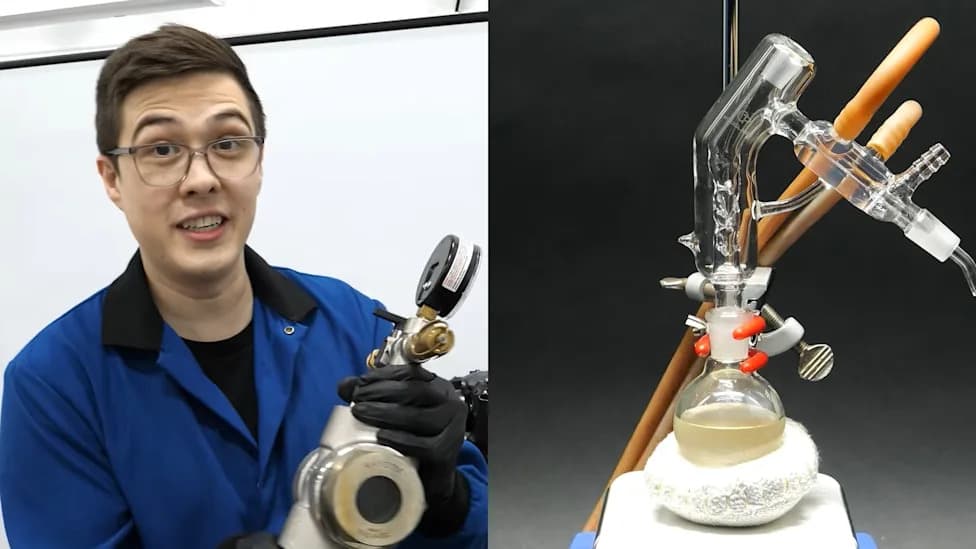
Chemistry YouTuber NileRed spent two years making alcohol from air and got mostly water
Nigel Braun, the chemist and YouTuber known as NileRed, spent roughly two years attempting to synthesize ethanol directly from the gases in ordinary air. He documented the project in an 80-minute YouTube video (reported by Gizmodo on August 9) and ultimately produced a small flask of liquid that was mostly water, contained about 7% ethanol, and included a trace of methanol. Braun tasted the sample on camera and called it, cautiously, "It's… it's actually pretty good."
How the Idea Worked — And Why It Was Hard
The concept is simple on paper: air contains carbon dioxide (CO2) and water vapor; ethanol (C2H6O) is made of carbon, hydrogen and oxygen. In broad strokes the plan was to extract CO2 and hydrogen from ambient air, use a catalyst to couple those feedstocks into ethanol, and collect the liquid product.
In practice, each step posed serious technical challenges. CO2 and hydrogen do not spontaneously combine into ethanol — the reaction requires a selective catalyst to favor the C2 product (ethanol) over other possible products. Braun evaluated many catalyst approaches and found the candidates either prohibitively expensive, difficult to synthesize at scale, or insufficiently selective.
He ultimately pursued a two-part iron-based catalyst. His first synthesis attempt, a five-day run, produced only 1.8 grams of catalyst material when he needed roughly 25 grams. After additional weeks of work he managed to synthesize both parts of the catalyst in sufficient quantities, but the effort underscored the large gap between conceptual simplicity and practical implementation.
Engineering Hurdles: Hydrogen Delivery And Feedstock Choices
Delivering CO2 and hydrogen to a high-temperature, high-pressure reactor required custom engineering. Hydrogen presents a particular problem because the atom is so small that under pressure it can diffuse into metal crystal lattices and cause embrittlement. Standard off-the-shelf gas-handling equipment is generally not suited for this environment, so Braun designed and built a custom high-pressure gas-delivery system.
He also addressed a subtler chemical issue: adding water vapor directly to the reactor would introduce extra oxygen (CO2 already contains two oxygens per carbon), complicating selectivity. To avoid that, Braun split water externally using a hydrogen generator and fed only the hydrogen into the reactor, leaving the oxygen behind.
What He Got — And What's Next
After two years of catalyst work, custom engineering and troubleshooting, the reactor produced liquid output. Analysis showed roughly 7% ethanol, the remainder water, plus a small amount of methanol. Methanol is toxic at sufficient doses and can form as a byproduct in CO2 hydrogenation; Braun's sample was small enough that he judged the methanol concentration not to pose an immediate practical hazard and tasted it on camera.
Braun frames the result as an early-stage proof of concept rather than a finished method. His next goals are to improve yield and selectivity, remove methanol contamination, and scale the process toward producing a full bottle. Whether this approach can become a viable synthetic-fuel route depends on substantial improvements in catalyst performance and overall process efficiency beyond this initial attempt.
Quote: "It's… it's actually pretty good," Braun said after tasting the small sample — a human moment in a long experimental struggle.
Context: The project highlights how deceptively simple green-chemistry ideas can become resource- and time-intensive engineering challenges. It also illustrates the iterative nature of experimental science: an imperfect result can still point the way to future improvements.
Help us improve.





















