
Taiwan staged rapid runway-repair and emergency-takeoff drills at Hsinchu Air Base, its closest major airfield to mainland China, to keep interceptor jets operational after simulated missile strikes. Crews cleared debris, filled a crater and rolled out a heavy fiberglass mat while an Antelope short-range SAM system provided local defense. Hsinchu houses 53 Mirage 2000-5 interceptors and is considered vulnerable to an initial PLA missile barrage, which explains the emphasis on quick repairs and unscripted readiness during the 10-day Han Kuang exercises.
Taiwan Drills Rapid Runway Repairs to Keep Interceptors Flying — Hsinchu Base Prepares for Missile Strikes
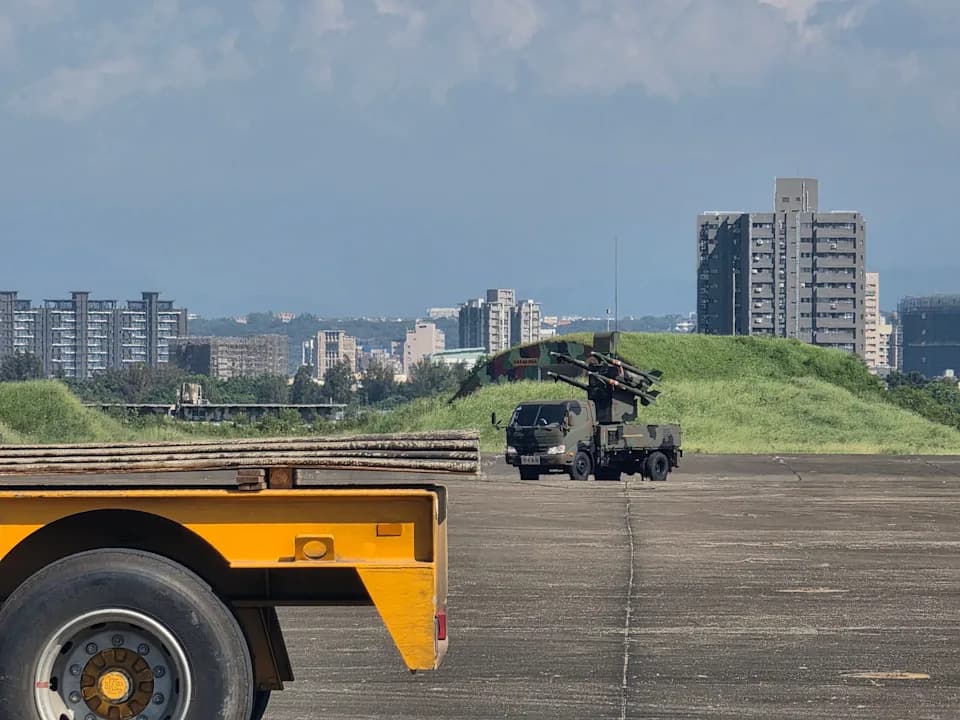
An Antelope surface-to-air missile launcher could be seen a short distance from the fiberglass mat.Matthew Loh for Business Insider
Taiwan's air force carried out rapid runway-repair and emergency-takeoff drills on Friday at Hsinchu Air Base, the island's nearest major airfield to mainland China and the home of its primary interceptor fleet.
The exercises simulated a scenario in which long-range Chinese missiles or rockets had already struck base facilities. As part of the annual Han Kuang war games, crews practiced clearing rubble, filling a crater in the concrete and restoring a landing surface quickly so fighters could keep operating under degraded conditions.
Ground crews used bulldozers and graders to remove debris and fill the crater, then deployed and secured a heavy fiberglass mat designed to restore a usable runway surface. An Antelope short-range mobile surface-to-air missile system provided local air defense while troops worked.
Friday's drills emphasized sustained air-to-air operations under pressure. Ground teams rapidly rearmed Dassault Mirage 2000-5 fighters with short-range "Magic II" missiles and the medium-range MICA air-to-air missile system, while pilots and support crews executed an emergency scramble of two Mirages.
Hsinchu Air Base, roughly 90 miles from mainland China, is home to Taiwan's 53-strong Mirage 2000-5 fleet. These fourth-generation fighters, first delivered beginning in 1997, serve as the island's principal interceptors alongside more than 130 F-16 Fighting Falcons and about 129 domestically produced F-CK-1 Ching-Kuo aircraft.
"Realistically, Hsinchu Air Base could be rendered inoperable after just the first missile wave, or at least in the first 24 hours," said Benjamin Blandin, a research fellow at the Taipei-based Institute for National Defense and Security Research. The base is well equipped but highly exposed to initial PLA strikes.
Why These Drills Matter
The rapid-repair and scramble exercises highlight Taiwan's focus on resilience and survivability: restoring runways fast, protecting repair crews with short-range air defenses, and dispersing operations so interceptors can continue to fly even after initial attacks. US and allied forces similarly use fiberglass runway mats to enable shorter aircraft turnarounds and emergency operations.
This year's Han Kuang began Wednesday and runs for 10 days and 9 nights. Taipei says the drills have shifted away from highly scripted demonstrations toward an unscripted, reactive format that stresses real-time decision-making. The opening phase emphasized "gray-zone" tactics — coercive or hostile actions that stop short of open warfare.
These measures form part of Taiwan's broader defensive planning to complicate and slow any attempt by the People's Liberation Army to neutralize the island's air capabilities in the opening hours of a conflict.
Help us improve.





















