
Death in space is rare but possible, and protocols depend on location. In low Earth orbit or on the Moon, bodies are usually returned to Earth quickly when feasible. On long voyages to Mars, remains would likely be stored securely aboard the spacecraft until mission end. Unprotected exposure to vacuum or to the Moon or Mars without a suit causes almost instantaneous death. Planning must also address crew psychological support and family communication.
If Someone Dies in Space — What Happens to the Body and the Crew?
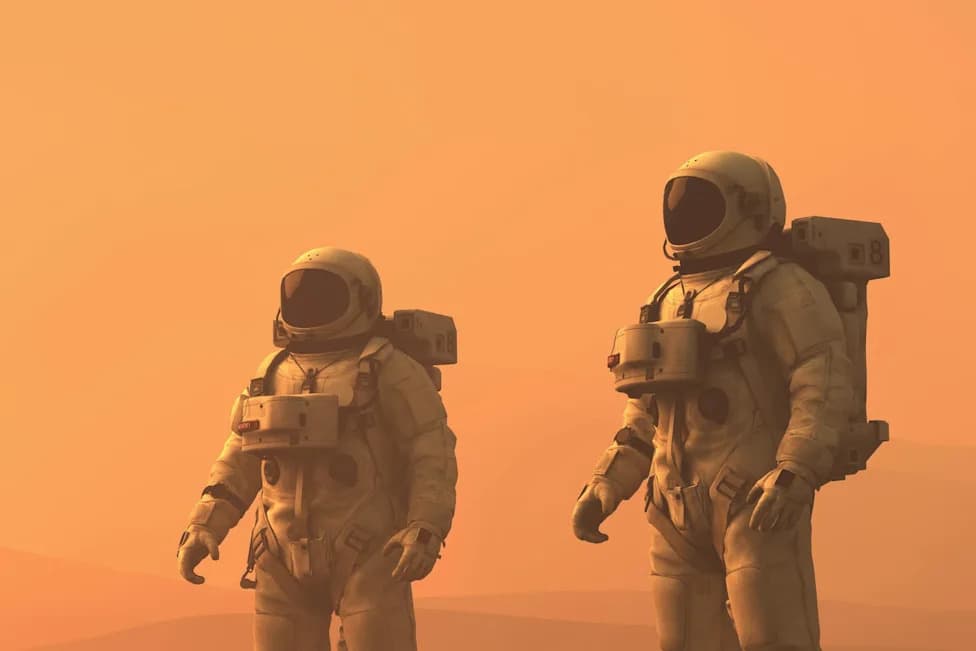
An artist's depiction of two astronauts on Mars.cokada/E+ via Getty Images
Human spaceflight is inherently risky. In more than six decades of crewed exploration, 20 people have died: 14 in the NASA space shuttle disasters (1986 and 2003), three cosmonauts on Soyuz 11 (1971), and three astronauts in the Apollo 1 launch pad fire (1967). As missions become more frequent and longer — including planned returns to the Moon and eventual crewed trips to Mars — agencies and companies must prepare for how to handle a death off Earth.
Where the Death Occurs Matters
Low Earth Orbit (for example, the ISS): If a crewmember dies aboard a pressurized vehicle in low Earth orbit, current procedures prioritize the safety and return of the surviving crew. When feasible, the remains are returned to Earth quickly in a reentry capsule or other return vehicle — often within hours.
On the Moon: A death on the lunar surface could usually be resolved within days. NASA and other agencies already have contingency protocols for lunar missions. As with orbit, crew safety and mission integrity are the primary concerns; returning the body promptly is preferred when possible.
En Route to Mars or During Long-Duration Missions: Missions to Mars take many months and involve roughly 300 million miles of travel. Turning the spacecraft around is typically impractical. The likely plan is to store the remains securely aboard the spacecraft in a sealed container or body bag, or in a separate chamber, until the mission concludes and the crew returns to Earth. The controlled temperature and humidity inside the vehicle will slow decomposition but cannot eliminate it over years.
Exposure to Vacuum or Unprotected Surface
An unprotected exit into space is immediately life-threatening. Without a spacesuit, loss of pressure and the vacuum of space would cause loss of consciousness within seconds; body fluids would vaporize and the outcome would be catastrophic within a very short time.

In the future, NASA and other space agencies, along with private industry, hope to establish colonies on Mars.janiecbros/E! via Getty Images
Stepping onto the Moon or Mars without a suit produces a similar outcome. The Moon has essentially no atmosphere; Mars has a thin atmosphere with almost no oxygen. Unprotected exposure results in suffocation and severe physiological damage from depressurization.
Why Cremation or Burial Off Earth Are Problematic
Cremation on the Moon or Mars is generally impractical because it consumes large amounts of energy and resources that crews need for life support and mission operations. Burial raises planetary protection concerns: terrestrial microbes and organic matter from human remains could contaminate extraterrestrial environments, complicating scientific investigations and violating planetary protection policies.
Because of these issues, the prevailing approach for long missions is sealed, secure preservation of remains until they can be returned to Earth.
Human And Operational Considerations
Handling a death in space is not only a technical challenge. Supporting the psychological wellbeing of crewmembers who grieve during missions, and providing timely, compassionate communication with families on Earth, are essential. Mission planners must include medical, logistical, legal and bereavement protocols long before launch.
As humanity moves toward sustained presence on the Moon, Mars, and beyond, robust, ethically grounded procedures for death off Earth will be an integral part of mission design.
Article adapted from work by Emmanuel Urquieta, Baylor College of Medicine, and the Translational Research Institute for Space Health.
Help us improve.





















