
New analyses combining JWST, Hubble and Chandra data suggest many "little red dots" are not exotic new objects but the compact, red cores of ordinary galaxies seen at extreme distance. By artificially moving a nearby spiral nicknamed Saguaro to early-universe distances, researchers showed its spiral arms fade while the central red nucleus remains visible as a pointlike source. The result implies LRDs may trace an early growth phase of supermassive black holes rather than a novel galaxy class.
Little Red Dots Decoded: JWST Shows They May Be Distant Galactic Cores
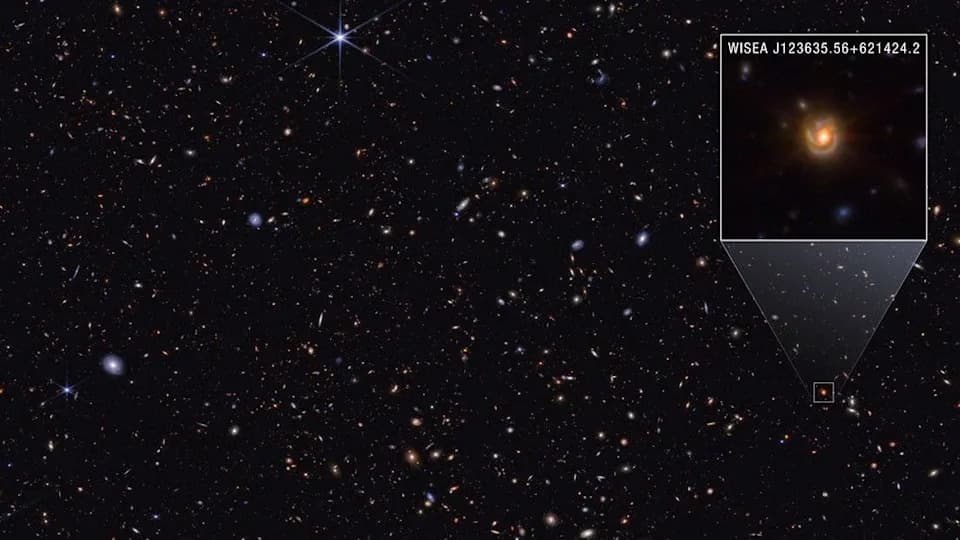
This James Webb Space Telescope image of the spiral galaxy Saguaro reveals a bright red core linked to mysterious 'Little Red Dots.'. | Credit: NASA, ESA, CSA, STScI, Pierluigi Rinaldi (Steward Observatory); Image Processing: Alyssa Pagan (STScI)
Since the James Webb Space Telescope (JWST) began full science operations in 2022, astronomers have noticed hundreds of tiny, crimson smudges in its deepest infrared images. These so-called "little red dots" (LRDs) are compact, intensely red sources that are abundant in images of the universe about 600 million years after the Big Bang, then appear to decline within the next few hundred million years.
New work that combines JWST imaging with archival data from the Hubble Space Telescope and NASA's Chandra X-ray Observatory offers a simpler explanation for many LRDs: they may not be an entirely new class of object, but the bright, compact nuclei of otherwise ordinary galaxies that become the only visible component at extreme distances.
Nearby Clue: The Saguaro Galaxy
Researchers targeted a relatively nearby spiral galaxy cataloged as WISEA J123635.56+621424.2 and nicknamed Saguaro because its sweeping arms evoke the cactus. Saguaro lies at a cosmic epoch about 3.3 billion years after the Big Bang (roughly 10 billion light-years away), long after the era when LRDs are most common.
At its center, the Saguaro hosts a compact, reddish nucleus that shares several observational properties with distant LRDs, including an unusually weak X-ray signal compared with its strong infrared brightness. That combination can indicate a heavily obscured or otherwise unusual active galactic nucleus (AGN) — a growing supermassive black hole shrouded in dust and gas.
How a Galaxy Turns Into a "Dot"
To test whether a resolved galaxy could masquerade as an LRD, the team used simulations to "artificially redshift" the Saguaro: they dimmed and reddened its light, reduced its angular size, and added the noise and resolution limits appropriate to JWST deep-field observations at very high redshift. As the galaxy was pushed to earlier cosmic times, its broad spiral arms gradually faded below detectability while the luminous red core remained visible as a pointlike source. The transformed appearance closely matched many LRDs in JWST's farthest deep fields.
Implications
These results suggest that selection effects — distance, surface-brightness dimming, and instrument resolution — can turn normal galaxies into tiny red points in deep surveys. Rather than representing a new population, many LRDs may mark a phase in early supermassive black hole growth when the central engine outshines, or is more easily seen than, the rest of the host galaxy.
The team now plans to search for additional, nearer analogues to test whether the Saguaro effect reproduces the LRD population more generally. Building a catalog of such objects will help astronomers trace how galaxies and their central black holes co-evolved through the first billion years of cosmic history.
Instruments and Methods: This study combines JWST infrared imaging with archival Hubble optical/near-infrared data and Chandra X-ray observations, plus artificial redshifting and observational noise modelling to compare how resolved galaxies would appear at extreme distances.
Image credit: NASA, ESA, CSA, STScI, Pierluigi Rinaldi (Steward Observatory); Image Processing: Alyssa Pagan (STScI)
Help us improve.





















