
The Vera C. Rubin Observatory in Chile used its car‑sized, 3,200‑megapixel camera to produce a deep image of the COSMOS field revealing over 650,000 galaxies and more than 75,000 stars. COSMOS — first imaged by Hubble in 2003 — offers an extensive archive of observations, making it an ideal reference target for Rubin’s new data. Over its 10‑year LSST, Rubin will repeatedly observe this region to add a time dimension, helping uncover transient events such as supernovae.
Rubin Observatory’s Car‑Sized Camera Captures Over 650,000 Galaxies in One Deep Image
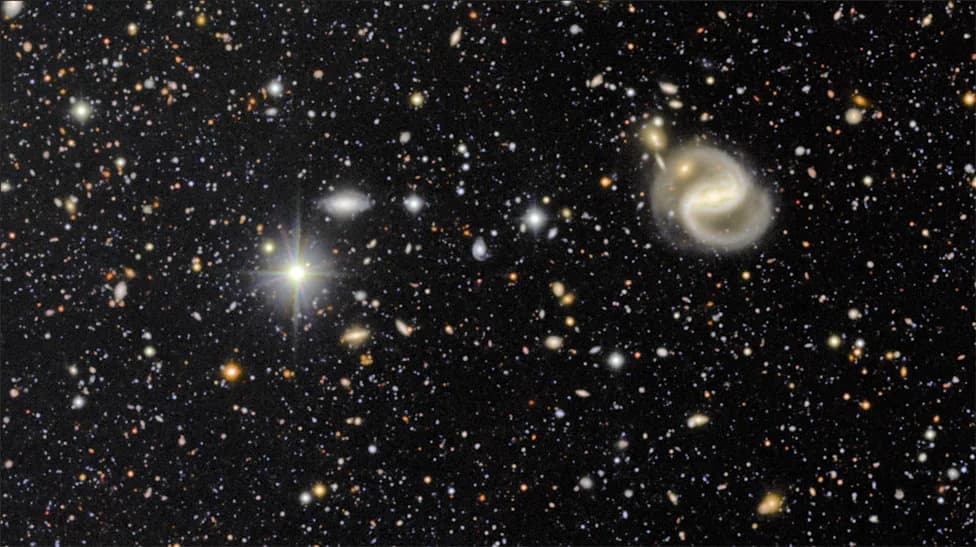
At the core of Chile’s Vera C. Rubin Observatory sits the largest astronomical camera ever built. Roughly the size of a small car and weighing more than three tons, the 3,200‑megapixel instrument produces images so detailed that showing them at full resolution would require hundreds of ultra‑high‑definition screens.
Since coming online in 2024, Rubin has been mapping the southern sky as part of its 10‑year Legacy Survey of Space and Time (LSST). As an early preview of that effort, the observatory recently stitched together a series of exposures of the Cosmic Evolution Survey Deep Field (the COSMOS field), producing a deep image that reveals more than 650,000 galaxies and over 75,000 stars in a single view.
Why COSMOS? The COSMOS field is one of the most intensely studied patches of sky, first imaged by the Hubble Space Telescope in 2003 and since observed across many wavelengths by telescopes worldwide. That wealth of existing data makes COSMOS an ideal reference region to validate and compare Rubin’s new measurements.
Equally important, Rubin’s repeated visits to the same fields over its decade‑long survey add a powerful time dimension. By regularly imaging COSMOS, Rubin will help reveal transient and variable phenomena — such as supernovae, variable stars, and other explosive events — that single snapshots can miss.
"The COSMOS deep image is just the beginning for Rubin in this region," Rubin Observatory director Bob Blum said in a statement. "Repeated visits to the field over the next few years will demonstrate the power of our survey design for discovery by providing our science community with a huge number of transient and variable objects like supernovae and other explosive transients for follow-up and detailed study."
This new deep image is an auspicious start for Rubin’s planned decade of monitoring the southern sky. As LSST progresses, astronomers expect the observatory’s massive camera and rapid survey cadence to transform studies of cosmic structure, dark matter, and time‑domain phenomena.
Video Credit: NSF–DOE Vera C. Rubin Observatory.
Help us improve.





















