
A fleeting X‑ray shock breakout detected by China's Einstein Probe in March allowed astronomers to watch a massive star’s explosion from the very start. Follow‑up observations with Chandra and ground telescopes tracked a ~30‑solar‑mass Wolf‑Rayet star about 500 million light‑years away as it produced a broad‑lined Type Ic supernova. No gamma‑ray burst was observed, suggesting any jet was likely "choked" before escape — offering fresh clues about how the most massive stars die.
Astronomers Witness a Giant Star’s Death From Start to Finish — A Rare Shock Breakout Caught in X‑Rays
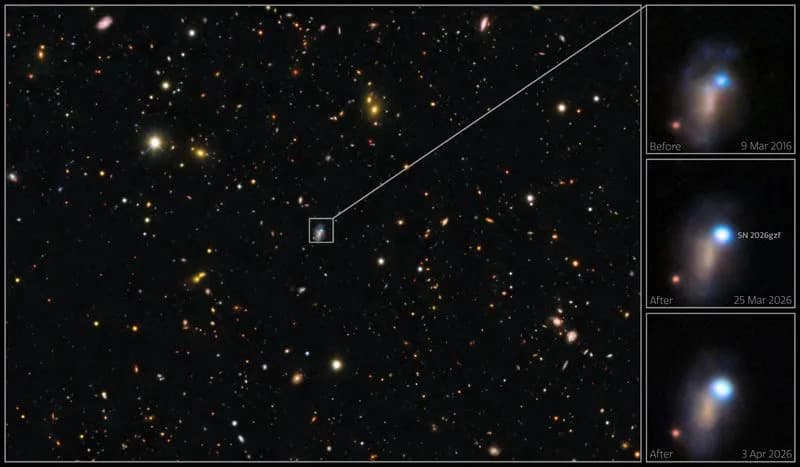
A combination of images show the evolution of supernova SN 2026gzf, which was first detected by the Einstein Probe on March 21, 2026. Images taken on March 25 and April 3, 2026, show the supernova brightening. An archival image of the host galaxy from March 9, 2016, reveals a bright blue source at the location of the supernova, which scientists say likely represents a compact, extreme star-forming region in the host galaxy, combined with pre-explosion activity of the star before its death. CTIO/NOIRLab/DOE/NSF/AURA Image Processing: D. de Martin & M. Zamani (NSF NOIRLab)/Handout via REUTERS THIS IMAGE HAS BEEN SUPPLIED BY A THIRD PARTY. NO RESALES. NO ARCHIVES. MANDATORY CREDIT
A rare, complete view of a massive star's explosive death has given astronomers new insight into how such violent events can unfold. In March, China's Einstein Probe space telescope detected a fleeting X‑ray flash known as a shock breakout — the moment a powerful shock driven by a collapsing stellar core tears through a star's surface.
Coordinated Follow‑Up Observations
After the initial detection, teams rapidly mobilized a fleet of observatories, including the orbiting Chandra X‑ray Observatory and numerous ground‑based telescopes, and tracked the event for nearly three months until the object moved behind the sun from Earth's perspective. These follow‑up observations captured the supernova's evolution from its earliest moments and provided an unprecedented close‑up of the doomed star at the brink of collapse.
What Astronomers Found
Researchers estimate the progenitor was a Wolf‑Rayet star roughly 30 times the mass of the Sun, located about 500 million light‑years away in a nearby galaxy. The explosion was classified as a broad‑lined Type Ic supernova, meaning the star had been stripped of its outer hydrogen and helium layers and that the ejected material raced outward at extreme speeds — a little above 10% of the speed of light.
Although the event exhibited several features commonly associated with explosions that produce gamma‑ray bursts (GRBs), no GRB was detected. Astronomer Brendan O'Connor noted that one key question in the field is why some collapsing massive stars launch relativistic jets that escape the star and produce GRBs, while others do not.
"The difference between a successful and choked jet is whether the jet is moving fast enough, or is powerful enough, to break out of the surrounding stellar material," O'Connor said.
One plausible explanation is a "choked jet": a jet that formed but was halted by the stellar surface or dense material shed by the star in its final stages, preventing an observable gamma‑ray flash. If so, this would be the first clear example of a broad‑lined Type Ic supernova observed without an accompanying GRB and escaping jet.
Why This Matters
Jillian Rastinejad, a NASA Einstein Fellow, emphasized that these observations let scientists study how matter and energy behave under extreme conditions — high densities, intense temperatures and enormous masses — that cannot be reproduced on Earth. The event offers a natural laboratory for testing physics in regimes relevant to stellar death, black hole formation and particle acceleration.
Researchers also say the blast likely left behind a black hole, the ultradense remnant formed when the star's core collapses. The combined multiwavelength data set from this event will help refine models of how massive stars die and when jets succeed or fail at breaking out.
(Reporting by Will Dunham; editing by Daniel Wallis)
Help us improve.





















