
The study investigates why truly tiny non-avian dinosaurs are missing from the fossil record. Mathematical models show physiology and energy budgets alone do not explain the absence; instead, small, shrew-sized early mammals likely occupied the tiny-animal niches and prevented dinosaurs from evolving to mouse size. Birds later escaped that constraint by evolving flight and diversified into many small-bodied species.
Why There Were No Mouse-Sized Dinosaurs — Early Mammals May Have Closed Tiny Niches
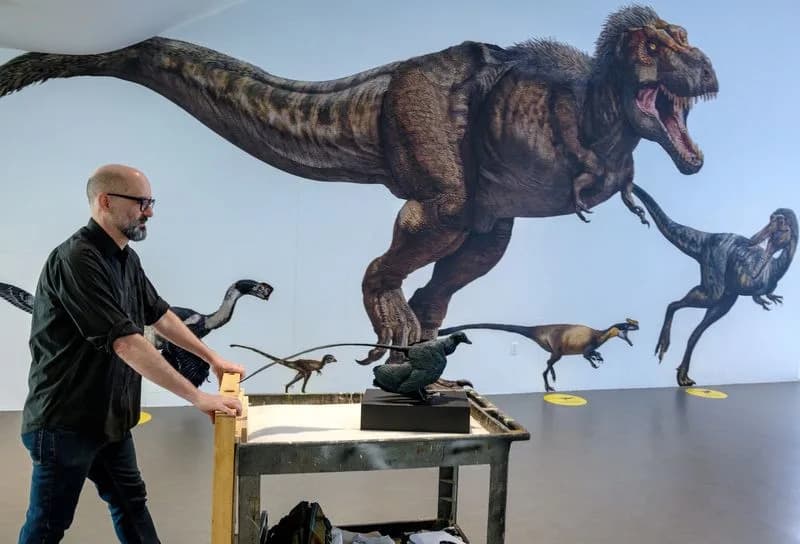
A model of the small dinosaur Microraptor being put on display at the American Museum of Natural History in New York, seen in this photograph released on August 5, 2026. Microraptor was one of the smallest-known dinosaurs, weighing about one pound, roughly the size of a large rabbit. Alvaro Keding/American Museum of Natural History/Handout via REUTERS
New research explains why truly tiny non-avian dinosaurs — mouse-sized or smaller — are absent from the fossil record. Scientists used mathematical models of energy budgets and reproduction and conclude that physiology alone cannot account for this gap; instead, ecological competition from small early mammals likely blocked dinosaurs from invading the tiniest niches.
Study And Models
Researchers led by Stephanie Lechki and Roger Benson used mathematical models that combine an animal's energy intake, physiology, and how efficiently it converts energy into offspring. These models correctly predict the typical size ranges for mammals, flying birds, and turtles, but they fail to explain the lack of very small non-avian dinosaurs.
Competition From Small Mammals
The team argues that most early mammals were shrew-sized and occupied insectivore and seed-eating niches suited to very small animals. That ecological dominance likely prevented dinosaurs from evolving into mouse-sized forms.
'A small animal typically requires fewer resources and can achieve reproductive maturity and reproduce more quickly than a large-bodied animal,' Lechki said.
'Most living species are small, much smaller than us, and smaller than even the smallest dinosaurs,' said Roger Benson, curator of dinosaur paleobiology at the American Museum of Natural History.
How Small Were The Smallest Dinosaurs?
The smallest known non-avian dinosaurs included crow-sized Microraptor (around 430 g), Anchiornis (about 530 g), and Fruitadens (about 730 g). By comparison, the bee hummingbird is roughly 1.75 g and the Etruscan shrew about 1.8 g — orders of magnitude smaller.
Birds, Flight, And Exceptions
Birds, which evolved from small feathered theropods, largely conform to the models and were able to reach tiny sizes after developing flight adaptations around 130 million years ago. The authors suggest flight let avian lineages escape competition on the ground and invade small-bodied niches, helping explain birds' tremendous species richness today.
The study also notes that other groups, such as snakes and crocodilians, deviate from the same model predictions for reasons that merit further research.
Fossil Bias Considered Unlikely
One alternate explanation is that tiny dinosaurs existed but left few fossils. The researchers regard this as unlikely because many fossil sites that preserve dinosaur bones also preserve remains of small animals.
Implications: The findings suggest that ecological interactions — not just physiology — shaped the size distribution of ancient vertebrates, with early mammals and dinosaurs locking each other out of some size classes until the end-Cretaceous extinction reshuffled ecosystems.
Study published in the journal Evolution. Reporting by Will Dunham; editing by Daniel Wallis.
Help us improve.





















