Ukrainian astronomers report detecting over 20 anomalous objects near the Moon, but experts urge caution. The claims are based on single-station high-speed camera footage from Vinarivka on September 7 and August 16, 2025, with size estimates ranging from about 440 meters to 15-25 miles and implied speeds up to 11 km/s. The study is an unreviewed preprint and shares methodological weaknesses with the team's prior work, including no parallax measurements and signals only a few pixels wide. Independent replication and rigorous peer review are required before the claims can be validated.
20+ Objects Near the Moon? Ukrainian Preprint Sparks Skepticism

Image: PICRYL
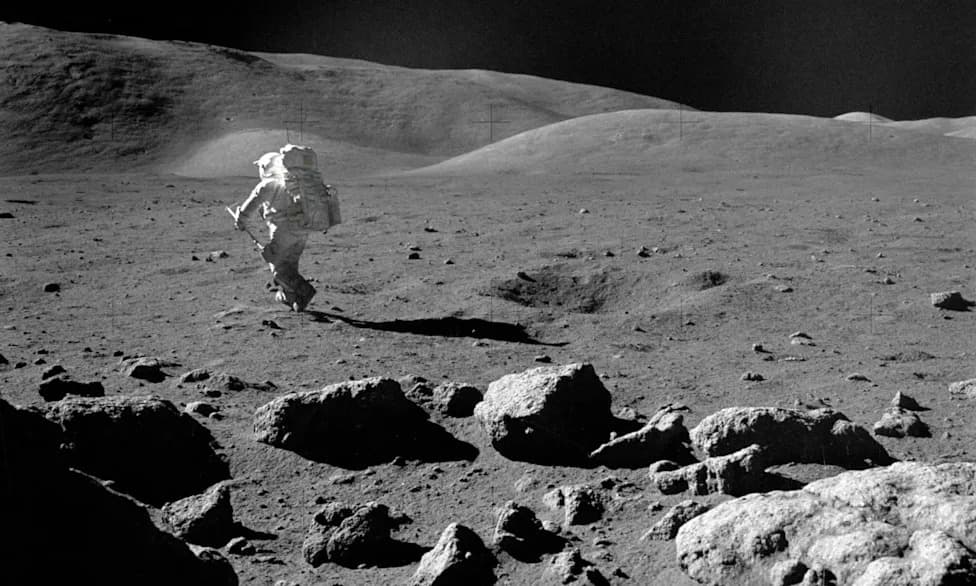
Ukrainian astronomers report more than 20 anomalous objects near the Moon, but experts urge caution. A research team at Ukraine's Main Astronomical Observatory published a non-peer-reviewed preprint describing faint, fast-moving specks recorded by high-speed cameras that the authors interpret as very large artificial structures.
Observations
The team, led by Boris Zhilyaev, used a high-speed camera running at 20 frames per second at an observatory in Vinarivka and analyzed footage recorded on September 7 and August 16, 2025. The authors classify detections into two types: 'atmospheric' objects that appear fixed to the lunar surface and 'continental' objects that reportedly streak across the Moon, with implied speeds up to 11 km/s.
Claims
- Size estimates depend strongly on assumed reflectivity and range from roughly 440 meters up to 15–25 miles across.
- Objects produced repeating flashes lasting 0.1–0.5 seconds; two flashes hundreds of miles apart were reported to flash in sync.
- The team describes ring-shaped features they estimate at 22–36 km in diameter that allegedly rotate every three minutes, which the authors calculate would generate centrifugal forces exceeding twice Earth gravity.
- The authors suggest, under their assumptions, that the Moon could serve as a base for unidentified aerial phenomena and that such objects might reach Earth in on the order of 20 minutes.
Limitations and Criticism
These dramatic conclusions are model-dependent and rest on data and assumptions that have significant uncertainty. Key methodological weaknesses include:
- Single-station observations with no parallax measurements, so distances are not independently constrained.
- Signals appear as only a few pixels in raw frames, making precise sizing and shape interpretation unreliable.
- Reflectivity and composition are unknown, and the authors acknowledge that size and speed estimates vary wildly depending on those assumptions.
- No independent replication or corroborating observations from other telescopes are presented.
The same research group previously published UAP analyses that Ukraine's National Academy of Sciences formally criticized for significant errors and for not meeting professional standards. External scientists, including Harvard astrophysicist Avi Loeb, argued earlier distance estimates from this team were off by roughly an order of magnitude, transforming purported giant craft into far more prosaic objects such as artillery shells or nearer optical artifacts.
Other plausible explanations include image artifacts, satellites, cosmic rays, atmospheric effects, or misestimated ranges. NASA and U.S. government UAP offices maintain that there is no confirmed evidence of extraterrestrial technology.
Bottom Line
The observations merit follow-up, but the current preprint does not meet the evidentiary standards required to support extraordinary claims. Multiple, coordinated observations with parallax, higher resolution imaging, and independent analysis are needed before the 'giant craft' interpretation can be considered credible.
Help us improve.