
A faint X‑ray flash detected in March 2026 heralded supernova SN 2026gzf, a broad‑lined Type Ic explosion about 500 million light‑years away. Rapid, multiwavelength follow‑up captured what researchers interpret as the faintest shock breakout yet linked to this class. The progenitor was likely a ~20‑solar‑mass Wolf‑Rayet star that had shed its hydrogen and helium and expelled multiple circumstellar shells before collapsing. The event shows that broad‑lined Type Ic supernovas need not produce gamma‑ray bursts, implying more diverse explosion pathways.
Faint X‑Ray Flash Reveals Unusual Supernova — A Missing Link Between Ordinary Explosions and Gamma‑Ray Bursts
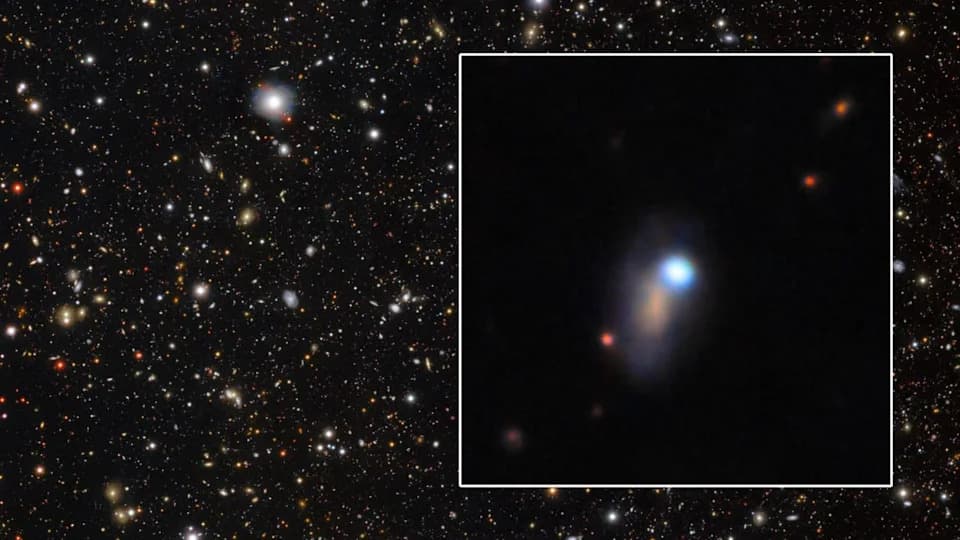
Credit: CTIO/NOIRLab/DOE/NSF/AURA Image Processing: D. de Martin & M. Zamani (NSF NOIRLab)
A faint X‑ray flash recorded in March 2026 has given astronomers an unprecedented real‑time look at the final moments of a massive star. The event, now identified as supernova SN 2026gzf, challenges assumptions about the connection between broad‑lined Type Ic supernovas and the extreme explosions that produce gamma‑ray bursts.
Discovery and Early Signal
China's Einstein Probe first flagged a brief X‑ray burst from a galaxy roughly 500 million light‑years away. The source, cataloged initially as EP260321a and later confirmed as SN 2026gzf, was classified as a broad‑lined Type Ic supernova — the class associated with stripped, very massive stars that have lost their hydrogen and helium envelopes.
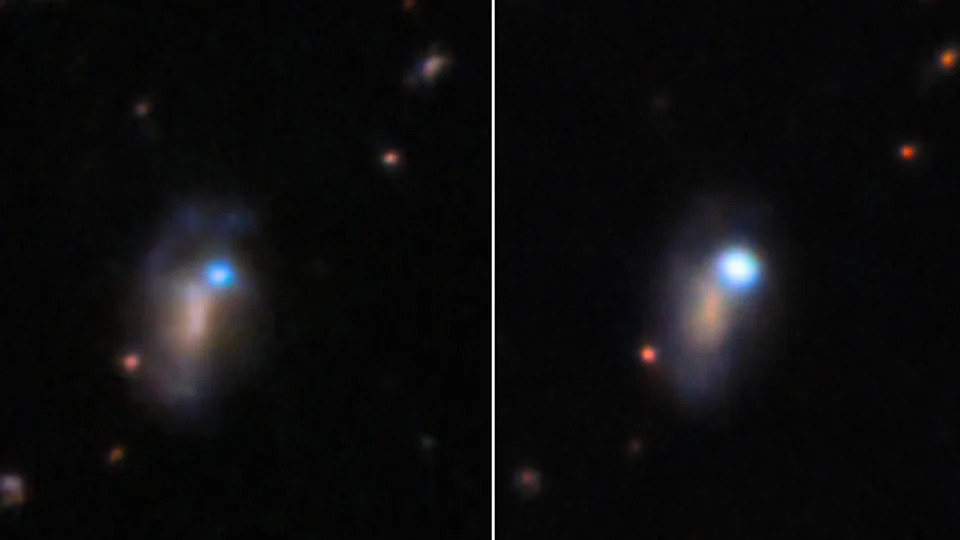
An image of a galaxy 500 million light-years away captured by the Dark Energy Camera (DECam), mounted on the NSF Víctor M. Blanco 4-meter Telescope in Chile taken on March 9, 2026 (left); and an image of the galaxy now containing supernova SN 2026gzf taken by the same camera on April 3, 2026. | Credit: CTIO/NOIRLab/DOE/NSF/AURA Image Processing: D. de Martin & M. Zamani (NSF NOIRLab)
What the X‑Rays Showed
Rather than signaling a gamma‑ray burst or a relativistic jet, the initial X‑ray flash appears to be a shock breakout: the moment the explosion's blast wave reaches the star's surface and releases a burst of high‑energy radiation. According to the research team, this is the faintest shock breakout yet linked to a broad‑lined Type Ic event.
Rapid, Multiwavelength Follow‑Up
Because shock breakouts typically last only seconds to hours, they are rarely observed. In this case, a fast‑response campaign using a network of space‑ and ground‑based facilities — including multiple NSF NOIRLab observatories, the Dark Energy Camera (DECam) on the Víctor M. Blanco 4‑meter Telescope, and the LSST Camera at the Vera C. Rubin Observatory — tracked the supernova from its earliest moments across multiple wavelengths.
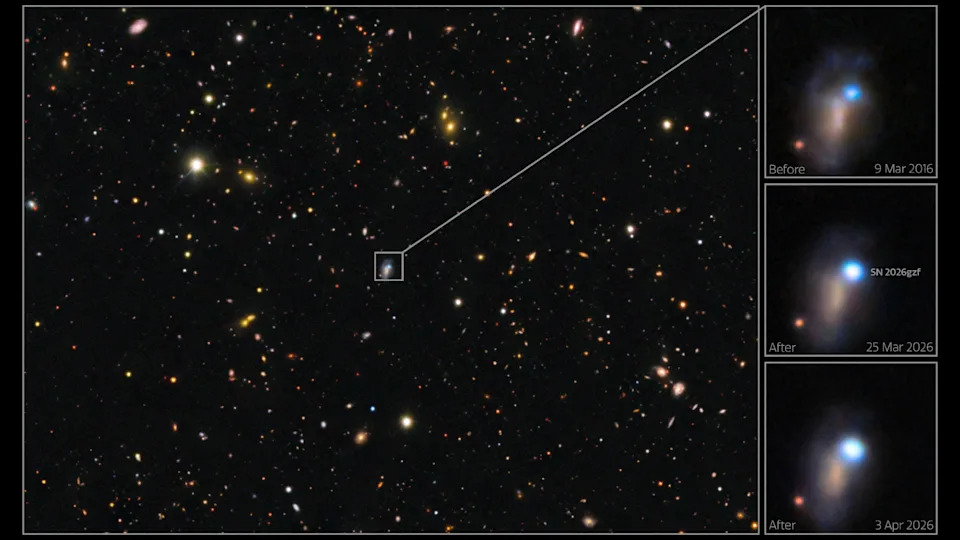
A close up of the area of space that contains the the galaxy home to supernova SN 2026gz, taken by the LSST Camera at the Vera C. Rubin Observatory. | Credit: CTIO/NOIRLab/DOE/NSF/AURA Image Processing: D. de Martin & M. Zamani (NSF NOIRLab)
Progenitor And Surrounding Material
Analysis indicates the progenitor was likely a Wolf‑Rayet star born with roughly 20 times the mass of the Sun that had already stripped away its hydrogen and helium layers, leaving a carbon–oxygen core. Observers also found evidence of multiple shells of circumstellar material, probably expelled during recent, violent bouts of mass loss. Those shells provided an unusually detailed window into the star’s last stages.
"Our observations allowed us to study the physics of three pieces of this explosion: the X‑ray shock breakout, the accompanying supernova, and the interaction of the supernova with material previously cast out by the dying star," said Jillian Rastinejad, lead author on one of the studies. "With this information we were able to map out the structure of the material surrounding the star and understand the star's violent lifestyle before it collapsed."
Implications
The case of SN 2026gzf suggests that energetic, broad‑lined Type Ic supernovas do not always produce gamma‑ray bursts or relativistic jets. Instead, similarly appearing explosions can result from a broader variety of progenitor histories and explosion mechanisms than previously appreciated. Continued rapid detections of shock breakouts will help test whether stripped massive stars commonly follow the same pre‑explosion "lifestyle."
"Going forward, I'm excited to observe more shock breakout events in similar detail to test if all stripped stars have a similar 'lifestyle' prior to collapse and what, if any, differences we see," said Gokul Srinivasaragavan, a member of Rastinejad's team.
Image credits: CTIO/NOIRLab/DOE/NSF/AURA. Image processing by D. de Martin & M. Zamani (NSF NOIRLab). DECam images taken March 9 and April 3, 2026; later imaging from the LSST Camera at the Vera C. Rubin Observatory.
Help us improve.





















