The military’s recent battlefield gains and growing regional diplomacy have created an uncommon opening for talks to resolve Myanmar’s civil war. The SCEF — a coalition of ethnic armed groups and the shadow government — says it is committed to pursuing a negotiated political settlement after meetings with Thai and Philippine officials. Min Aung Hlaing has not recognised the SCEF as a formal interlocutor, and observers say meaningful negotiations remain distant while battlefield dynamics and mutual distrust persist.
Diplomacy Opens Rare Window for Myanmar Peace Talks as Military Regains Ground
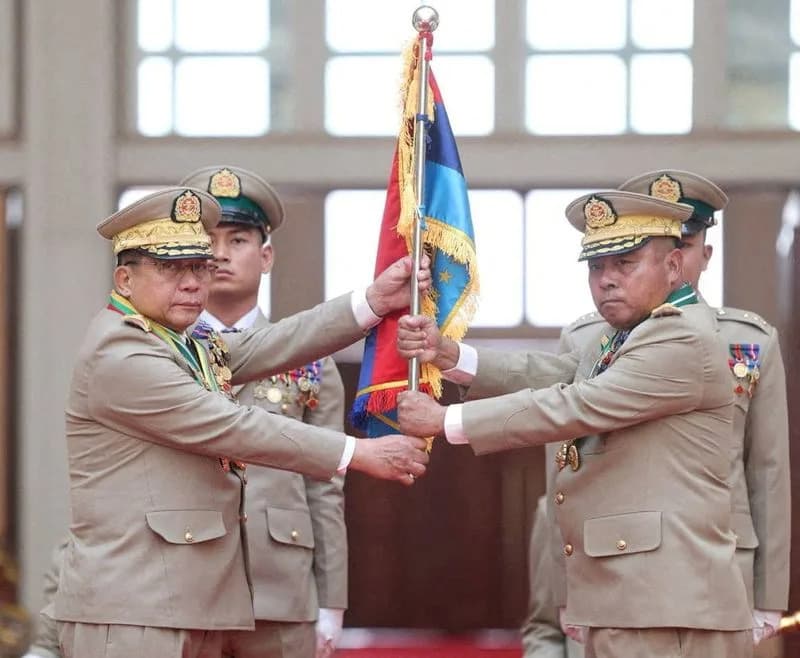
FILE PHOTO: Myanmar junta chief Senior General Min Aung Hlaing hands over a flag to newly appointed Commander-in-Chief General Ye Win Oo during a ceremony in Naypyitaw, Myanmar, March 30, 2026. Myanmar Military True News Information Team/Handout via REUTERS
After more than five years of war, a rare window for negotiations over Myanmar's brutal civil conflict is opening as the military regains ground and regional diplomacy heats up.
Shift In Positions
Analysts point to a notable change in the stance of the Steering Council for the Emergence of a Federal Democratic Union (SCEF) — an umbrella grouping that brings together several major ethnic armed organisations and the shadow administration formed from remnants of the last elected government. Following meetings last month with the foreign ministers of Thailand and the Philippines, the SCEF said it is committed to pursuing a negotiated political settlement.
Diplomatic Momentum
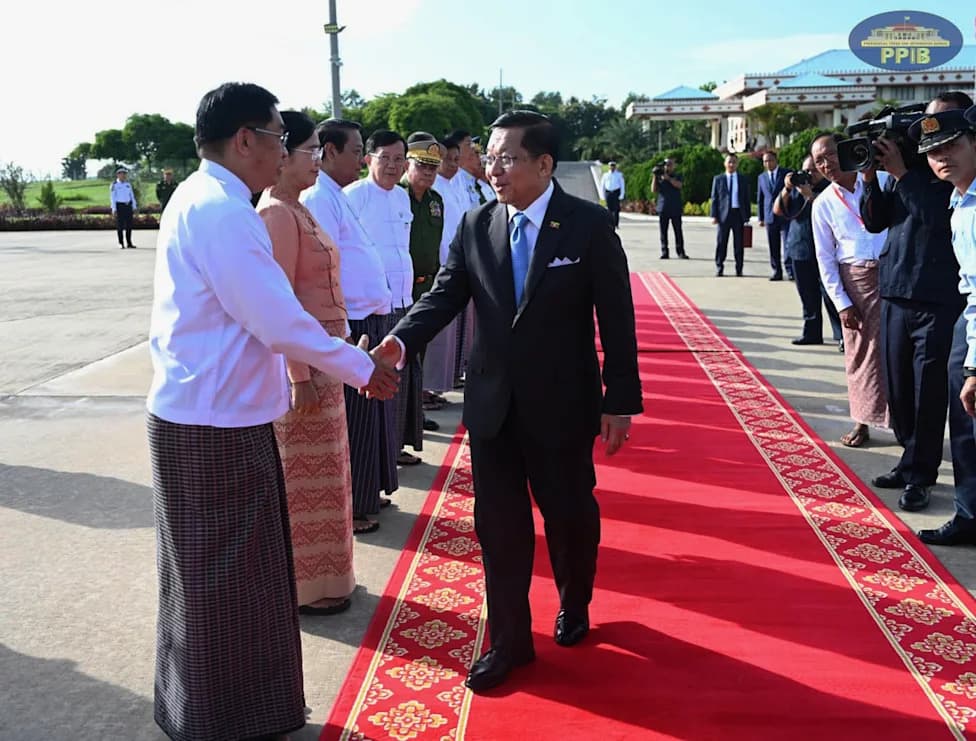
Myanmar’s junta chief-turned-president, Min Aung Hlaing, has not formally recognised the SCEF as a negotiating partner. Still, his visit to Thailand — where Bangkok is pressing for the gradual re-engagement of Myanmar with ASEAN — underscores regional efforts to coax a truce and expand humanitarian access. Thailand’s priorities include reducing cross-border violence, increasing aid delivery and containing spillover into Thai territory.
“It therefore seems that they have abandoned their previously stated public objective of overthrowing the Tatmadaw,” said Morgan Michaels, a research fellow at the International Institute for Strategic Studies. He added that a direct political dialogue may be distant, with a nearer-term prospect being movement toward a formal “talks of talks.”
Preconditions And Sticking Points
SCEF spokesperson Saw Nimrod said the coalition’s long-term aim remains civilian supremacy and removing the military from political life, but added the group is now committed to negotiating a political solution. The SCEF has called on the military to stop attacks on civilians and to release all political prisoners to create conditions for meaningful dialogue.
Naypyitaw has instead signalled a preference for bilateral talks with individual armed groups rather than recognising an umbrella interlocutor. Observers warn that a durable peace will require concessions and compromises from all parties — an outcome that currently looks distant.
Why The Military Holds The Upper Hand
Since the February 2021 coup that ousted the elected government led by Aung San Suu Kyi, fighting has killed more than 100,000 people, displaced millions and devastated the economy. After a period of setbacks, the military introduced conscription, consolidated backing from key allies such as China, and adopted new battlefield tactics. Those factors, along with intensified offensives in regions such as central Bago and southern Dawei, have helped the junta recover momentum.
“The military, which was previously thought to be on the verge of collapse, has not collapsed but has instead managed to survive, both politically and militarily,” said independent analyst Aung Ko Ko.
Outlook
International and regional pressure is increasing on ethnic armed organisations to enter talks, but deep distrust, competing goals and the junta’s strengthened battlefield position will complicate negotiations. For now, diplomats and analysts expect preliminary confidence-building steps or "talks about talks" before any substantive peace process can begin.
Reporting: Reuters staff and Panu Wongcha-um in Bangkok. Writing: Devjyot Ghoshal. Editing: Saad Sayeed.
Help us improve.