
Taiwan has launched its largest Han Kuang drills (Aug 5–14) to rehearse responses to a potential Chinese invasion. The exercises combine decentralised command drills, integrated reconnaissance-and-attack drone operations, naval deployments and urban resilience training. Simulations include a 30-minute slowdown of mobile internet to mimic wartime communications outages and tests of wartime production and supply escorts. Political debate continues over defence spending as President Lai pledges to raise the budget to 5% of GDP by 2030.
Taiwan Launches Largest Han Kuang Drills Amid Rising Chinese Pressure
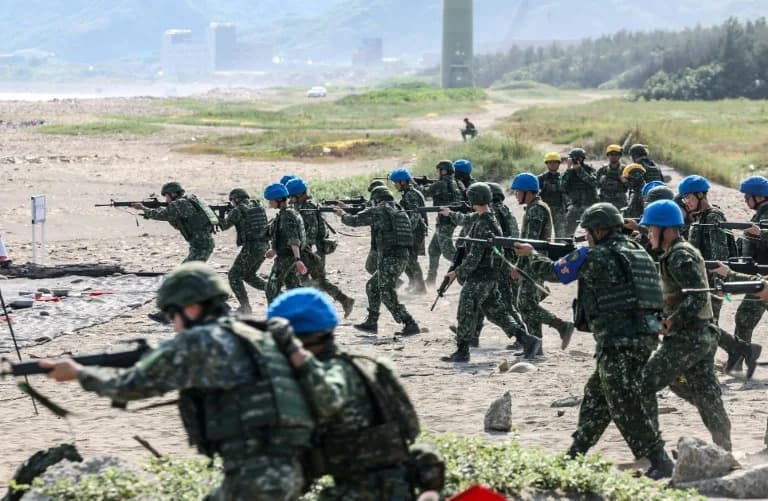
Taiwan military personnel conduct a live-fire exercise on Zhongfu Beach as part of annual Han Kuang military exercise (I-Hwa Cheng)
Taiwan on Wednesday launched its largest annual military exercise of the year, the Han Kuang drills (Aug 5–14), aimed at preparing troops, reservists and civilians for a possible Chinese invasion. Defence officials say the exercises stage realistic combat scenarios and test civilian readiness across the island.
What the Drills Involve
Combined Military and Civilian Training: The drills involve active-duty troops, reservists and civilians in air-raid exercises, urban resilience training and simulations of wartime communications disruption.
Decentralised Command: A central objective this year is to decentralise command and control so field commanders can make rapid operational decisions without waiting for higher-level orders.
Drone Kill Chain: Exercises practise integrated operations in which reconnaissance drones detect targets and attack drones, together with other assets, engage them—part of Taiwan’s shift toward smaller, more nimble systems to enable asymmetric defence.
On-the-Ground Activity
Reservists fired Taiwanese-made assault rifles on a beach facing the Taiwan Strait to rehearse defending potential landing sites. In Taipei, reservists practised loading mortars and handling M4A1 rifles at a school playground. Navy vessels, including a submarine, were deployed off southern Taiwan while tanks and armoured vehicles carried out pre-dawn manoeuvres in Taichung. Black Hawk helicopters were also active above Kaohsiung.
Simulations And Civil Preparedness
To simulate wartime disruption, mobile internet speeds will be slowed for 30 minutes during air-raid drills in central and northern regions so civilians experience communications outages. The government will also test escorting supplies in a simulated Chinese blockade east of the island and assess the capacity of mobilised factories to support wartime production and relocation.
“In recent years, we've constantly emphasised that the Han Kuang exercise must be closer to real combat scenarios, so that even without actually experiencing war our units can test their real operational capabilities,” a senior defence official said on the eve of the drills.
Budget And Politics
President Lai Ching-te has pledged to raise defence spending to 5% of GDP by 2030 under pressure from the United States to boost Taiwan’s security posture. However, the administration has clashed with opposition parties that control the legislature over spending priorities.
In May, the Kuomintang (KMT) and the Taiwan People's Party approved a $25 billion special defence budget, cutting roughly one-third from the amount sought by Lai’s Democratic Progressive Party and removing about $15 billion the government had earmarked for domestic drone procurement and related projects. Lawmakers are now debating rival multi-billion-dollar proposals for drone investment.
“As the CCP's authoritarianism continues to expand, red terror is also spreading into every corner of the world,” President Lai said at a security forum. Defence Minister Wellington Koo added: “Training can always be better. We will therefore continue to train diligently and intensively, so that we are fully prepared in peacetime and able to carry out our missions in wartime.”
Taiwan's population of about 23 million lives under persistent pressure from Beijing, which claims the island as its territory and has not ruled out the use of force. In recent years Beijing has increased military activity around Taiwan, including frequent fighter-jet and naval patrols and large-scale exercises, as well as expanded coast guard operations in so-called grey-zone tactics.
Help us improve.





















