The James Webb Space Telescope detected magnesium-rich phyllosilicate clays on three small inner moons of Neptune (Proteus, Larissa and Galatea) and in its rings. These clays form only after prolonged water–rock interaction, implying the material originated inside much larger icy bodies that no longer exist. The leading explanation is that Triton — a retrograde, captured Kuiper Belt object that now makes up over 99% of Neptune's satellite mass — disrupted and destroyed the original moon system. The resulting debris gives scientists a rare chance to study deep-interior material from large icy worlds.
Webb Finds Clay Minerals That Reveal an Ancient Catastrophe in Neptune’s System
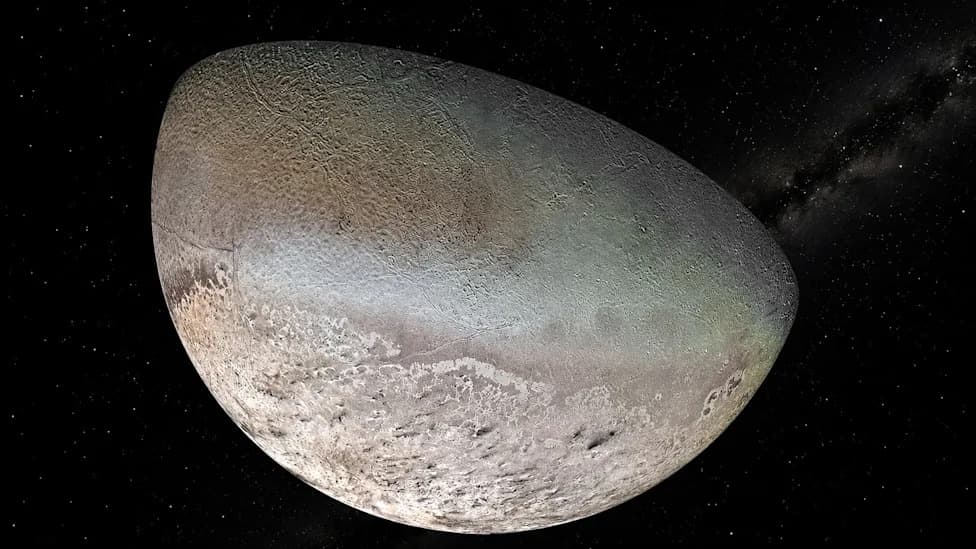
Global color mosaic of Triton, taken in 1989 by Voyager 2 during its flyby of the Neptune system. Image: NASA/JPL/USGS
New observations from the James Webb Space Telescope (JWST) have uncovered forensic evidence that Neptune’s current satellite system was dramatically reshaped billions of years ago. Infrared spectra reveal magnesium-rich phyllosilicate clays on several small inner moons and in Neptune’s rings — minerals that point to material excavated from the deep interiors of once-larger icy worlds.
What Webb Detected
Using JWST's infrared instruments, researchers identified magnesium-rich phyllosilicates — the same class of clay minerals seen on dwarf planet Ceres and in some meteorites — on three small inner moons and within Neptune’s dusty rings:
- Proteus
- Larissa
- Galatea
Why This Is Unexpected
Phyllosilicates form only after prolonged interaction between liquid water and rock. Those conditions require sizable, warm interiors found in large icy bodies, not in the tiny, cold moons currently orbiting Neptune. As lead author Ryleigh Davis told Reuters:
"The moons themselves are far too small and cold for that chemistry to have occurred in place. We were shocked to find the observed clays, which had to come from objects that were much, much bigger than Neptune's small inner ring moons."
The Likely Story: Triton's Arrival
The most widely supported explanation is that a Pluto-sized object — now known as Triton — was captured by Neptune in a retrograde orbit early in the solar system's history. Models suggest Triton arrived as part of a binary pair and that Neptune's gravity separated the pair, keeping Triton. Its capture would have violently destabilized and effectively destroyed the original family of large satellites.
Today Triton comprises more than 99% of the total mass orbiting Neptune, while the remaining moons (about 16 known satellites) and the rings appear to be fragmentary remains or re-accreted rubble from that ancient disruption. One possible survivor of the original system is Nereid, whose eccentric orbit and water-rich composition are consistent with being a remnant rather than a newly formed body. Researchers also acknowledge a less likely alternative — that another Kuiper Belt object caused the upheaval — but Triton best matches the combined lines of evidence.
Scientific Payoff
Although the past violence erased Neptune's original moon system, it created an observational advantage: material from deep interiors is now exposed on small surviving moons and in the rings. That rubble offers a rare, direct window into the composition of large icy bodies — information otherwise locked beneath thick ice shells on worlds such as Europa and Enceladus.
Source: Reuters reporting on JWST observations.
Help us improve.