
Researchers at the Weizmann Institute used cat-food-scented, 3D-printed objects in laser-cut mazes to test how group size affects longhorn crazy ants' problem-solving. Larger ant groups outperformed smaller ones on more complex mazes and when gravity influenced maneuvers. Machine-learning models matched simple cases with gravity-based rules but needed "ant-like" distributed properties to solve harder puzzles. The team cautions that this reflects scalable collective behavior, not conscious "hive mind" cognition.
When More Is Better: How Ants Use Numbers To Solve Tougher Puzzles
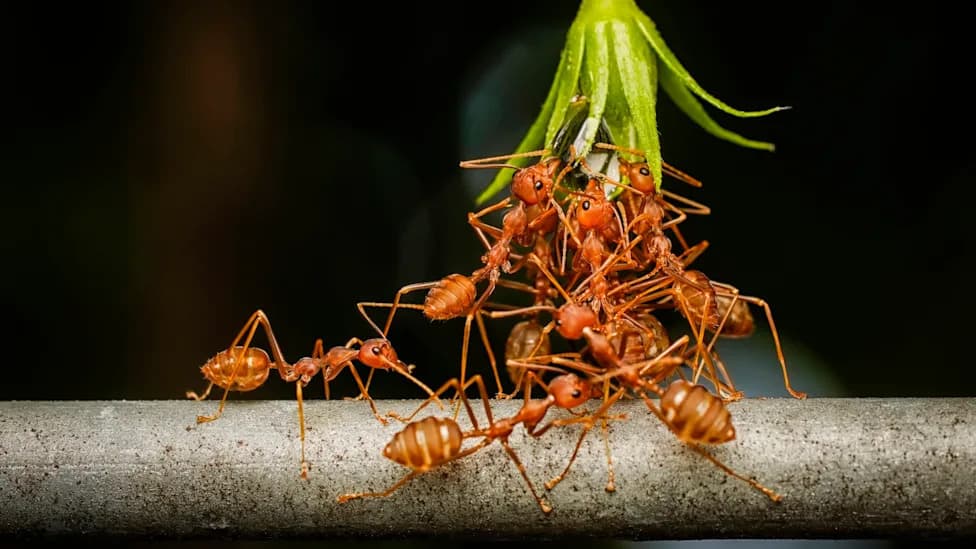
Ant cooperation could help design better machine learning programs and swarm robots.
Collaborative human projects often suffer from the "too many cooks" problem — but ant colonies appear to benefit from larger numbers. Researchers at the Weizmann Institute of Science observed longhorn crazy ants (Paratrechina longicornis) and found that increasing group size helped colonies solve more complex transport challenges than smaller teams could manage. The study appears in the Journal of the Royal Society Interface.
Experimental Setup
To test how group size affects problem-solving, the team 3D-printed small props with precise shapes and masses, then soaked them overnight in cat food to make them attractive to the ants. The baited objects were placed inside laser-cut mazes of varying sizes and difficulty. Crucially, researchers scaled object weight in proportion to the number of ants in each trial, so that the experiments measured coordination and cooperation rather than merely brute force. The ants' interactions with the maze and the loads were recorded on video for analysis.
Key Findings
Across simple mazes, almost every group size succeeded at guiding the lighter or simpler objects along straightforward routes. But as maze complexity increased and tasks became effectively heavier relative to their complexity, larger ant groups outperformed smaller ones by a substantial margin. The advantage for bigger groups persisted even in trials where ants had to account for gravity and maneuver asymmetric loads through convoluted paths.
Simulations And The Role Of Distributed Behavior
Feinerman's team also ran computer simulations to explore whether machine-learning models that include physical principles could reproduce the ants' success. Simple gravity-based models matched outcomes for easy puzzles: "If one were to take the maze, with the load inside, tilt it and shake the whole thing, the load would eventually fall out," Feinerman said. But for the more challenging mazes, simulations only succeeded when the researchers introduced "ant-like" distributed properties such as forces acting on different points of an object over time rather than assuming a single fixed pivot.
"The simulations showed that simple puzzles can be solved by simple gravity-based models," Feinerman said. "For harder mazes we had to add ant-like, distributed rules. The ants themselves do not require such tuning and appear to use the same basic rules to solve different mazes without outside information."
Implications And Caveats
The findings suggest that collective problem-solving in ant colonies scales with group size: more individuals can enable distributed strategies that tackle greater complexity. However, the team cautions against interpreting these results as evidence of a conscious "hive mind." The simulated agents required human tuning for each maze, whereas ants applied the same simple local rules across tasks. The study has implications for understanding collective intelligence and could inform decentralized robotics and algorithms that mimic biological distributed problem-solving.
Help us improve.





















