
The Shanjiabao cemetery yielded 3.74 liters of grain wine sealed in a Qin-era bronze bottle for about 2,300 years. Chemical and microscopic analyses identified 24 compound categories and matched the profile to artificially fermented Huangjiu. Evidence of simultaneous saccharification and fermentation reveals a sophisticated brewing method still used in East Asian grain wines today. The discovery sheds light on Warring States–period brewing, burial ritual and material culture.
2,300-Year-Old Grain Wine Found Sealed in Qin-Era Bronze Bottle — 3.74 L Remarkably Intact
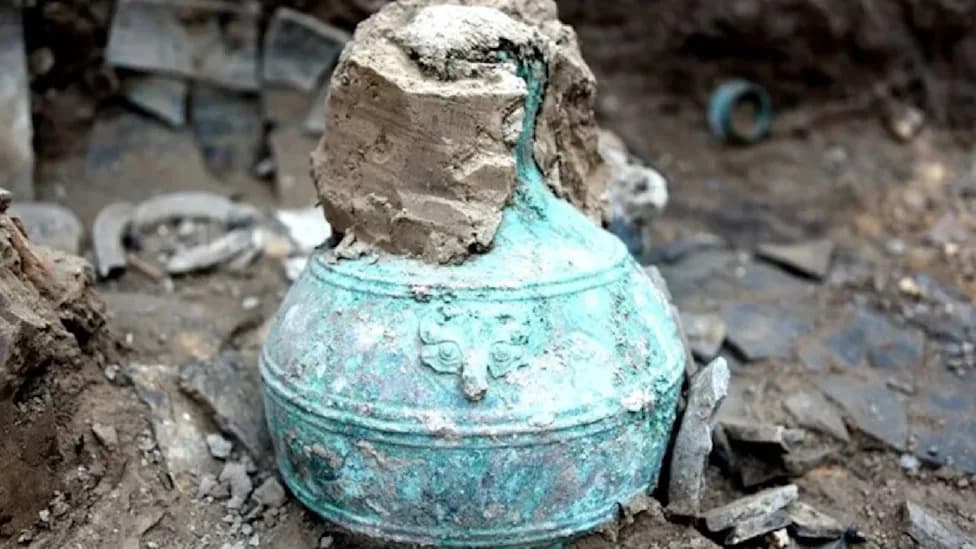
2,300-year-old grain wine found sealed in its original bronze vessel in China
Archaeologists in northwest China have recovered 3.74 liters (3,740 milliliters) of grain-based wine sealed inside a Qin-era bronze vessel for roughly 2,300 years. The liquid was excavated from Tomb M39 at the Shanjiabao cemetery near Guyuan City in the Ningxia Hui Autonomous Region, close to an ancient section of the Qin Great Wall.
Scientific Analysis Reveals Ingredients and Technique
Researchers from the Ningxia Institute of Cultural Relics and Archaeology and Northwest University used a suite of modern laboratory methods — including infrared spectroscopy, ultra-high-performance liquid chromatography–mass spectrometry (UHPLC–MS), and microscopic analysis of starch grains, phytoliths and yeast microfossils — to examine the contents.
The team identified 24 categories of chemical compounds, including organic acids, amino acids and carbohydrates. The organic-acid profile matches that of artificially fermented Huangjiu, a traditional Chinese grain wine still produced today, confirming the find as a grain-fermented alcoholic beverage.
Evidence of Advanced Brewing: Simultaneous Saccharification and Fermentation
Microscopic and chemical evidence indicates simultaneous saccharification and fermentation (SSF) was used: fermentation starters converted starches to sugars while fermenting those sugars at the same time. This sophisticated technique is the same basic approach used in modern Huangjiu production and many East Asian grain wines.
Context and Preservation
The Shanjiabao cemetery, about 2 kilometers south of a Warring States–era stretch of the Qin Great Wall, is interpreted as a burial ground for garrison troops and local residents of the period. Excavations have uncovered 183 tombs, 179 attributed to Qin people.
The bronze bottle from Tomb M39 has a distinctive garlic-shaped mouth typical of Qin culture and often used to store alcohol. Its opening was sealed in two layers: textile packed inside the mouth and a layer of mud mixed with organic material over it. That double seal minimized evaporation and preserved the liquid’s clarity (a pale bluish-green), nearly odorless character, and a thin sediment at the base.
Significance
This find is described by the team as the best-preserved liquid alcohol relic from the Warring States Period (475–221 BC) publicly reported in China. It provides rare, direct evidence of ancient brewing techniques, ritual or funerary use of alcoholic drinks, and material culture in a key era that preceded China’s imperial unification under the Qin Dynasty in 221 BC.
Publication: The research was first published in the Journal of Archaeological Science.
Help us improve.





















