Researchers analyzing Colombian municipalities (2010–2020) find that environmental and geographic factors — including coca cultivation, informal gold mining, and transportation corridors — predict local homicide rates more reliably than the mere presence of armed groups. Homicide hot spots concentrate where illicit resources and trafficking routes overlap, and violence spills over across municipal borders. The findings challenge "kingpin" approaches and recommend prevention strategies that change places and opportunities through rural development, legal jobs and a sustained state presence.
Why Geography — Not Just Gang Presence — Explains Homicide Patterns in Latin America
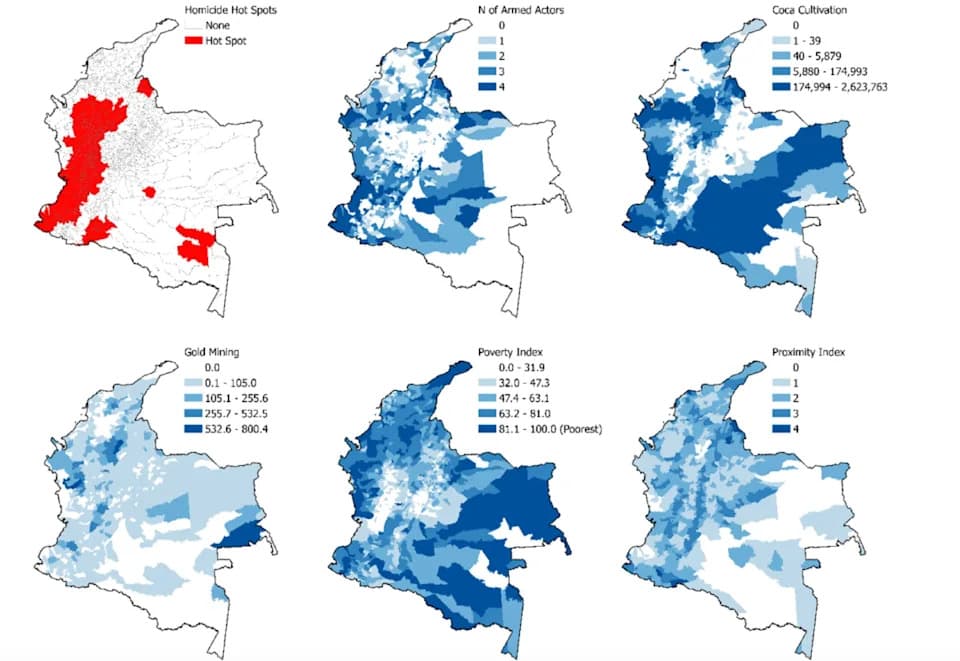
A graphic shows the correlation between homicide hot spots, gang concentration, and environmental and geographic features.Pires/Guerette/Del Rio/Spencer,CC BY-SA
Environmental features and geographic location may be better predictors of homicide rates in Latin America than the simple presence of organized criminal groups. That is the central finding of a recent study that mapped and analyzed municipal homicide patterns in Colombia from 2010 to 2020.
Working as place-based criminologists, we tested whether the specific places where violence occurs matter more than how many or which armed groups operate there. We compared local homicide rates with the prevalence or proximity of environmental and geographic factors that shape illicit opportunity, including coca cultivation, informal gold mining, and transport and trafficking corridors (major roads, rivers, ports, airports and border crossings).
Key Findings
Place-based factors matter. Using spatial statistical models, environmental and geographic variables consistently predicted municipal homicide rates even after controlling for the presence of armed actors such as the Revolutionary Armed Forces of Colombia (FARC) and its dissident factions, the National Liberation Army (ELN), and other organized criminal syndicates.
Homicide hotspots cluster where illicit resources and routes overlap. Many eastern municipalities with a high concentration of armed actors showed relatively low murder rates. By contrast, the most intense homicide hot spots occurred primarily in a western corridor where coca production, informal mining and major transport routes converge.
Violence spills across municipal borders. We observed strong spatial spillover effects: homicide rates in one municipality were significantly shaped by the environmental conditions of neighboring municipalities, particularly adjacent coca cultivation and mining activity. This suggests that geography and neighboring opportunity structures help facilitate and propagate lethal violence across space.
Implications for Policy
These results challenge long-standing "kingpin" strategies that focus primarily on arresting or killing top leaders. If lethal violence is driven largely by the geographic distribution of illicit economic opportunity, removing individual criminals does not change the underlying conditions that make violence profitable and persistent. When the environment remains lucrative, new or splinter groups are likely to move in and continue violent competition.
For policymakers, this points to a need for prevention strategies that change places and opportunities rather than relying solely on reactive, offender-focused tactics. Potential interventions include:
- Ambitious crop-substitution and rural development programs in coca-growing regions;
- Legal employment opportunities and formalization for communities dependent on informal mining;
- A stronger, sustained state presence and public services along trafficking corridors and in areas with weak governance;
- Targeted infrastructure and economic policies that reduce the profitability of illicit markets.
Limitations and Future Research
Our study used municipalities as the unit of analysis because homicide data were available at that scale. Some municipalities are large and heterogeneous, so armed actors and violence are not evenly distributed across every area. Future research should test whether these place-based patterns hold at finer spatial scales (neighborhoods, street segments) and whether annual changes in armed actor presence and environmental conditions correspond with year-to-year shifts in violence.
We also plan to apply this place-based analytical framework to other conflict-affected countries in Latin America — notably Mexico and parts of Central America — to assess whether environmental and geographic predictors similarly explain homicide patterns across different national contexts.
Our findings, published in the peer-reviewed journal Crime Science, suggest that addressing the geography of illicit opportunity is essential to reducing violence sustainably.
Authors: Stephen Pires (Florida International University), Dylan Spencer (Georgia Southern University), Juan Del Rio (Florida International University), and Rob T. Guerette. The authors report no conflicts of interest relevant to this analysis.
Help us improve.