Researchers from Lawrence Berkeley National Laboratory, UC Berkeley and Estonia's National Institute of Chemical Physics and Biophysics used a custom microscope to watch captured CO2 convert into solid carbon inside molten salts at about 932°F (≈500°C). They observed a surprising two-stage conversion that held across different salts and electrodes, and found the process may be tunable to produce graphite or other carbon allotropes. The method could ease graphite supply-chain pressures and lower carbon intensity, but it still requires optimization and scaling to reach industrial production.
Captured CO2 Converted Into Graphite Using Molten Salts — Live Microscope Reveals Two-Stage Reaction
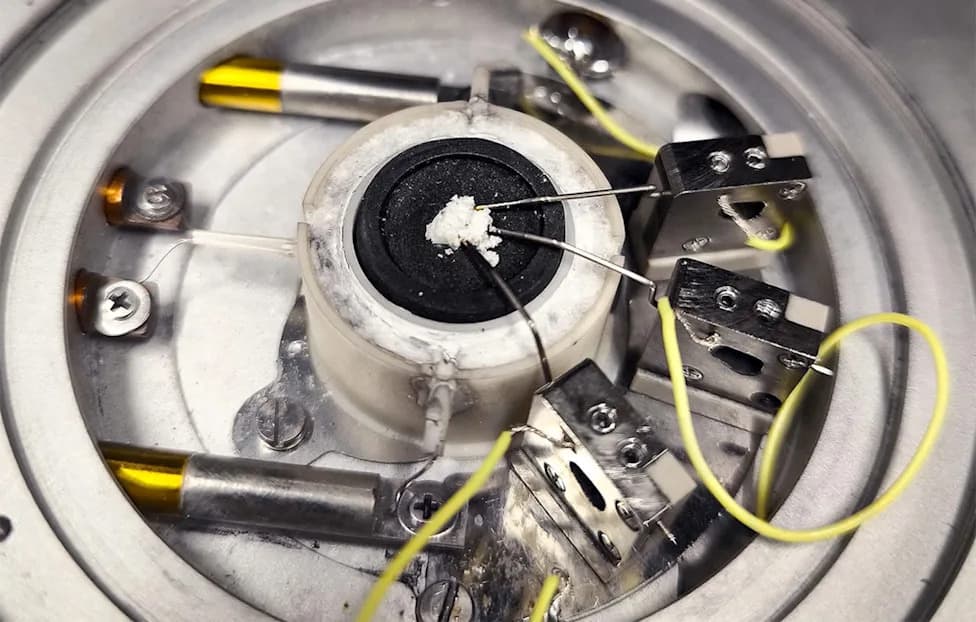
Photo Credit: Sander Ratso / National Institute of Chemical Physics and Biophysics
Researchers in California report a potentially cleaner route to produce graphite — a material essential to batteries, electronics and large-scale energy storage — by converting captured carbon dioxide into solid carbon inside a bath of molten salts.
How The Team Did It
The study, published in Nature Communications and highlighted by Phys.org, involved scientists from Lawrence Berkeley National Laboratory, UC Berkeley and Estonia's National Institute of Chemical Physics and Biophysics. To observe the reaction directly, the team built a custom high-temperature microscope that can image chemical processes inside corrosive molten salts heated to about 932°F (≈500°C).
What They Observed
Using live imaging, the researchers watched captured CO2 undergo electrochemical reduction and form solid carbon. The measurements revealed an unexpected two-stage conversion sequence. Importantly, the core chemistry remained consistent when the scientists varied salt compositions and electrode materials, although those changes affected which carbon allotropes formed.
Why This Matters
Graphite is a key ingredient in lithium-ion batteries and other technologies, and much of the world’s supply is mined and often imported. A method that turns atmospheric or captured CO2 into graphite or other useful carbon materials could reduce reliance on mined graphite, strengthen domestic supply chains, and provide a lower‑carbon route to materials used in electric vehicles, phones, laptops and grid storage.
Practical Challenges And Next Steps
The discovery is an important proof of concept but not yet a commercial solution. Researchers need to identify optimal combinations of molten salts, electrode materials, temperatures and voltages to produce graphite reliably and efficiently. Scaling from lab demonstrations to industrial production will be a major next step.
Broader Research Value
The custom microscope itself is a valuable tool: because molten salts are extremely hot and corrosive, they have been difficult to study directly. Real-time imaging of these environments can accelerate research into other critical materials synthesized under similar conditions.
“This is a major win in a larger effort to synthesize critical materials and battery materials using molten salts,” said Mike Whittaker, a Berkeley Lab scientist who worked on the project. “If you could run this process at low temperatures with really cheap salts, you could have it in a lot of places, and you could generate enough graphite that you could feed into battery supply chains.”
While mining will not disappear overnight, this approach points to a future where critical carbon materials might be produced more flexibly and closer to where batteries and equipment are assembled.
Help us improve.