
Simulations by Lujendra Ojha and colleagues indicate Europa’s icy shell likely prevents deep ocean water from rising intact to the surface. Turbulent flow and rapid cooling produce supercooling and frazil ice that can clog fractures in hours, meaning shallow pools or plumes may originate from local melt rather than direct ocean upwellings. These findings will shape how scientists interpret data from NASA’s Europa Clipper (arriving 2030) and ESA’s JUICE mission (arriving 2031).
New Study Suggests Europa’s Icy Shell May Block Direct Access to Its Buried Ocean
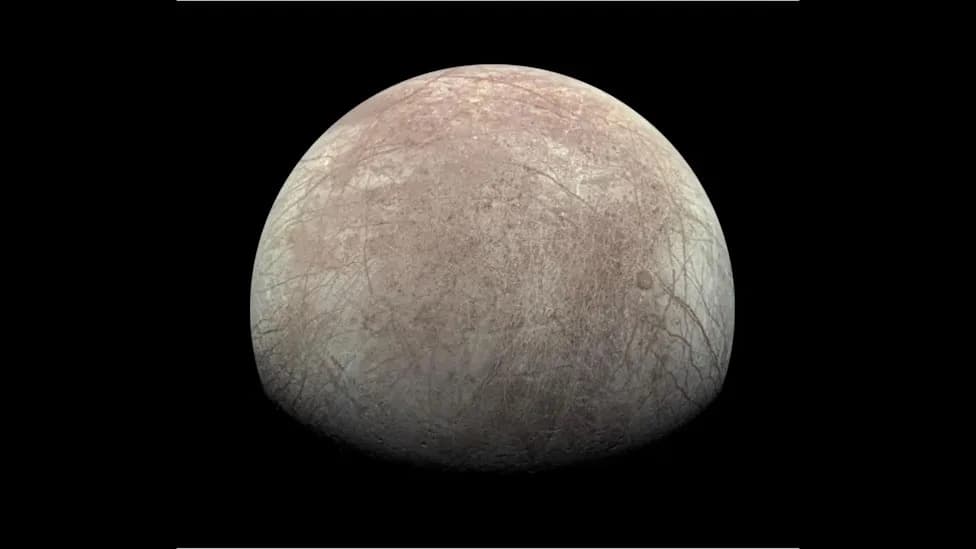
A view of a white-ish world with a subtle, large brown patch over it. There are streaks all over as well.
NASA's Europa Clipper is currently on a roughly 1.8‑billion‑mile journey to Jupiter to investigate whether Europa, one of Jupiter’s icy moons, could harbor life. Earlier missions (Voyager and Galileo) revealed that Europa hides a global ocean beneath its frozen crust — a body of water estimated to contain more than twice the volume of all Earth's oceans combined. Many scientists had hoped that cracks or plumes could deliver ocean material close enough to the surface for spacecraft to sample.
A new study led by planetary scientist Lujendra Ojha at Rutgers University challenges that idea. Using high‑resolution computer simulations of water rising through fractures in Europa's ice shell, the team found that turbulent flow, rapid cooling and the formation of frazil ice (tiny slushy crystals) are likely to freeze and clog conduits before ocean water can reach shallow reservoirs or the surface.
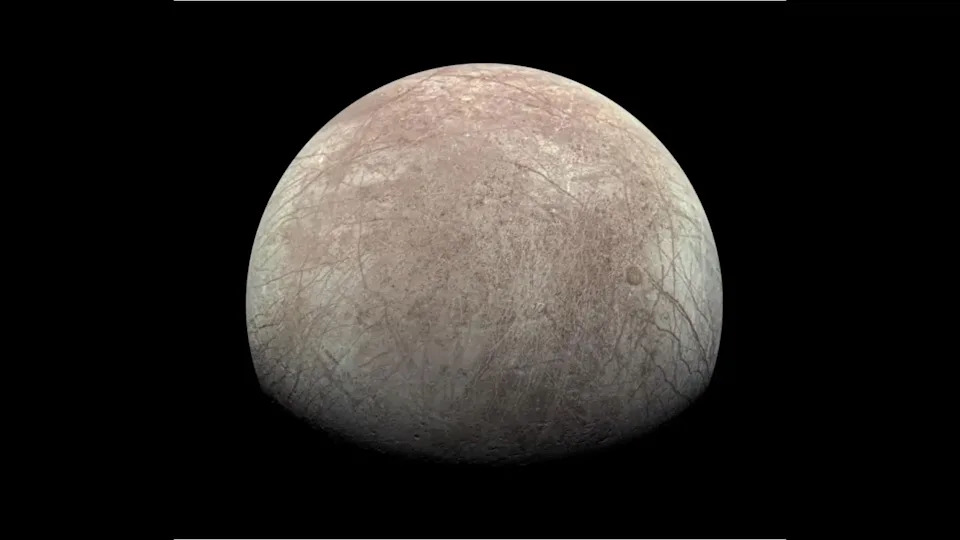
This view of Jupiter's icy moon Europa was captured by JunoCam, the public engagement camera aboard NASA's Juno spacecraft, during the mission's close flyby on Sept. 29, 2022. | Credit: Image data: NASA/JPL-Caltech/SwRI/MSSS | Image processing: Kevin M. Gill CC BY 3.0
What the Study Modeled
Previous, simpler models treated rising water as a steady, laminar flow. Ojha’s team incorporated realistic fluid dynamics and heat exchange between moving water and cold ice walls. The simulations show that water ascending from depth would churn and swirl inside fractures, repeatedly contacting cold surfaces and losing heat quickly.
“There’s an icy shell, there’s water underneath, and there’s all this speculation about how that water can come from deep underground and make its way all the way up without freezing en route,” Ojha said. “That’s really what we think we disproved.”
Key Physical Processes
As the turbulent water cools, it can remain liquid below its normal freezing point (a supercooled state). Supercooling seeds frazil ice, which forms rapidly and accumulates on fracture walls and within the flow, effectively sealing the pathway — often within hours in the simulations. The authors note that only very wide, extremely numerous, or unusually long fractures could plausibly deliver continuous ocean flow to near‑surface reservoirs, and such conditions appear unlikely under Europa’s expected geology.
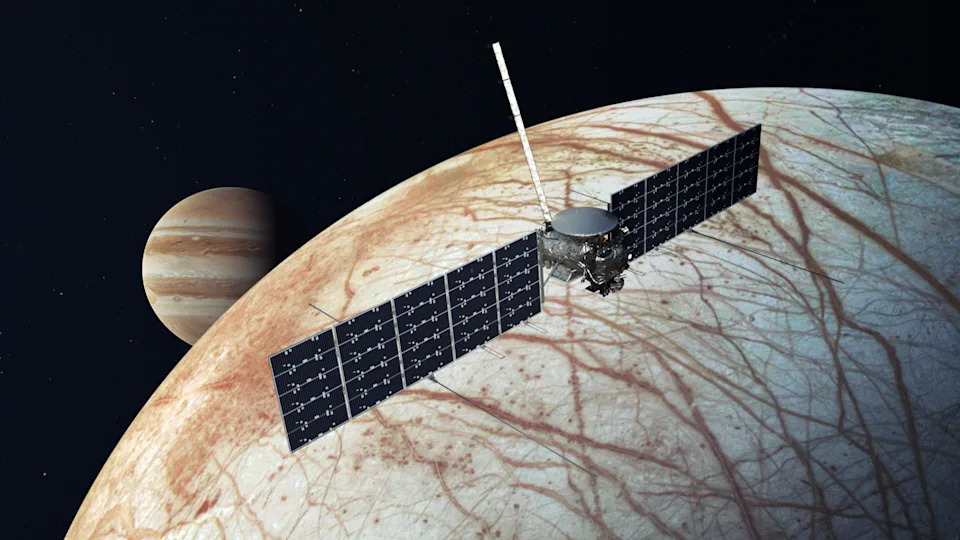
An artist's illustration of Europa Clipper spacecraft flying above Jupiter's icy moon Europa. | Credit: NASA/JPL-Caltech
Implications for Europa Clipper and JUICE
Europa Clipper (arriving at Jupiter in 2030) and ESA’s JUICE mission (arriving in 2031) aim to study Europa’s habitability. If these spacecraft observe shallow liquid, plumes, or warm pockets, Ojha’s results suggest those features may more likely arise from localized melting within the ice shell — for example, from tidal heating, radioactive decay, or shallow melt events — rather than representing direct samples of the deep ocean.
The distinction matters because surface or near‑surface liquid formed in the ice shell may have very different chemistry and biological potential than ocean water that has circulated and mixed for long periods at depth. Interpreting plume or pond chemistry correctly will be essential when assessing Europa’s potential habitability.
Publication and Next Steps
The research was published on July 23 in the journal Nature Astronomy. Future work will refine fracture geometry, ice rheology, and heat sources to better constrain when and where shallow liquids might form. Observations from Europa Clipper and JUICE will provide critical data to test these models and help target future missions or landers.
Bottom line: Turbulence, rapid cooling and frazil ice formation make it difficult for ocean water to travel intact through Europa’s ice shell. Shallow liquids seen from orbit are more likely to be products of local melting than direct upwellings from the deep ocean.
Help us improve.





















