
The translucent, yellow-tinged rock crystal scraper from Abri des Merveilles (excavated in 1924 by George MacCurdy’s team) and six related pieces — plus numerous tiny flakes — indicate rock crystal was knapped on-site. Contextual evidence and an associated Neanderthal molar place the tools at roughly 45,000–80,000 years old. MacCurdy argued the assemblage shows Neanderthals valued visual qualities of materials, challenging earlier stereotypes of them as purely crude toolmakers.
45,000–80,000-Year-Old Rock Crystal Scraper Reveals Neanderthals’ "Eye for Beauty"
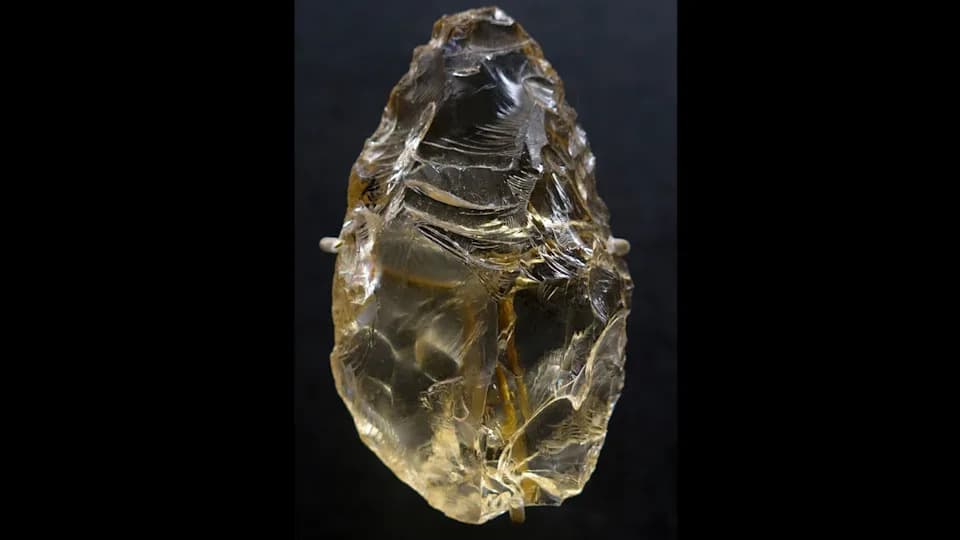
Archaeologists unearthed quartz tools at the site of Abri des Merveilles in France, revealing that Neanderthals had a sophisticated artistic sense. | Credit: Don Hitchcock 2015; donsmaps.com
Archaeologists first uncovered a striking translucent quartz scraper at the Abri des Merveilles shelter in Dordogne, southwestern France. Excavated in 1924 by a Harvard-affiliated team from the American School of Prehistoric Research led by George MacCurdy, the tool — along with six other rock crystal implements and numerous tiny flakes — challenged early 20th-century views of Neanderthals as purely utilitarian, brutish toolmakers.
a red-painted wooden mask in the shape of a stylized human face with human hair attached
What Was Found and Where
The object is made from microcrystalline quartz, commonly called rock crystal. Unlike the more typical flint or chert tools, rock crystal is translucent and can take on an attractive, glass-like appearance. MacCurdy described the notable scraper as transparent with a slight yellow tinge; he suggested it could have served as a combined scraper and point.
a green-tinted bronze helmet with gold figurines on the front
Evidence of On-Site Workmanship
Alongside the scraper MacCurdy documented six additional rock crystal pieces and many tiny production chips, indicating that at least some of the crystal tools were knapped at the shelter itself. The raw material may have been transported to the site naturally — possibly tumbled downstream from the headwaters of the Vézère, a tributary of the Dordogne — rather than quarried at the cave.
a human-like figurine made of white marble against a black background
Dating and Significance
Abri des Merveilles has not been dated by modern absolute methods, but stratigraphic context, associated tool types and the presence of a Neanderthal molar place the assemblage broadly between about 45,000 and 80,000 years ago. For MacCurdy and many later scholars, the choice and careful working of rock crystal suggested that Neanderthals appreciated the visual qualities of materials as well as their practical properties.
"We are accustomed to think of Neandertal man as devoid of the artistic sense," MacCurdy wrote in PNAS (1931), "but he had an eye for beauty of form and color... Neandertal man must also be given credit for discernment of beauty and quality of the material employed in his industry."
MacCurdy's interpretation was notable because early 20th-century depictions of Neanderthals — heavily influenced by Marcellin Boule's 1909 analysis of an arthritic skeleton from La Chapelle-aux-Saints — often emphasized brutishness. Subsequent archaeological discoveries and paleogenetic evidence have revealed far more complex Neanderthal behavior and interactions with modern humans.
Today the Abri des Merveilles rock crystal scraper is part of the collection at France's National Archaeological Museum, which highlighted the object as its "Object of the Month" in September 2025. The find remains an evocative example of deliberate material choice and skilled workmanship among Neanderthals, and it continues to inform debates about aesthetics and cognition in Middle Paleolithic communities.
Help us improve.





















