National surveys conducted in 2022, 2023 and 2025 indicate that a majority of Americans perceived Dr. Anthony Fauci as supporting prolonged school closures during the 2020–21 school year. Those who believed Fauci favored extended shutdowns were significantly more likely to judge returning to school as risky even after vaccines became widely available. A 2025 experiment found that telling Democrats Fauci opposed year-long closures substantially increased their likelihood of judging the policy wrong, suggesting leader cues often outweighed empirical evidence on learning loss.
Opinion: National Surveys Found Most Americans Viewed Fauci As The 'Dr. No' On Reopening Schools — And That Perception Mattered
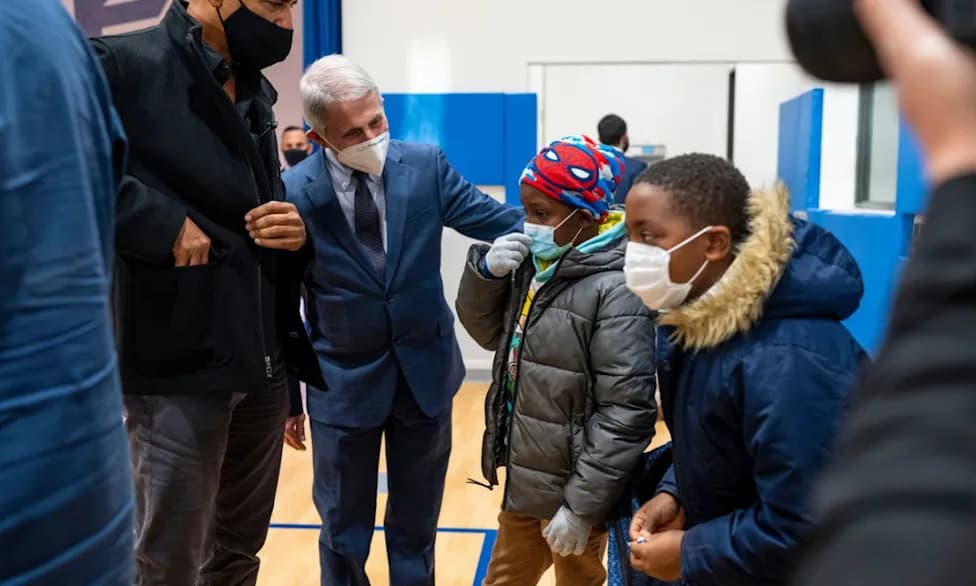
Dr. Anthony Fauci's recently released diaries have reopened the debate about whether he should shoulder responsibility for the widespread school closures during the COVID-19 pandemic. Critics have highlighted diary passages describing conversations with New York City Mayor Bill de Blasio just before the city's 2020 shutdown. But that argument collapses two separate questions: Fauci's support for initial, short-term closures and whether he advocated year-long, nationwide school shutdowns.
Fauci has consistently denied pushing for prolonged closures. In August 2020, as districts debated reopening, he told National Geographic that "there are areas and regions of the country ... where the level of infection is low enough that you really should try very hard to get the children back to school." Four years later he reiterated the point to CBS News: "I kept on saying, 'Close the bars, open the schools.' Initially to close it down was correct. Keeping [schools closed] for a year was not a good idea."
What the Surveys Measured
For a book on the politics of pandemic-era school closures, I fielded three national surveys that together reveal how Americans and local officials perceived the rationale for prolonged shutdowns and which public figures they believed backed them:
- November 2022 YouGov Cooperative Election Study panel of 1,000 U.S. adults (weighted to reflect the national adult population).
- December 2023 survey of 5,000 elected school board members (responses weighted to match district demographics nationwide).
- A 2025 YouGov survey using the same parameters as the 2022 adult study.
Key Finding 1 — Fauci Became The Public Face Of Prolonged Closures
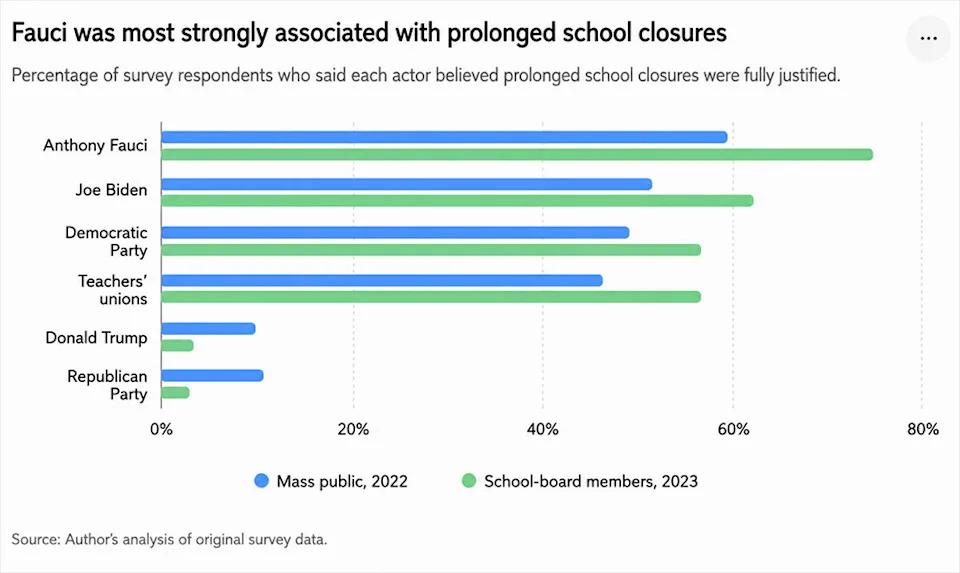
Respondents were asked whether they believed various leaders and organizations viewed keeping schools closed through the 2020–21 school year as strongly justified, somewhat justified, somewhat unjustified, or strongly unjustified. Overall, 57% of adults in the 2022 survey said they believed Fauci thought prolonged closures were strongly justified — a larger share than any other leader or organization listed. Among school board members, more than 70% said the same. This perception cut across partisanship: 63% of Democrats and 57% of Republicans held that view.
Key Finding 2 — Perceptions Of Fauci Linked To Elevated Risk Judgments
In the 2022 survey, respondents who believed Fauci supported extended closures were about twice as likely as those who thought he opposed them to say it remained too risky for a 10-year-old child to return to elementary school. They were roughly 40% more likely to say a vaccinated 50-year-old teacher still faced substantial risk. These are correlations, not proof of causation — Americans already worried about reopening may have assumed Fauci agreed with them — but they show how closely Fauci's public image had become linked to fears about returning to classrooms.
Key Finding 3 — Leader Cues Often Outweighed Evidence
To test whether voters weight empirical evidence or cues from public figures, I ran an experiment in the 2025 survey. All participants were reminded that many public schools remained closed after vaccines became available while bars and restaurants reopened. Respondents were then randomized into four groups: one received no additional information; the others were told that (a) research showed school closures caused lasting academic harm, (b) Donald Trump had opposed keeping schools closed, or (c) Fauci had publicly rejected year-long shutdowns.
Results: About two-thirds of Republicans said prolonged closures were the wrong decision regardless of information provided. Among Democrats, however, the information mattered. Only about one-third of Democrats who received only the basic reminder said the closures were wrong. Presenting learning-loss research changed that little. But when respondents were told that Fauci himself had rejected year-long closures, nearly half of Democrats concluded the policy had been wrong. In short, many respondents gave greater weight to a trusted leader's cue than to the empirical evidence.
Conclusion
Fauci may be accurate about his intended communications, but these surveys suggest most Americans — including many school board members charged with reopening decisions — heard something different. By becoming publicly associated with support for prolonged closures, Fauci's perceived stance shaped how people judged the risks of returning to school and influenced retrospective assessments of one of the pandemic's most consequential policy decisions.
Note: The findings describe perceptions and correlations; they do not establish that any single individual caused specific policy outcomes. The evidence does show, however, the power of elite cues in shaping public judgments about complex health-policy trade-offs.
Help us improve.