
Researchers have posted a preprint on arXiv describing a compact group of six galaxies observed about 1.2 billion years after the Big Bang that appear poised to merge into a single, massive galaxy. The light from the system took over 12 billion years to reach us, offering a rare view of galaxy assembly rather than a finished object. If peer review confirms the interpretation, this candidate proto-BCG could help explain how the universe formed very massive galaxies so early.
Astronomers Spot Six Galaxies Merging 1.2 Billion Years After the Big Bang — A Giant May Be Forming
Image: NASA
When the universe was barely a tenth of its current age, astronomers have identified a compact group of six young galaxies packed so closely together that they appear likely to coalesce into a single, enormous system. The finding comes from a new study posted to arXiv and was reported in La República; the paper is currently a preprint and awaits formal peer review.
What the Observations Show
The system dates to about 1.2 billion years after the Big Bang. Its light has traveled more than 12 billion years to reach modern telescopes, so researchers are effectively looking back at a construction site in the cosmos’ distant past. According to the study, six galaxies are interacting and crowding one another in a compact formation that suggests they will gradually merge into a single, far more massive galaxy over cosmic time.
What Is a Brightest Cluster Galaxy (BCG)?
BCGs are the ultra-massive galaxies that sit at the centers of galaxy clusters. Astronomers think BCGs grow through hierarchical merging: over billions of years, larger galaxies grow by accreting smaller neighbors. Rather than forming in one explosive event, they build up mass like a snowball rolling downhill — picking up companions along the way. The observed six-way system is presented as a candidate proto-BCG: it shows multiple components actively interacting and on a likely merger path, though the classification is not yet confirmed.
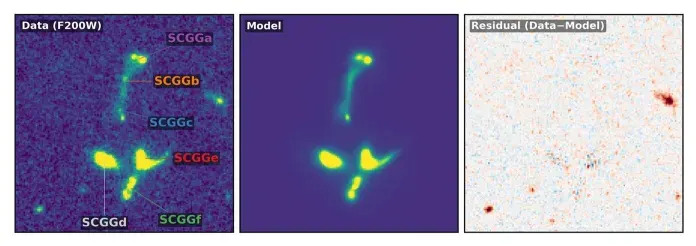
Image: Ronaldo Laishram et al., arXiv (2026)
Why This Candidate Matters
The discovery is notable because recent observations from the James Webb Space Telescope (JWST) and other instruments have repeatedly found surprisingly massive galaxies at earlier epochs than many models predicted — some as early as 540–770 million years after the Big Bang, and others near 1.4 billion years. Finding a compact, interacting group of six galaxies at ~1.2 billion years offers a rare glimpse of the assembly process itself rather than only the finished product.
If peer review supports the authors’ interpretation, this system could provide direct evidence for the hierarchical processes that build the universe’s most massive galaxies and might require adjustments to theoretical models of early galaxy formation.
Note: The result is based on a preprint posted to arXiv. Until the study undergoes peer review and independent confirmation, the merger interpretation and any BCG classification should be considered provisional.
Image credit: Ronaldo Laishram et al., arXiv (2026)
Help us improve.





















