
Ghana's government has agreed to extend the presidential term from four to five years and to lower the minimum age for presidential candidates from 40 to 35. Parliament's term will be adjusted to match the presidency, and presidential elections will be held in the first week of November to preserve a window before the January 7 inauguration. Two constitutional amendment bills are to be drafted by October 2026, and a national referendum on the changes is planned for 2027 with strict turnout and approval thresholds.
Ghana Agrees to Five-Year Presidential Term and Lowers Candidacy Age to 35
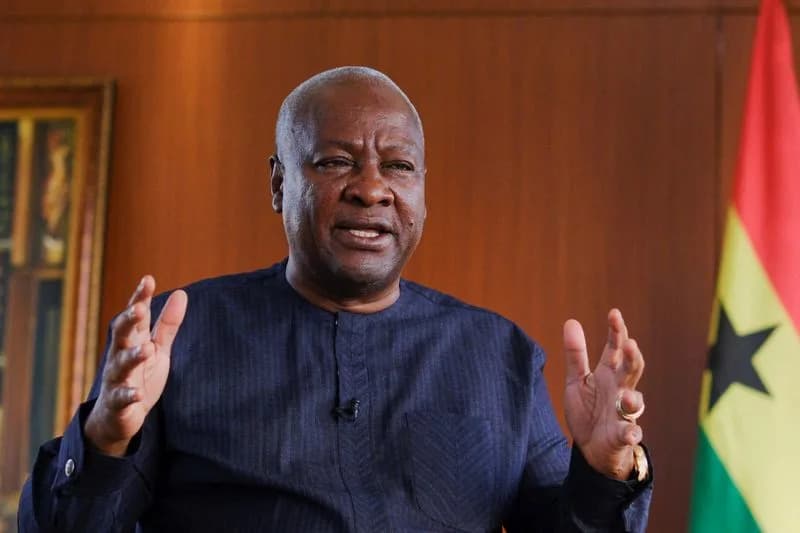
FILE PHOTO: Ghana's President-elect John Dramani Mahama, 66, speaks with Reuters journalists in his office after general elections, in Accra, Ghana, December 13, 2024. REUTERS/Francis Kokoroko/File Photo
ACCRA, July 30 (Reuters) - Ghana's government has accepted a recommendation to extend the presidential term from four to five years, Attorney General and Minister for Justice Dominic Awine said on Thursday.
President John Dramani Mahama set up a committee last year to review the 1992 constitution. The committee produced a series of proposals, some of which the government has now agreed to implement following its review.
Awine confirmed that Parliament's term would also be extended so it aligns with the new five-year presidential mandate. The government says the change is intended to give administrations more time to implement policies, arguing that the early months of a term are taken up by transition and the final year is dominated by election activity.
"The early months of every administration are consumed by transition matters, and the final year is largely consumed by elections,"
The government accepted in principle the committee's recommendation to lower the minimum age for presidential candidates. While the committee proposed reducing the minimum age to 30, the government has modified that recommendation and will lower the threshold from the current 40 to 35.
Officials also agreed that presidential elections should be scheduled in the first week of November to ensure a clear interval between voting and the January 7 inauguration.
Another committee will be established to draft two constitutional amendment bills, which the government expects to complete by October 2026. The bill addressing term changes must then proceed through the required legislative steps before being submitted to a national referendum in 2027.
Under the proposed referendum rules, at least 40% of registered voters must participate for the referendum to be valid, and at least 75% of votes cast must be in favour for the amendment to pass.
Reporting by Emmanuel Bruce; Editing by Anait Miridzhanian and Joe Bavier.
Help us improve.





















