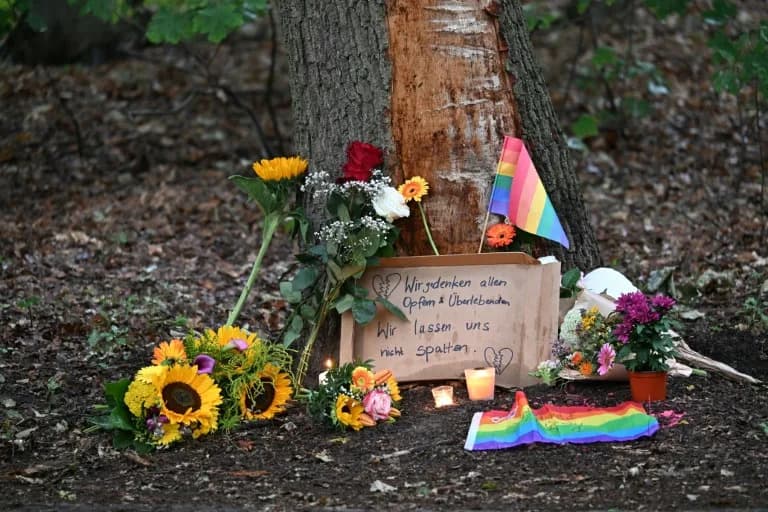
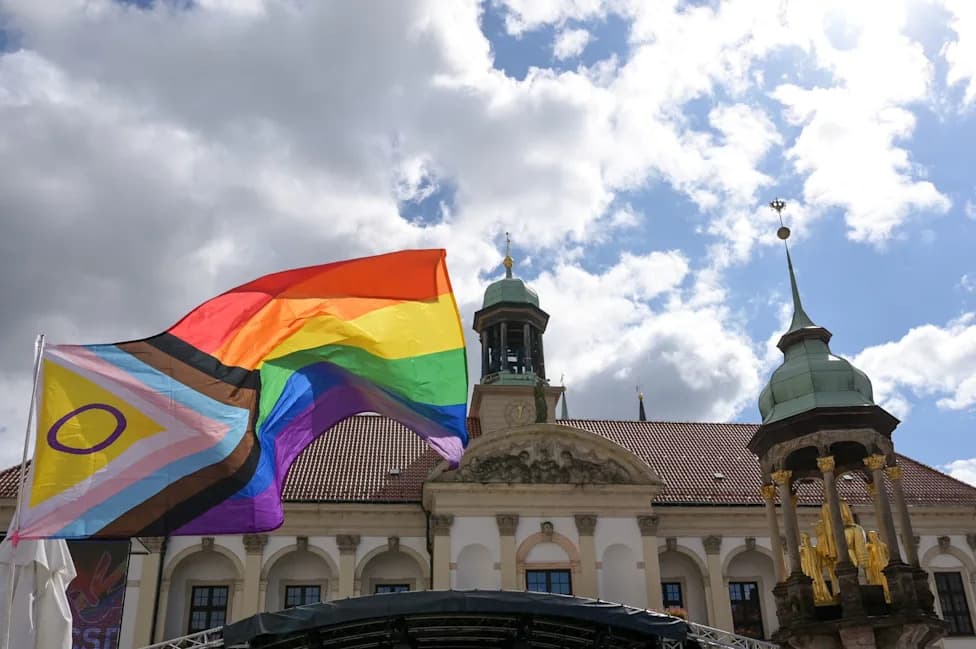
The author recounts surviving the van attack at Berlin’s Christopher Street Day, which left one woman dead and 29 wounded. The attacker, 21-year-old Abdul Ballout, had been on a federal "Red" watch list and reportedly attempted to join ISIS; authorities have labeled the incident a terrorist attack. The piece warns against letting grief be used to demonize Muslims or expand repressive policies, noting that recent data show most ideologically linked hate crimes against LGBTQ+ people in Germany come from the far right. The author concludes that, despite fear, solidarity with the queer community is the best response.
I Survived the Berlin Pride Attack — Don’t Let the Right Weaponize Our Grief
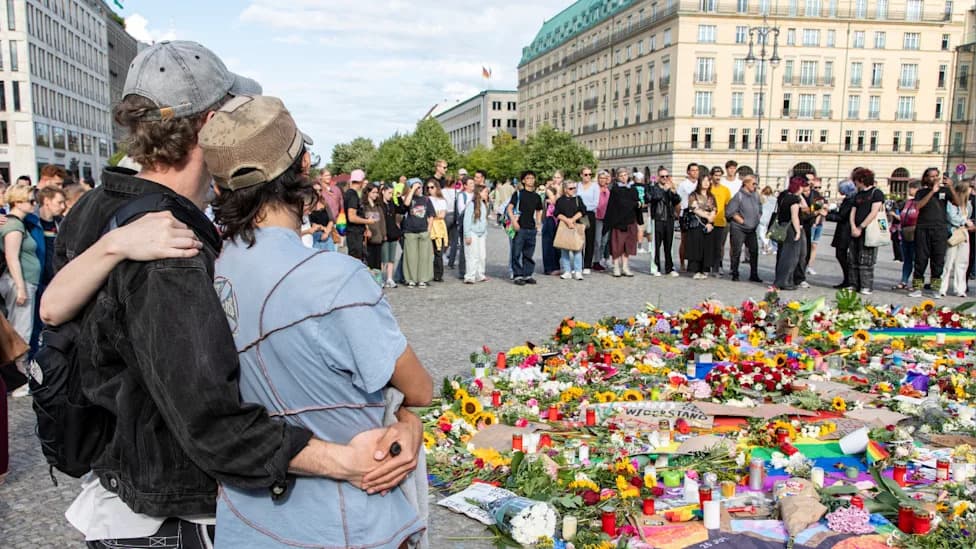
People stand beside a memorial of flowers and candles near Berlin's Brandenburg Gate after the Christopher Street Day attack.
Last Saturday in Berlin was bright and hot. I woke late and joined hundreds of thousands of people for Christopher Street Day (CSD), the city’s main Pride march. My boyfriend had worked a shift in Schöneberg, Berlin’s historic gayborhood, so I chose the big parade so we could spend the day together.
We only reached the Tiergarten — the parade’s finale in front of the Brandenburg Gate — after friends who had followed the route all day. The crowd there turns into a dense street party where movement becomes difficult. Just before 10 p.m., a van plowed into people near the park’s exit.
What Happened
According to reporting by Tagesspiegel and the Associated Press, the driver steered the vehicle into people leaving the finale, collided with a tree, then exited carrying a machete. One woman, a 65-year-old Polish citizen visiting Berlin with her daughter, was killed; 29 others were wounded, some seriously. After a daylong manhunt, officers shot and killed the attacker, identified as 21-year-old Abdul Ballout. Authorities say he had attempted to join the Islamic State in Syria and have classified the incident as a terrorist attack.
Known Failures — And Unanswered Questions
What felt especially disturbing was that the attacker was already on authorities’ radar. A joint investigation by Süddeutsche Zeitung and public broadcasters Norddeutscher Rundfunk and Westdeutscher Rundfunk revealed that a police camera opposite Ballout’s front door recorded him leaving at 8:58 p.m. — roughly an hour before the attack. A federal risk assessment in late May reportedly placed him in the highest danger category, labeled “Red,” and he was on a watch list.
How Grief Was Politicized
Within hours the attack was politicized. Some right-wing and conservative politicians framed the strike as proof of a widespread Islamist threat and pressed for harsher security measures. The far-right AfD demanded deportations; the center-right CDU criticized the Left for allegedly downplaying the danger. Berlin’s mayor declared Islamism the greatest threat to the queer community, and Chancellor Friedrich Merz vowed to protect the country’s freedom. Berliner CSD e.V., which organizes Pride, warned:
"We do not want this act to be used for political ends."The group also said Islamist terror must be named, but that rhetoric must not be turned into hatred of Muslims.
Why Weaponizing Grief Hurts
One radicalized young man committed a horrific act. But to treat that individual as a representative of an entire religion or community is wrong and dangerous. Monolithic thinking — reducing diverse people to a single category — fuels the cycles of violence we see again and again. I hugged queer Muslims in Berlin on Saturday; watching politicians convert one attacker into an indictment of everyone who prays is painful and unjust.
Personal Reflection
After the attack my boyfriend and I considered going to our favorite busy gay bar. Old fears resurfaced; I wrote about surviving the Pulse massacre in my 2021 book and avoided bars for months afterward. In the end I reached the same conclusion I did years ago: there is nowhere I would rather be than among my community. Violence is always a possibility, but solidarity matters more than fear.
Context And Data
It’s important to place this attack in a broader context. Federal Criminal Police Office statistics, cited by queer.de, report that hate crimes against LGBTQ+ people have more than doubled since 2022, and of the offenses investigators could tie to an ideology, 84% were committed by the political right. The Amadeu Antonio Stiftung recorded disruptions or attacks at 111 of 245 German Pride events in 2025, a record largely attributed to far-right agitators. These data show that, in recent years, far-right-driven threats have been a major source of violence against LGBTQ+ communities in Germany.
Conclusion
We must grieve the loss of life and comfort those who were harmed. But we must also resist the temptation to answer violence with collective punishment, expanded surveillance, or blanket attacks on entire communities. Turning grief into political ammunition is itself an act of violence. I will grieve, then return to defending decency: standing with queer people who oppose genocide, supporting Palestinian rights where I believe they are violated, defending trans people, and opposing fascists — with liberty and justice for all.
Opinion pieces reflect the author’s views. For submissions and feedback, visit Advocate.com/submit or email [email protected].
Help us improve.