NASA's Curiosity rover photographed an elongated rock in Gale Crater that resurfaced online after UFO blogger Scott C. Waring called it an "unexploded alien missile." JPL scientists say the feature is a wind‑carved rock and attribute sensational readings to pareidolia. Past viral examples — like the 2022 "doorway" on Mount Sharp and an orbital "monolith" — were natural formations, and upgrades to Curiosity plus future missions will likely produce more striking but context‑poor images.
Slender Martian Rock Fuels Viral 'Alien Missile' Claims — Experts Say It's Just Geology
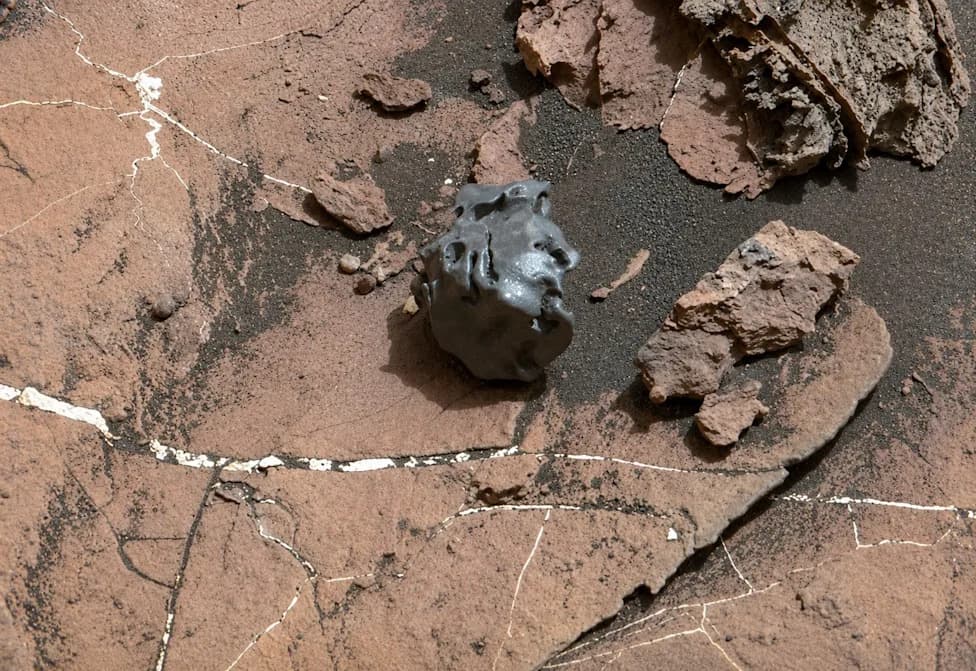
Image: NASA/JPL-Caltech/MSSS
A slender, elongated rock photographed by NASA's Curiosity rover in Gale Crater recently resurfaced on social media and was promoted by UFO blogger Scott C. Waring as an "unexploded alien missile." The image spread quickly, prompting renewed online speculation about ancient Martian warfare and advanced weaponry.
What Scientists Say
NASA Jet Propulsion Laboratory spokesperson Andrew Good addressed the photograph in a Snopes fact-check, explaining:
"It's a wind‑carved rock. We see a lot of odd shapes and textures in Martian rocks, usually due to them being sandblasted over eons into very smooth, swoopy shapes."Experts attribute the viral interpretations to pareidolia — the human tendency to perceive familiar objects, such as faces or man‑made items, in random patterns.
How Mars Makes Unusual Shapes
Billions of years of volcanic activity, meteorite impacts, sedimentation and relentless wind erosion have sculpted the Martian surface into forms that can appear strikingly regular or familiar. Processes that produce these shapes include:
- Wind abrasion that polishes and elongates rocks over long timescales.
- Cementation of fracture fills and sedimentary layering that can create stacked or columnar appearances.
- Image resolution and perspective effects from rover or orbiter cameras that exaggerate shape regularity.
Familiar Viral Examples
Similar episodes of misinterpretation include:
- 2022 "Doorway" on Mount Sharp — a natural bedrock fracture roughly 30 cm tall (about the size of a dog door).
- Orbital "Monolith" — a rectangular-looking boulder whose boxy appearance was amplified by low image resolution.
- Spiky Pillars and Layered Formations — features that resemble stacked chocolate cake but are actually sedimentary layers and cemented fracture fills studied for climate history.
Why This Will Keep Happening
Curiosity's recent software upgrades enable the rover to autonomously select scientifically interesting rock targets, increasing the number of unusual images returned to Earth. Upcoming higher-resolution instruments and planned sample‑return missions will likewise generate more visually striking yet context-poor photos that often reach social media before scientists can analyze them. That combination makes future cycles of speculation likely — and louder.
Bottom Line
To date, NASA has found no evidence of extraterrestrial life on Mars. What Curiosity and other missions have revealed is a planet with ancient, unusual geology that merits scientific study on its own terms. The dramatic visual appeal of many Martian rocks fuels sensational claims, but the explanations so far are grounded in well-understood planetary processes, not alien weaponry.
Help us improve.