
The private Link spacecraft sent by Katalyst to rescue NASA’s Swift telescope has experienced a thruster failure and entered an uncontrolled spin, disrupting communications. Engineers are working nonstop to recover Link so it can capture and raise Swift, which would otherwise re-enter this fall. NASA is funding the $30 million rescue, assembled in under a year, and Swift’s scientific observations remain suspended until stabilization.
Thruster Failure Spins Out Private Spacecraft Sent to Rescue NASA’s Swift Telescope
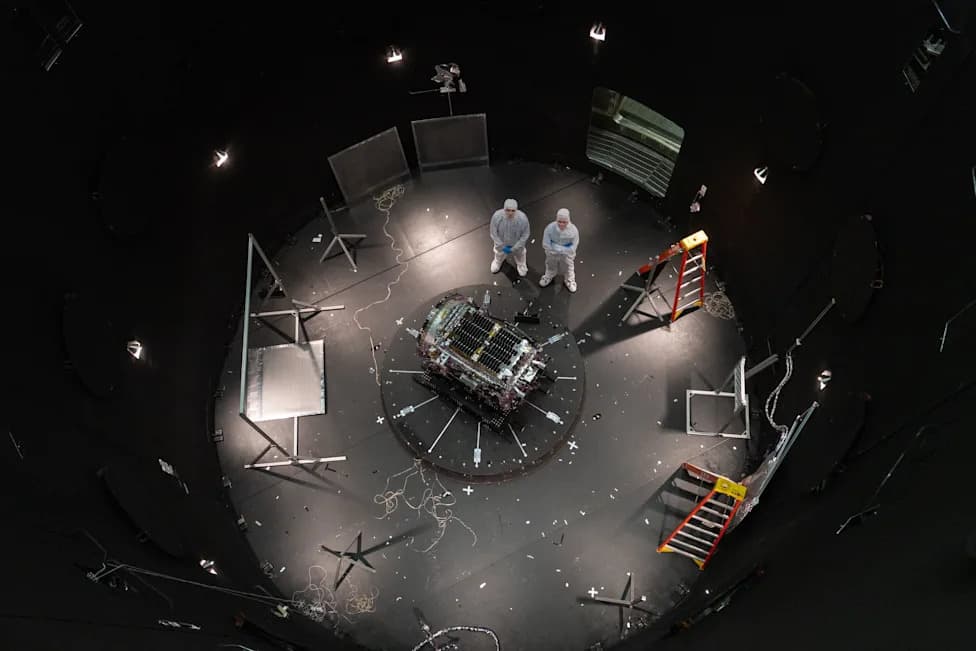
FILE - This photo provided by NASA shows Kieran Wilson, LINK's principal investigator, and Hunter Robertson, a space systems engineer, both at Katalyst Space, standing next to their spacecraft inside the SES (Space Environment Simulator) at NASA's Goddard Space Flight Center in Greenbelt, Md., April 17, 2026, ahead of thermal vacuum testing. (Sophia Roberts/NASA via AP, File)
CAPE CANAVERAL, Fla. — A private spacecraft dispatched to rescue NASA’s aging Swift telescope has suffered a thruster malfunction and gone into an uncontrolled spin, the mission developer said Tuesday.
Katalyst Space Technologies reported that its three-armed Link satellite began experiencing thruster problems over the weekend — roughly three weeks after its launch — and the spin is interfering with communications to the ground.
Engineers are working around the clock to stabilize Link so it can rendezvous with Swift, capture the telescope and boost it into a higher orbit. Without that intervention, Swift — launched in 2004 — is expected to re-enter Earth’s atmosphere this fall. NASA contracted the private rescue for $30 million, a mission plan assembled in under a year.
Swift has been descending faster than anticipated following recent increases in solar activity. Scientific observations are paused until the telescope is stabilized and lifted to a safer orbit.
Katalyst said Link's other major subsystems appear to be functioning normally and that the company remains cautiously optimistic about the mission's prospects.
"The mission remains active and we continue to believe that with these changes, Link has a viable path to rendezvous with Swift," Katalyst said in a statement.
Both Katalyst and NASA say they are committed to recovery efforts and will continue working to regain control of Link and complete the orbital boost if possible.
Help us improve.





















