A reanalysis of 89 major geological events over the past 260 million years finds a strong signal near a 27.5‑million‑year cycle and a weaker ~8.9‑million‑year rhythm. Michael Rampino (NYU) argues these diverse crises — extinctions, anoxic oceans, flood basalts and sea‑level swings — may periodically respond to shared long‑term drivers. Candidate mechanisms include changes in mantle convection, surface–interior feedbacks from orbital‑scale load shifts, and more speculative astronomical influences, though none is proven. Rampino stresses uncertainties in dating and incompleteness of the geological record and calls for further tests.
Hidden Rhythm of Catastrophe: Study Finds a Near 27.5‑Million‑Year Cycle in Earth's Biggest Geological Crises
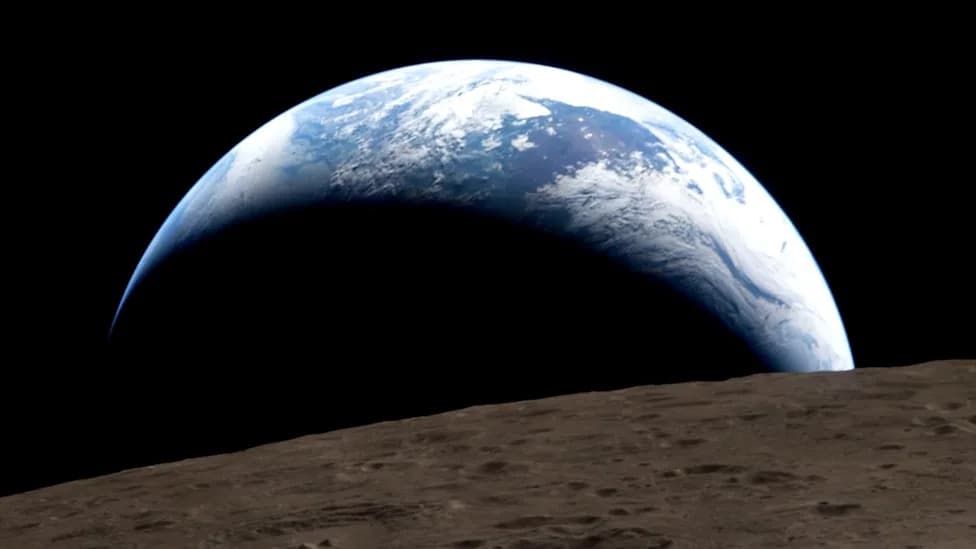
Earth seen from the Moon during the Artemis II mission. (NASA)
Mass extinctions, colossal volcanic eruptions and episodes when oceans lose most of their oxygen have long appeared as separate, catastrophic events in Earth history. A new reanalysis suggests many of those crises may follow a subtle, recurring tempo — a dominant cycle near 27.5 million years — that links diverse geological and environmental upheavals across deep time.
What the Study Revisited
In the paper published in Evolving Earth, New York University geologist Michael Rampino re-examined previously published datasets with updated geological timescales and contemporary statistical methods. He compiled 89 major events spanning roughly the last 260 million years and tested them for periodic signals. The events include marine mass extinctions, oceanic anoxic events, continental flood‑basalt eruptions, sea‑level fluctuations, terrestrial tetrapod extinctions, changes in seafloor‑spreading rates, and pulses of intraplate volcanism.
YouTube Thumbnail
Main Findings
The combined records show a dominant periodicity at about 27.5 million years, with a secondary, weaker cycle near 8.9 million years. Rampino emphasizes that he is not arguing for simple chains of cause and effect where one catastrophe directly triggers the next. Rather, these different systems — mantle, crust, oceans, climate and biosphere — might periodically respond to the same long‑term drivers operating over tens of millions of years.
Possible Drivers
Rampino explores several hypotheses, none of which is proven by the new analysis.

YouTube Thumbnail
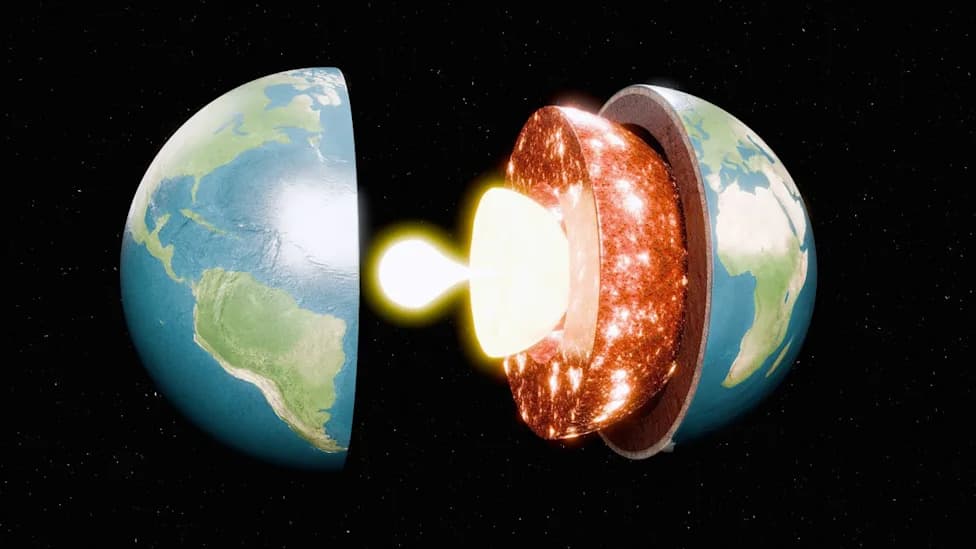
- Deep‑Earth Processes: Slow changes in mantle convection or episodic initiation of mantle plumes could modulate global volcanism, plate motions and mountain building. Over millions of years, such mantle behavior might trigger widespread environmental stress.
- Surface–Interior Feedbacks: Long‑term orbital variations and climate shifts rearrange water, ice and sediment across the planet. Those changing surface loads could subtly alter stress in the crust and upper mantle and, when summed over millions of years, influence tectonic or volcanic activity.
- Astronomical Influences: The Solar System oscillates above and below the Milky Way's mid‑plane. Rampino and others note that timings of some major upheavals cluster when Earth crosses the galactic mid‑plane — roughly every ~32 million years in some reconstructions — and that such crossings might perturb comet reservoirs or otherwise correlate with terrestrial crises. However, the periodicities discussed in the paper (~27.5 Myr vs. ~32 Myr) are not identical and the relationship remains uncertain.
- Speculative Ideas: More controversial notions include periodic capture of a tiny fraction of dark matter near the galactic plane, which some have proposed could generate minute amounts of internal heat over millions of years. There is currently no direct evidence supporting this mechanism.
What About Asteroid Impacts?
Large asteroid impacts are considered separately. They were not included in the main statistical test of the 89 events, although the ages of several large craters broadly overlap times predicted by the proposed rhythm. Rampino treats those correspondences as intriguing but does not assert a causal connection.
Caveats and Next Steps
Detecting robust periodic signals across hundreds of millions of years is challenging. The geologic record is incomplete, age uncertainties grow with time, and statistical tests can produce apparent cycles that weaken as datasets expand. Rampino frames his result not as a definitive answer but as a persistent ~27.5‑million‑year signal that has survived decades of updated timescales and methods.
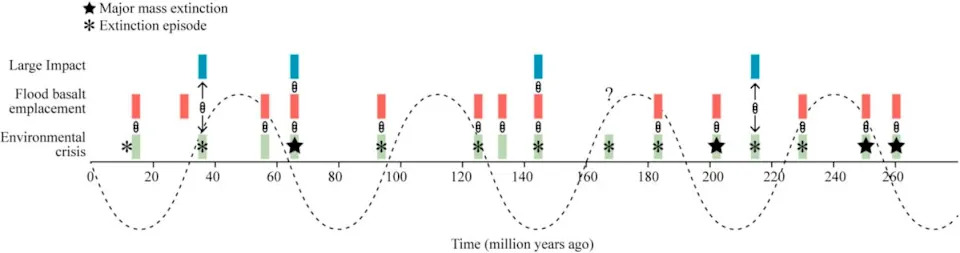
The best-determined ages of geological events (red bars), environmental crises (green bars), and mass extinctions (asterisks and stars) over the last 260 million years appear to align with Earth crossing the Galactic mid-plane (dotted line) about every 32 million years. (Rampino,Evolving Earth, 2026)
Confirming or refuting this pattern will require independent tests: expanded and better‑dated event catalogs, transparent statistical protocols, and mechanistic modeling that could connect plausible drivers to the observed rhythms. If validated, the result would shift how we view Earth's major upheavals — from isolated catastrophes to recurring expressions of long‑term, planet‑scale processes.
"While these ideas are still mostly outside the mainstream of current geological thinking, they could be the first steps in an important conceptual breakthrough," Rampino writes, urging further scrutiny and debate.
Figure note: Rampino's figures indicate that some well‑dated events cluster near times when Earth crosses the Galactic mid‑plane (dashed lines) at roughly ~32‑million‑year intervals in certain galactic models; this is similar but not identical to the ~27.5‑million‑year cycle identified in the statistical analysis.

Subscribe to ScienceAlert's free fact-checked newsletter
Bottom line: The reanalysis strengthens evidence for a recurring geological tempo near 27.5 million years, but the causes remain uncertain and controversial. The idea deserves further testing with improved dates, broader datasets and models that can plausibly link drivers to observed patterns.
This article was originally fact‑checked and edited by Clare Watson. If you spot an error, please report it to the publisher.
Help us improve.