
The conflict that began in late February has left about 6,000 seafarers stranded on hundreds of ships in the Gulf after attacks and Iran’s intermittent closure of the Strait of Hormuz. Crews face exhaustion, dwindling supplies and constant missile and drone threats; more than a dozen mariners have been killed. A temporary IMO corridor in June freed roughly 130 ships and 3,000 sailors, but attacks resumed and transits fell back to single digits. Recruitment for relief crews is faltering despite high pay offers, raising concerns about the future safety and sustainability of merchant shipping.
6,000 Seafarers Stranded as Attacks Close Strait of Hormuz and Shipping Halts
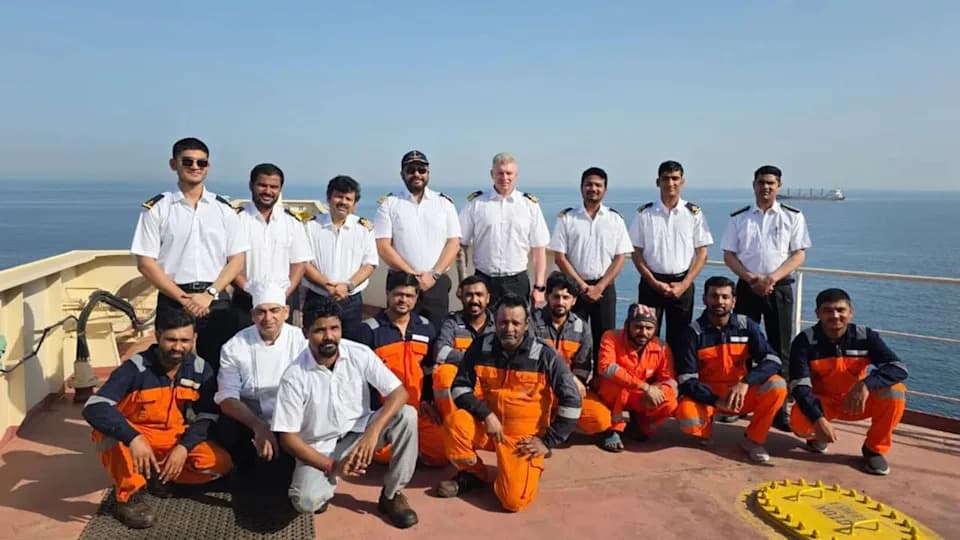
Captain Chopra, standing fourth from left, and his crew. | Credit: Fleet Management Limited
About 6,000 seafarers remain stuck aboard hundreds of tankers and cargo ships in the Gulf after attacks and Iran's intermittent closure of the Strait of Hormuz disrupted maritime traffic that normally carries roughly 20% of the world's oil and liquefied natural gas.
Background: Why the Gulf Is Locked Down
The Strait of Hormuz, a narrow channel between Iran and Oman that is about 21 miles at its narrowest point, links exports from Saudi Arabia, Kuwait, Bahrain, Qatar, Iraq and Iran to global markets. Before the conflict, more than 100 ships transited the strait daily. Since late February, missile and drone strikes and Iran's declaration of restricted passage have ground traffic to a halt; at the height of the disruption, as many as 20,000 mariners and roughly 2,000 ships were delayed.
Life Onboard: Stress, Shortages, Fear
Sailors from the Philippines, India, Bangladesh, Pakistan, Ukraine and other countries report constant fear and exhaustion. Crews are often aboard vessels loaded with highly explosive cargoes and have watched missiles and drones pass overhead. More than a dozen mariners have been killed in strikes attributed to both Iran and the United States.
"It’s as if we are trapped in a pond. There’s only one way out," Captain Shafiqul Islam told the BBC, describing a ship carrying about 37,000 tons of fertilizer bound for South Africa.
Long days, heat, boredom and limited communication take a heavy toll on mental health. Captains keep crews together, tighten access to knives and sharp objects, and encourage group activities. Supplies of food, water and medicine are running low on many vessels; satellite phone time is limited and costly, so calls home are infrequent but deeply valued.
Costs, Scams and Supply Problems
Supply boats from nearby ports deliver provisions, but prices have surged and sailors report opportunistic price gouging. One engineer said the cost for 180 tons of water jumped from about $2,000 to roughly $11,000. Some tanker operators reportedly paid up to $2 million for transit rights on individual ships, and fraudsters impersonating members of the Revolutionary Guard have lured companies into wiring cryptocurrency for fake "safe passage" guarantees.
Brief Relief—and Renewed Risk
In late June, a short-lived ceasefire and a corridor organized by the U.N.’s International Maritime Organization (IMO) allowed about 130 ships and 3,000 sailors to exit via northern and southern lanes that avoided mined central areas. The evacuation ended after Iran struck a tanker off Oman's coast that was not part of the escorted group. When hostilities resumed earlier this month, daily transits dropped back to single digits.
Desperate Escapes and Growing Hesitation
Some seafarers have taken extraordinary steps to get home, borrowing money to travel overland to neighboring countries and fly out. But many Gulf states have curtailed short-term shore passes for security reasons, complicating returns. Shipping companies are struggling to find replacement crews despite offering monthly pay of up to $30,000, raising concerns that fewer mariners will be willing to work in high-risk routes.
Wider Context
The Gulf crisis follows earlier disruptions: seafarers were stranded during the COVID-19 pandemic, drone attacks became more common in the Black Sea after Russia's 2022 invasion of Ukraine, and Iran-aligned Houthi forces recently declared an embargo on Saudi shipping in the Red Sea. Together, these developments have increased risks for global supply chains and highlighted how seafarers’ sacrifices are often taken for granted.
IMO Secretary-General Arsenio Dominguez warned the conflict has exposed vulnerabilities in the maritime system: "People take seafarers for granted, they don't value them." The evolving security environment threatens crew welfare, commercial flows and global commodity markets until safe, reliable passage is restored.
Help us improve.





















