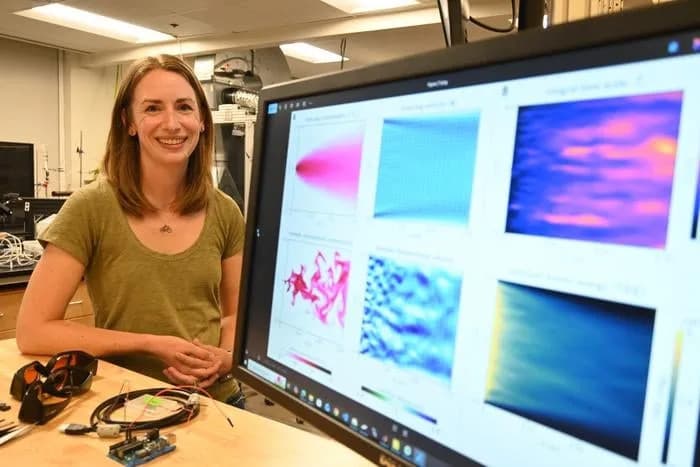
Researchers at New York University revisited Richard Feynman's reverse-sprinkler puzzle by testing seven unconventional sprinkler geometries. Their PNAS study (published July 13) rules out two leading explanations — Mach's angular-momentum account and Feynman's nozzle-pressure idea — and instead identifies momentum flux at the central hub as the primary mechanism. The team plans simulations to generalize the model and says the insight could inform turbine and energy-harvesting design.
Feynman's Reverse-Sprinkler Puzzle Revisited — NYU Team Pins Rotation on the Central Hub
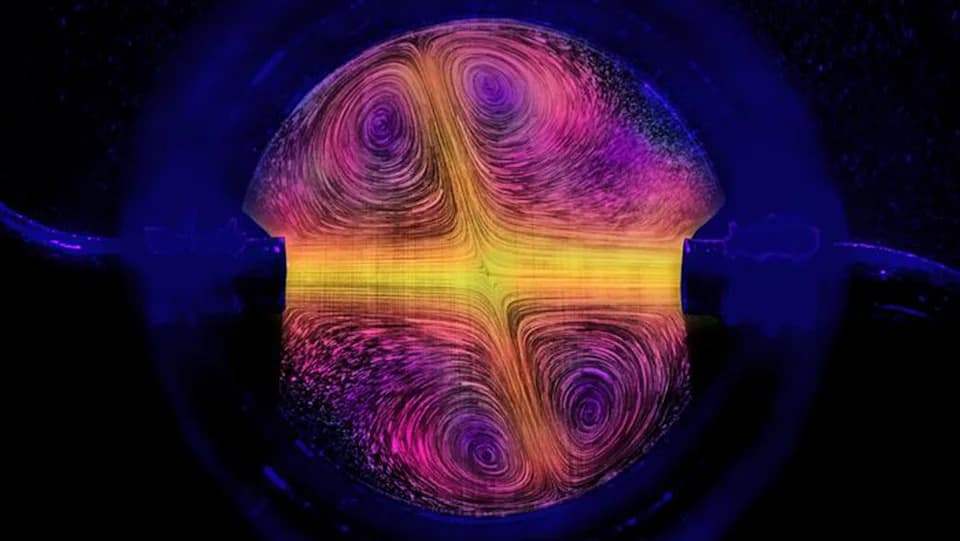
This photo captures the flows coming into the reverse sprinkler, as visualized using particles and false colors. | Credit: NYU's Applied Mathematics Laboratory
Richard Feynman loved playful physics puzzles, and one of his oddest experiments — the reverse sprinkler — has confounded researchers for decades. The puzzle is simple to state but fiendishly subtle: if a lawn sprinkler is put underwater and made to suck water in instead of spraying it out, which way does it rotate, if at all?
Feynman himself reported a brief tremor and then almost no motion in a glass device he built as a graduate student, and later experiments have produced every possible outcome depending on experimental details. In an effort to settle competing explanations, a team led by applied mathematician and experimental physicist Leif Ristroph at New York University designed a set of deliberately unusual sprinklers and measured how they responded when run forward and in reverse. Their study was published in PNAS on July 13.
What the Teams Tested
Two leading explanations dominated the debate. One, going back to Ernst Mach, argued that the angular momentum carried by fluid swirling inside the arms must be balanced by opposite rotation of the sprinkler body. The other, inspired by Feynman's own reasoning, emphasized local pressure and suction at the outer nozzles.
To force a decisive test, Ristroph's group built seven "silly" sprinkler geometries: S-shaped nozzles, arms that spiral several times to maximize internal fluid angular momentum, arms bent the opposite way, and designs with counter-bends at the nozzle tips. The goal was to see whether changing the internal angular momentum or the nozzle geometry would change the device's rotational response.
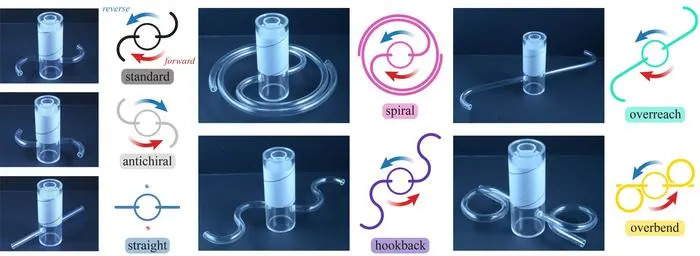
The sprinkler designs studied, with the observed rotation direction in the forward (red arrow) and reverse (blue) modes. | Credit: NYU's Applied Mathematics Laboratory
Key Findings
Across three independent measurement methods and all seven designs, the results were clear: neither Mach's angular-momentum account nor Feynman's nozzle-centered pressure explanation alone predicted the observed behavior. The spiral-armed device — which carried much more angular momentum in the inflow — produced almost no extra rotation, contradicting the Mach-style expectation. Likewise, flipping nozzle bends did not reverse the rotation as a pure pressure-suction model would predict.
'We were forced to say, "Feynman and followers, you guys are off,"' Ristroph told Live Science.
Instead, the data point to what the authors call a momentum-flux mechanism concentrated at the sprinkler's central hub. Incoming flows from the arms collide and swirl where the arms meet; that internal flux of angular momentum is reacted against by the solid structure of the hub, producing the net torque. In short, a reverse sprinkler behaves like an 'inside-out' forward sprinkler: the same core physics acts at the opposite ends of the arms.
Who Helped Make It Happen
Ristroph credited Jesse Smith, who completed his PhD at NYU while working on the project, a small team of Ristroph's students, and longtime collaborator Brennan Sprinkle, a computational-fluid-dynamics expert at the Colorado School of Mines, for key contributions.
Next Steps and Real-World Relevance
The team is now developing numerical simulations to test whether the momentum-flux model holds across a broader range of flow conditions and hopes to derive it from first-principles fluid-dynamics equations. Beyond the curiosity value, the findings could inform the design of turbines and devices that convert curved-channel flows into torque — potentially improving ways to harvest energy from wind and water.
Photo caption: Flow visualization of the reverse sprinkler using particles and false colors. Credit: NYU Applied Mathematics Laboratory.
Help us improve.