
Blue Origin's New Glenn was destroyed in a May 2026 hot-fire test at Cape Canaveral after a first-stage anomaly produced a large explosion; no one was injured. CEO Dave Limp says investigators are working and the company aims to return New Glenn to flight "this year," though he did not confirm a lunar mission. The next launch is more likely to be a lower-risk low-Earth orbit flight — possibly deploying Amazon Leo satellites — while engineers adapt operations to surviving facilities and probe the cause of the anomaly.
After New Glenn’s Cape Canaveral Explosion, Can Blue Origin Still Reach the Moon This Year?
Miguel J. Rodriguez Carrillo/Getty Images
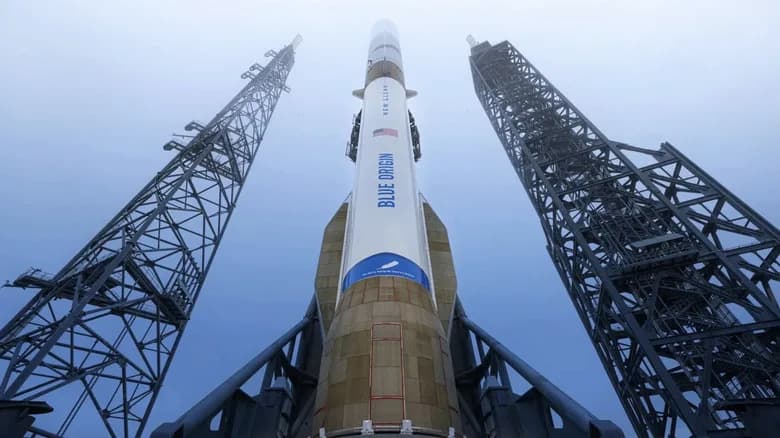
Blue Origin suffered a major setback in May 2026 when a hot-fire test at Cape Canaveral produced a dramatic explosion that destroyed a New Glenn rocket and damaged pad equipment. No personnel were injured, but the anomaly in the rocket's first stage produced a large fireball and significant damage to some launch infrastructure.
What Happened
During a hot-fire test — when engines are ignited while the vehicle remains secured to the pad — an anomaly in New Glenn’s first stage caused a sudden, spectacular fireball. The blast destroyed the tested vehicle and damaged the lightning tower, transporter-erector, and hydraulic cylinders used to raise and secure the rocket. Several nearby facilities, including the tank farm, integration facility (IF), vehicle access tower, and water tower, escaped major harm.

Blue Origin
Blue Origin’s Response
CEO Dave Limp said the company is investigating the root cause and that the mission team is aiming to return New Glenn to flight "this year." Limp declined to confirm whether the next launch would be a lunar mission. He also explained that engineers have identified ways to adapt launch operations to the surviving infrastructure to avoid a lengthy pad rebuild.
What The Next Flight Might Be
Absent an explicit Moon mission announcement, the next New Glenn flight is more likely to target low-Earth orbit (LEO). A lower-risk LEO mission — for example, deploying internet satellites for Amazon Leo (formerly Project Kuiper) — would let Blue Origin further validate New Glenn before committing a high-value lunar payload.

Tinseltown & Press Connect/Shutterstock
Outlook And Challenges
New Glenn is still relatively unproven, with only a few flights completed to date. Blue Origin has another New Glenn stack inside the integration facility, including the first stage named Never Tell Me The Odds, which has flown twice and remains intact. Returning to flight will hinge on the speed and findings of the investigation: engineers must identify the cause of the anomaly and implement reliable fixes before any high-profile missions can proceed.
Why This Matters
Rapidly restoring New Glenn to service is important for Blue Origin’s ambitions to compete for multi-billion-dollar lunar contracts, satellite launches and space infrastructure work. The incident also drew public reactions from industry peers; SpaceX CEO Elon Musk posted on X: "Most unfortunate. Rockets are hard." The history of rocket development shows that setbacks are common during maturation — but fixes and rigorous testing are essential for long-term success.
Bottom line: Blue Origin aims to fly New Glenn again this year, but whether that flight will be to the Moon or to low-Earth orbit depends on the investigation’s findings and how quickly any issues can be resolved.
Help us improve.





















