
The Wall Street Journal reports that satellite images from Planet Labs and Airbus show Iran has rebuilt military and naval sites hit by US and Israeli strikes far faster than expected. Images document re-excavated tunnel entrances near Kangavar, partial reconstruction at a Caspian Sea shipyard, and renewed activity at bases in Dezful and Kermanshah. Analysts warn many strikes collapsed only surface entrances, leaving underground stockpiles intact, while moves to store centrifuges inside Natanz's Pickaxe Mountain raise concerns about preserving enrichment capacity.
Satellite Images Show Iran Rebuilding Bombed Missile Bases Far Faster Than Expected
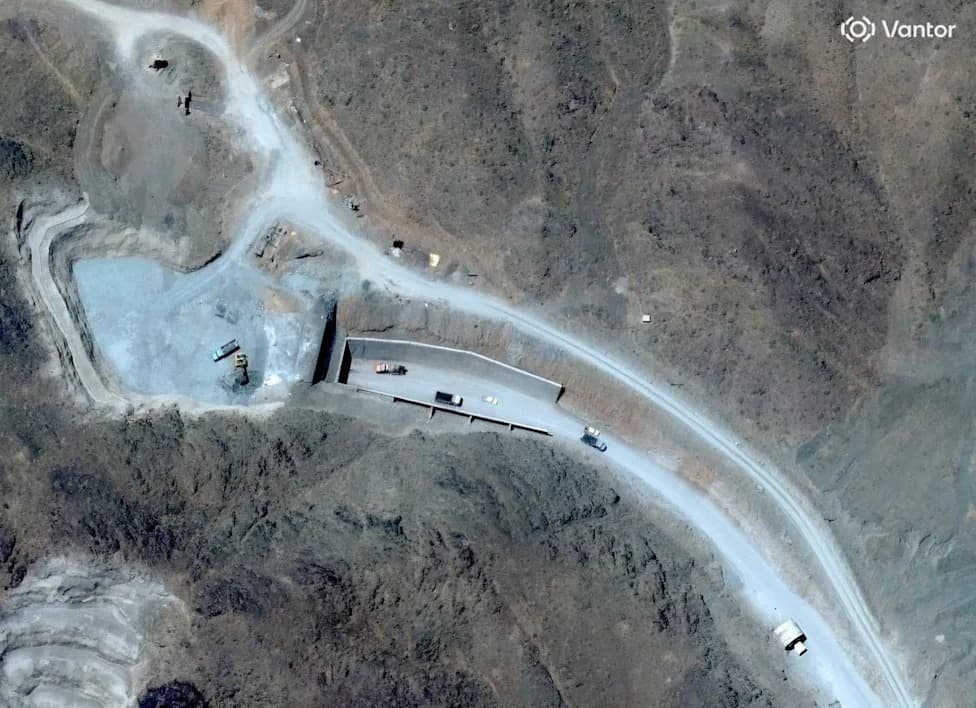
A satellite view shows vehicles at an entrance to Pickaxe Mountain tunnels, of the of the Natanz nuclear facility, near Natanz, Iran, June 21, 2026. (photo credit: VANTOR/HANDOUT VIA REUTERS)
Satellite imagery and expert analysis indicate Iran has reconstructed military infrastructure damaged by US and Israeli strikes much faster than analysts anticipated, The Wall Street Journal reports. Imagery from Planet Labs and Airbus, alongside assessments from intelligence and military sources, document renewed excavation, repaired roads and bridges, and partial rebuilding at shipyards and industrial sites.
Evidence From Multiple Sites
In western Iran near Kangavar, Planet Labs images from March showed two tunnel entrances and an adjoining access road that had been damaged in earlier strikes. Weeks later, Airbus imagery reportedly showed those entrances freshly excavated and a paved road where there had been destruction.
Planet Labs imagery from early July also indicated partial reconstruction at a shipyard in Bandar Anzali on the Caspian Sea, a site linked to the Islamic Revolutionary Guard Corps (IRGC). In March, the Israel Defense Forces (IDF) said it had struck multiple naval targets in the Caspian Sea, destroying dozens of vessels, including missile boats and a corvette.
Underground Facilities and Tunnel Networks
The Wall Street Journal reports that many strikes appear to have collapsed only surface-level tunnel entrances rather than destroying underground facilities themselves. Satellite images of a missile complex in Dezful—struck in June 2025 and again in March 2026—showed entrances that had been buried after attacks. Airbus footage taken three months later reportedly showed Iranian personnel excavating multiple tunnel openings at the site. Similar excavation and repair activity was observed at a base in Kermanshah.
Former IDF air defense chief Brig.-Gen. Ran Kochav told The Wall Street Journal:
"They refilled their stockpiles. They have very impressive industrialization and reconstruction capabilities."
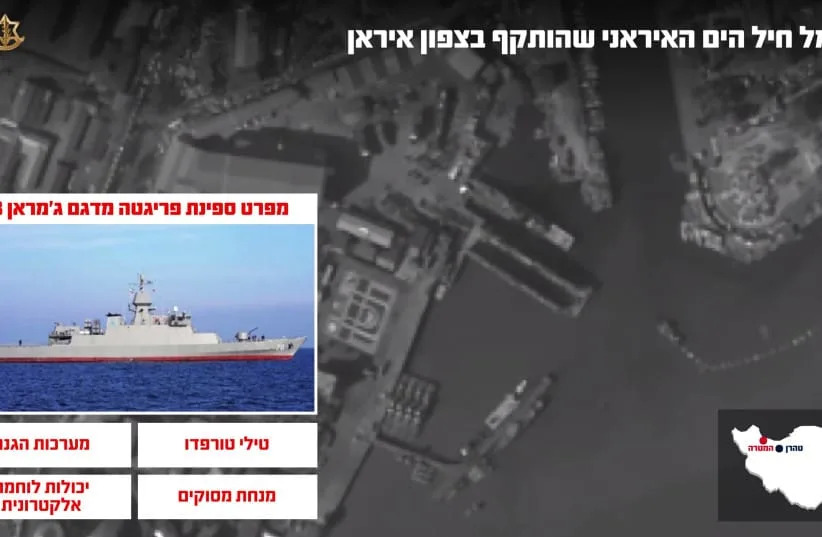
IDF GRAPHIC detailing Iranian Navy targets struck in the Caspian Sea. (credit: IDF SPOKESPERSON'S UNIT)
Industrial Sites and Missile Parts
Satellite imagery cited in a King’s College London report showed partial rebuilding at Raja Shimi Industries near Tehran, a facility reported to be involved in missile-component production. Jim Lamson, a visiting research fellow at King’s College London and a former CIA analyst who authored the report, said facilities that produce advanced components such as carbon-fiber parts could take months or years to rebuild, though he cautioned Iran may have stockpiled such components in underground locations.
Nuclear Moves: Centrifuges Moved Underground
The Wall Street Journal also reported, citing Israeli and US officials, that Iran transferred thousands of uranium-enrichment centrifuges into deep underground facilities inside Natanz’s Pickaxe Mountain last fall. Those moves followed the 12-day Israel-Iran conflict in June 2025, during which US and Israeli strikes hit several of Iran’s main nuclear sites in an operation the US called "Midnight Hammer." US and Israeli officials have said moving centrifuges underground raises concerns that Tehran is working to preserve enrichment capabilities even in the face of large-scale attacks.
Implications
Analysts warn that rapid surface repairs and the existence of underground facilities make it harder to permanently degrade Iran’s missile and nuclear-related capabilities. Reopening buried tunnel entrances and reconstructing industrial sites can restore operational capacity quickly, while relocating sensitive equipment underground increases resilience against future strikes.
Sources: The Wall Street Journal, Planet Labs, Airbus, Israel Defense Forces, King’s College London.
Report contributors: Tzvi Jasper and Idan Kweller.
Help us improve.





















