The NTSB's preliminary report says a false cockpit alert and air traffic controller confusion led to a close call at Boston Logan on June 20. American Flight 3161 paused its takeoff after an eight-second error message, then resumed 23 seconds later; Delta Flight 2351 executed a go-around. The jets came within about 670 feet with 318 people aboard. Cockpit voice recorder audio had been overwritten; flight data recorders are under analysis and a probable cause will be determined after the full investigation.
Near Miss at Boston Logan: NTSB Says False Cockpit Alert and Controller Confusion Put Two Jets Within 670 Feet
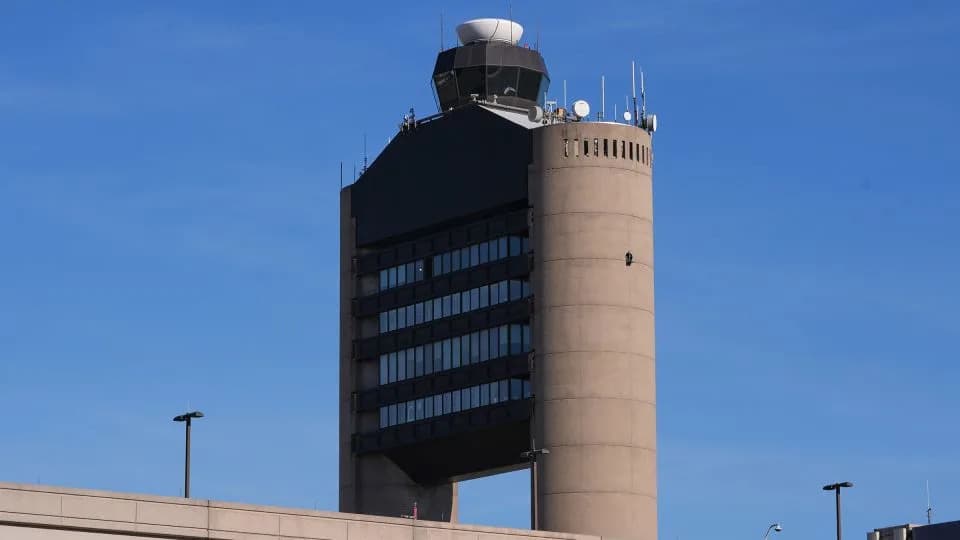
The control tower at Logan Airport in Boston Massachusetts, on December 9, 2025. - Charles Krupa/AP/File
The National Transportation Safety Board (NTSB) says a false cockpit alert and controller confusion led to a close call between two airliners at Boston Logan Airport on June 20.
Delta Air Lines Flight 2351, a Boeing 737, was cleared to land on Runway 33L behind a small general aviation aircraft. A little more than a minute later—and before the Delta jet touched down—American Airlines Flight 3161, an Airbus A319, was cleared to depart from the intersecting Runway 27.
The American A319 began its takeoff roll but stopped after about eight seconds when the crew received an error message in the cockpit. After rechecking systems and concluding the alert was a false alarm, the crew resumed acceleration 23 seconds later and continued toward the runway intersection.
The Delta crew observed the developing conflict and executed a go-around, circling the airport before landing safely. The American crew saw the other jet take evasive action and completed their departure. At the closest point, the two jets—carrying a combined total of 318 people—were approximately 670 feet apart, according to the NTSB.
Controller Actions and Tower Warnings
The air traffic controller told investigators he had seen the American flight start its takeoff roll, then shifted attention to the small aircraft to ensure it vacated the path of the arriving Delta flight. When an anti-collision alarm sounded in the tower, the Delta crew had already begun evasive action and the controller later said he "recalled feeling confused." He also reported that, unlike his usual practice of tilting paper flight strips to indicate clearance, the American flight strip had not been slanted.
"American 3161 where are you going?" the controller is heard asking in ATC audio. The pilot replies, "You cleared us to take off."
The NTSB report also notes that airport stoplights that could have warned the American flight extinguished after the small plane landed and did not illuminate again until the Delta jet was on final approach. Neither crew reported receiving a cockpit collision warning.
Investigation Status
Investigators requested the cockpit voice recorders (CVRs), but those devices retain only the most recent two hours of audio; by the time the NTSB requested them, the close-call audio had been overwritten. The flight data recorders, which preserve data for a longer period, captured systems information from the event and are being analyzed by the NTSB. The board will determine the probable cause when the investigation concludes, a process that typically takes one to two years.
Safety Context
The preliminary report highlights how a combination of human factors (controller workload and procedural variation) and transient system alerts can create high-risk situations even when technical collision warnings do not trigger. The NTSB's final findings may identify recommendations to reduce the risk of similar incidents.
Help us improve.