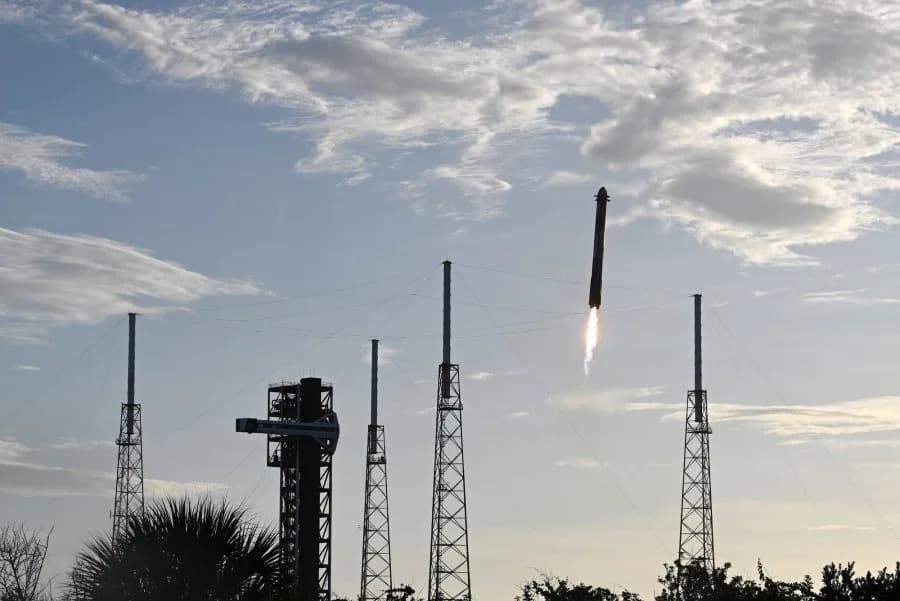
NASA has moved the six-satellite SunRISE heliophysics mission from ULA’s Vulcan Centaur to SpaceX’s Falcon Heavy after a recent Vulcan solid-rocket-booster anomaly prompted a Space Force pause on national security flights. SunRISE will fly ~22,000 miles above Earth in a 10-mile X formation, using 10-foot antenna booms to monitor fast solar radio bursts. The mission’s data will refine space weather prediction models and help improve mitigation strategies for satellites and crewed missions.
NASA Moves SunRISE From ULA Vulcan Centaur To SpaceX Falcon Heavy After Vulcan Booster Anomaly
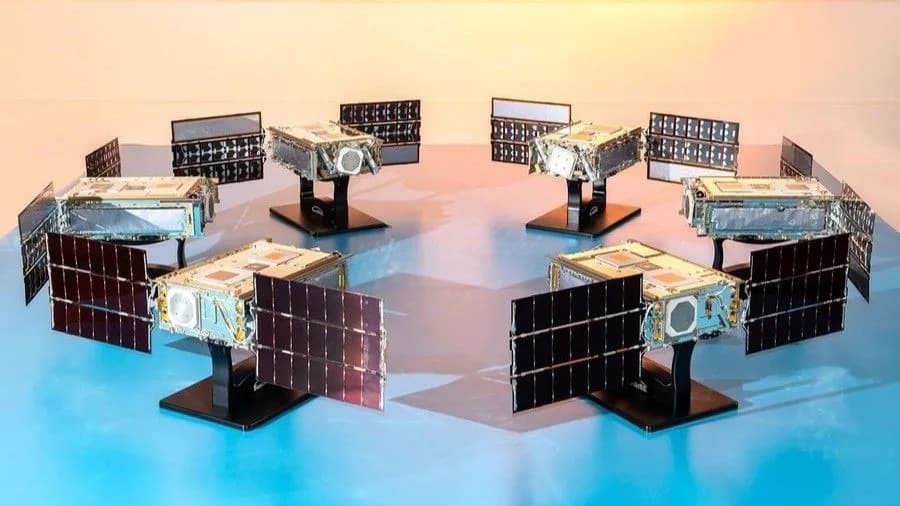
NASA's SunRISE mission, which consists of six small satellites, will now fly on a SpaceX Falcon Heavy rocket rather than a ULA Vulcan Centaur. | Credit: Space Dynamics Laboratory/Allison Bills
NASA has reassigned the Sun Radio Interferometer Space Experiment (SunRISE) — a six-satellite heliophysics mission — from United Launch Alliance's (ULA) Vulcan Centaur to SpaceX's Falcon Heavy, according to a NASA update. The change follows recent solid-rocket-booster issues on Vulcan and a temporary pause by the U.S. Space Force (USSF) on national security launches using the vehicle while the anomaly is investigated.
SunRISE is planned to fly as part of a rideshare organized by the U.S. Space Force's Space Systems Command (SSC). NASA has not disclosed which specific SSC rideshare will carry SunRISE on Falcon Heavy; SSC has previously re-manifested payloads between Vulcan and SpaceX vehicles, so this swap may reflect operational adjustments while Vulcan's booster problem is addressed.
What SunRISE Will Do
SunRISE consists of six small satellites, each roughly the size of a mailbox. The mini-constellation will be placed at about 22,000 miles (35,000 kilometers) above Earth — just above typical geostationary parking altitude — and fly in a coordinated 10-mile (16-km) "X" formation. Each spacecraft will deploy ~10-foot (2.5-meter) antenna booms so the array can act as a single large radio interferometer to monitor solar radio bursts.
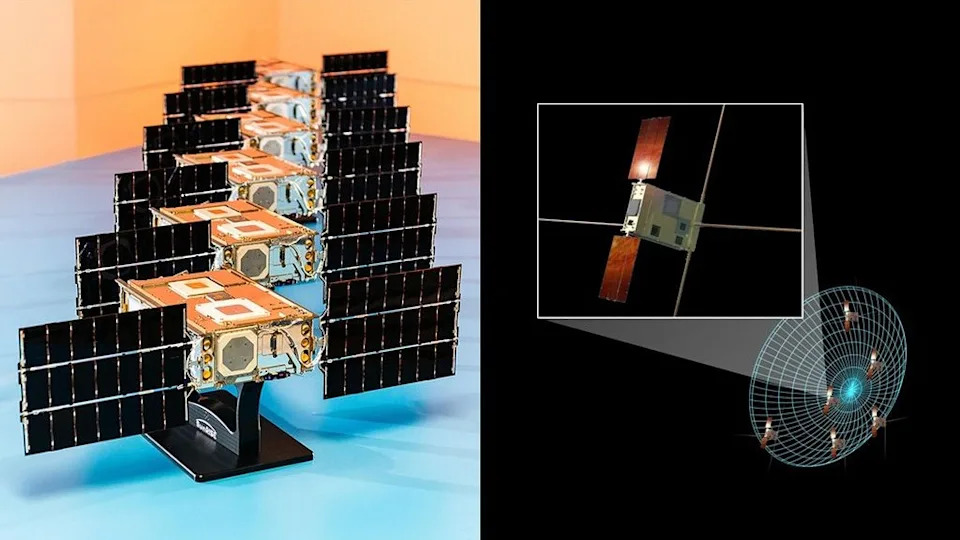
The SunRISE satellites, seen at left, will fly in formation, illustrated on the right, working as one large radio telescope in Earth orbit. | Credit: NASA/JPL-Caltech
Solar radio bursts travel faster than the energetic particles that accompany solar storms, giving researchers an earlier signature of events headed toward Earth. SunRISE’s measurements will be used to refine space weather prediction models, which can improve mitigation plans for satellites, communications networks and crewed missions. The mission is designed to improve forecasting and scientific understanding, not to serve as an operational alerting system by itself.
Program And Management
SunRISE is funded under NASA’s Science Mission Directorate as a "mission of opportunity" and is part of the Explorers Program managed from Goddard Space Flight Center. The science team is led by researchers at the University of Michigan, and overall mission management is handled by NASA’s Jet Propulsion Laboratory in Southern California.
Why Falcon Heavy?
Falcon Heavy is SpaceX’s heavy-lift launcher, capable of delivering up to about 58,860 pounds (26,700 kg) to geostationary transfer orbit. Since its 2018 debut it has flown multiple national security and commercial payloads. With Vulcan temporarily paused for national security missions following the booster anomaly on USSF-87, SSC and launch customers have been shifting payloads among available vehicles to keep schedules on track — a likely reason SunRISE was reassigned.
Falcon Heavy is currently manifested for NASA’s Nancy Grace Roman Space Telescope, tentatively scheduled for no earlier than Aug. 30. SunRISE remains slated to launch later this year, though NASA has not announced a specific window.
Why it matters: Improving early detection and prediction of solar radio bursts helps protect satellites, communications, and crewed missions from disruptive or damaging space weather events.
Help us improve.