
The roughly three‑pound Hillsborough meteorite that pierced a bedroom on July 16, 2024, has been identified as a rare CM1/2 carbonaceous chondrite. Lab tests found a diverse suite of amino acids and sodium‑rich minerals, indicating saline fluids once moved through its parent asteroid. Rapid, careful recovery limited contamination and allowed detailed chemical analysis. Trajectory reconstruction points to asteroid 163 Erigone as the likely source.
Bedroom Meteorite Delivered Amino Acids and Evidence of Ancient Salty Water
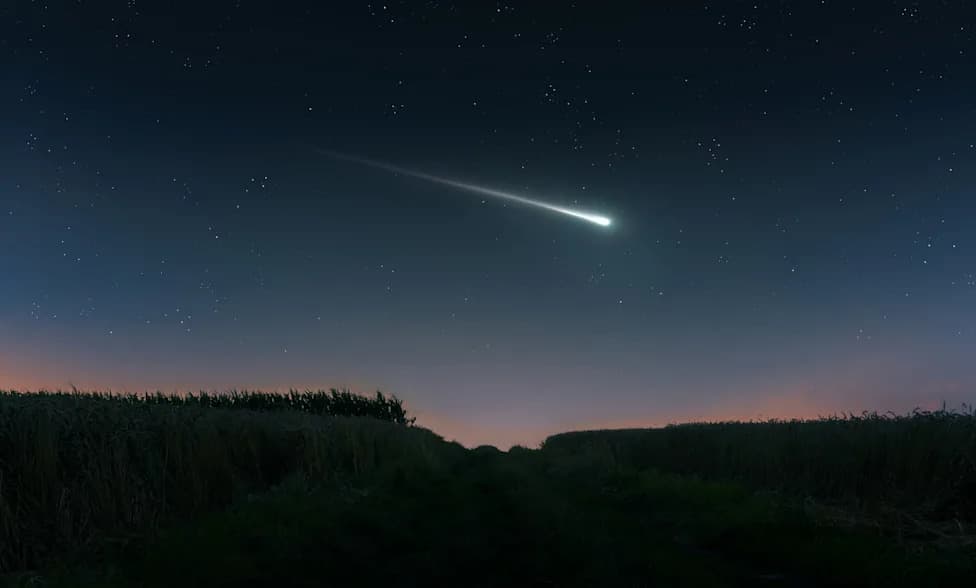
Photo Credit: iStock
Last summer a bright fireball streaked across the New York City sky and ended in an unusual place for a space rock: a bedroom in Hillsborough, New Jersey. The roughly three‑pound fragment punched through the ceiling on July 16, 2024, and was recovered quickly. Researchers report it carried a diverse suite of amino acids and mineral signatures consistent with ancient saline fluids in its parent asteroid.
Key Findings
Published July 15 in Science Advances, the study identifies the Hillsborough specimen as a rare, primitive carbon‑rich meteorite classified as an intermediate CM1/2 carbonaceous chondrite. While 22 CM‑type falls have been recorded overall, only two—including this one—have been assigned the CM1/2 subtype, making this a particularly valuable sample.
Homeowner Discovery and Early Preservation
"I heard an immense crash and felt the house shake. I open the door, and I see a hole in the ceiling above my bed," a homeowner who asked to remain anonymous told The New York Times.
After the impact the homeowners contacted amateur astronomer Mike Hankey of the American Meteor Society. Following his advice, they handled fragments with gloves and stored them in aluminum foil and glass containers to minimize contamination—steps that preserved the meteorite's pristine chemistry.
Chemistry and Implications
Laboratory examinations using microscopy and chemical assays revealed a broad range of amino acids—the molecular building blocks of proteins—and sodium‑rich minerals in tiny fractures. The sodium signatures indicate that saline (salty) fluids once circulated through the meteorite's parent body, leaving chemical traces preserved in the rock's minerals.
Because primitive carbonaceous meteorites undergo less thermal and aqueous alteration than many other space rocks, they can retain chemical clues from the solar system's earliest era. That preserved chemistry helps scientists probe the raw materials and processes that contributed to planetary formation and may shed light on how some of Earth's water and organics were delivered.
Trajectory and Origin
Multiple camera recordings across New Jersey captured the fireball, enabling trajectory reconstruction and orbital modeling. The research team concludes the meteoroid most likely originated from asteroid 163 Erigone in the main belt between Mars and Jupiter and reached Earth at an estimated speed near 32,000 miles per hour.
Study co‑author Peter Jenniskens of the SETI Institute noted that the rapid, careful recovery produced some of the most pristine CM1/2 fragments known. Danny Glavin of NASA's Goddard Space Flight Center said the variety and complexity of organic molecules in the sample were striking, though the team is careful to note that these findings do not constitute evidence of past life.
Overall, this find strengthens evidence that asteroids can preserve records of early solar system chemistry and that carbon‑rich meteorites remain valuable windows into the organic and aqueous processes that operated during planetary formation.
Help us improve.





















