Summary: A 6-minute-56-second video of Abderrahim Fakir being restrained by police and a civilian in Bologna has triggered protests and renewed scrutiny of police accountability in Italy. Fakir falls silent after several minutes with zip ties on his ankles; prosecutors ordered a post-mortem and a local health authority opened an internal inquiry. The case—investigated under the new Article 45-bis procedure—has prompted calls for the release of bodycam footage and references a recent European Court of Human Rights ruling on a similar restraint death.
Video of Abderrahim Fakir’s Final Minutes Sparks Outcry and Renewed Debate Over Police Accountability in Italy
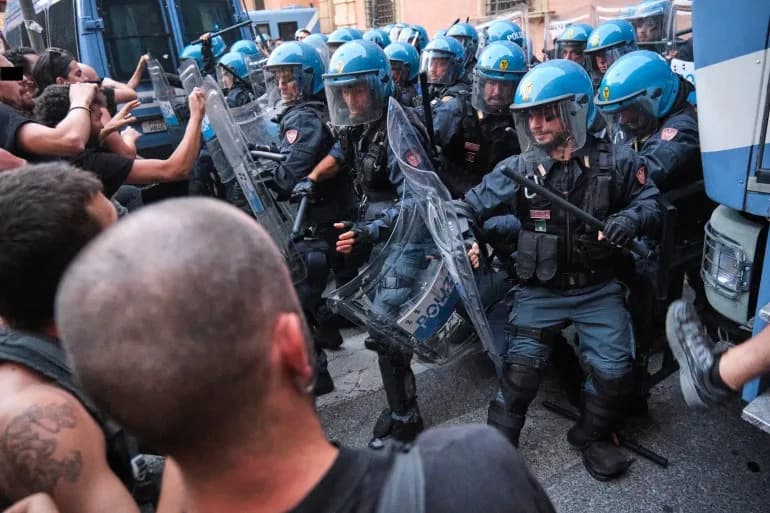
Police clash with protesters in Bologna after a rally over the death of Abderrahim Fakir turned violent [Dea Sibilla/Al Jazeera]
Bologna, Italy — A six-minute-and-56-second video showing the final moments of 42-year-old Abderrahim Fakir has reignited national debate over police conduct and accountability in Italy. The footage, filmed shortly after 12:30pm local time on July 19 from a nearby balcony, shows two officers and a civilian restraining Fakir on the pavement while four Red Cross volunteers stand close by.
What the Video Shows
The recording captures Fakir repeatedly calling for help for more than four minutes before he falls silent. His ankles are bound with a black plastic zip tie, and paramedics only appear to recognise he has lost consciousness after the restraint ends. Authorities say officers had been responding to reports of "a person behaving violently," and that restraint procedures were carried out in the presence of medical staff.
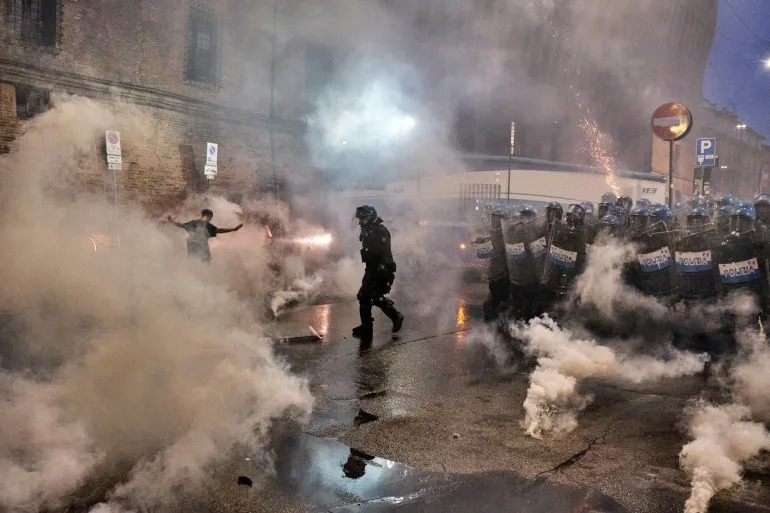
A protester moves through smoke as police stand nearby during clashes in Bologna following demonstrations over Fakir's death [Dea Sibilla/Al Jazeera]
Immediate Response and Investigations
Prosecutors ordered a post-mortem examination, and Bologna’s local health authority opened an internal inquiry. The footage spread rapidly on social media, drawing dozens to the site and prompting a spontaneous vigil where Fakir’s sister appealed for justice:
“My brother wasn't an animal. He was a father, a worker, a good man. Why did they do this to him? We don't want revenge. We want justice.”
Legal Context and Expert Commentary
Fabio Anselmo, the lawyer for Fakir’s family, urged people to watch the video closely and drew parallels with a January 2026 European Court of Human Rights ruling in the Riccardo Magherini case. In that ruling the court found Italy had violated Article 2 of the European Convention on Human Rights because authorities failed to demonstrate that keeping a restrained person face down was "absolutely necessary." Anselmo said the case echoes past failures to adequately account for deaths in restraint.
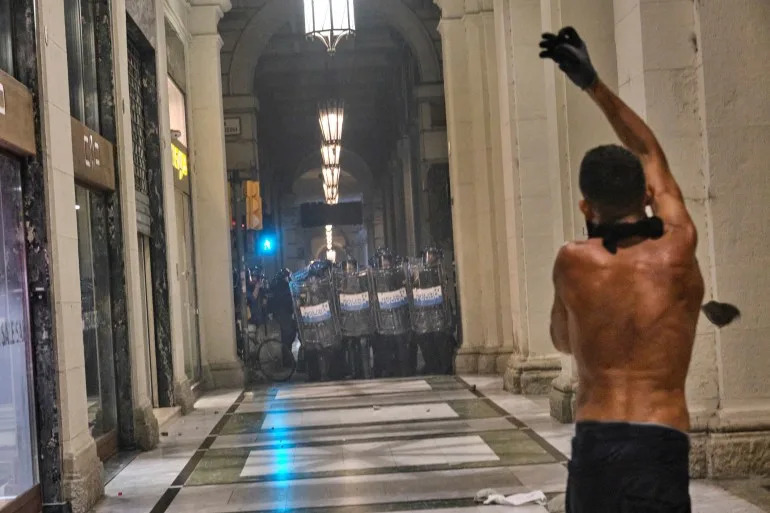
A protester gestures with a raised hand as police officers stand nearby during a demonstration in Bologna following Fakir's death [Dea Sibilla/Al Jazeera]
Protests, Clashes and Political Fallout
On the evening of July 20 thousands gathered in Piazza Maggiore for a solidarity rally called by Bologna’s mayor, Matteo Lepore. While the demonstration began peacefully, part of the crowd marched toward the Prefecture and the city police headquarters, where clashes with riot police erupted. Demonstrators hurled bottles and fireworks, smashed windows and ATMs, and set two cars alight. Police responded with baton charges, water cannon and tear gas. Authorities reported 64 officers injured and widespread damage to the historic centre.
Several protesters and journalists told Al Jazeera they were struck by officers during the unrest; one protester reported hospital treatment for multiple bruises and an eye injury. Prime Minister Giorgia Meloni condemned the violence and called for a full, impartial inquiry into Fakir’s death, while stressing that violence against law enforcement is unacceptable.
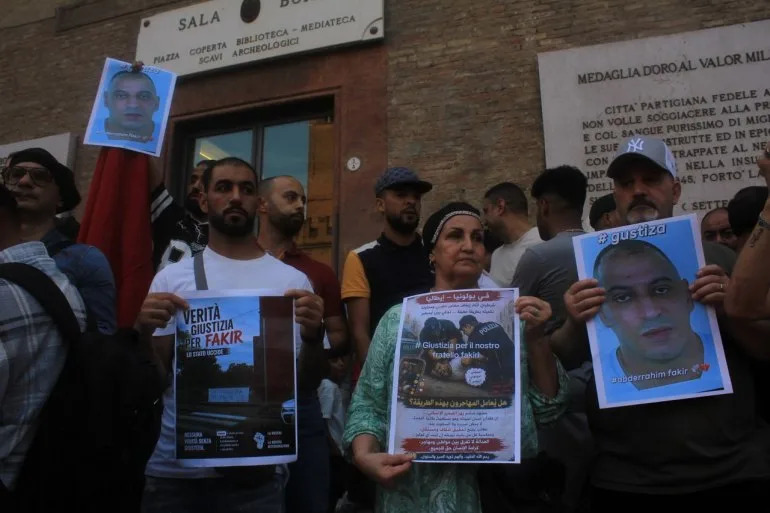
People, including family members, hold pictures of Abderrahim Fakir during a vigil in Bologna after his death during a police restraint [Dea Sibilla/Al Jazeera]
New Procedure Raises Accountability Concerns
The investigation into Fakir’s death will be the first conducted under Article 45-bis, introduced by the Meloni government's Security Decree that came into force in February 2026. Under the new rule, officers involved in alleged offences while on duty are not immediately entered into the register of criminal suspects. Opposition parties, legal scholars and human rights organisations warn this change could hamper independent scrutiny and accountability. Anselmo described the reform as "a legal monstrosity."
Calls For Transparency
Opposition lawmakers have urged Interior Minister Matteo Piantedosi to report to parliament and to release any body-camera footage recorded by the officers involved. As inquiries continue, both prosecutors and health officials say determining the precise cause and responsibility for Fakir’s death will require careful forensic and procedural review.
Next Steps: A full autopsy report and the outcome of the local health authority’s internal probe are expected to be central to the public and legal response. The case has already prompted fresh calls for clearer rules, independent oversight and greater transparency when deaths occur in police custody.
Help us improve.