Using the Very Large Telescope, astronomers detected a moon-like body orbiting a brown dwarf in the CD-35 2722 system, about 73 light-years away. The object is massive enough to blur the line between planet and moon, so the team calls it an "exosatellite." Published in Nature (22 July), the discovery is a strong exomoon candidate but remains unconfirmed pending clearer definitions and follow-up observations. Next-generation facilities like the ELT should help confirm and characterize the object.
Astronomers Spot a Moon-Like World Orbiting a Brown Dwarf — First Exomoon Candidate or Something Stranger?
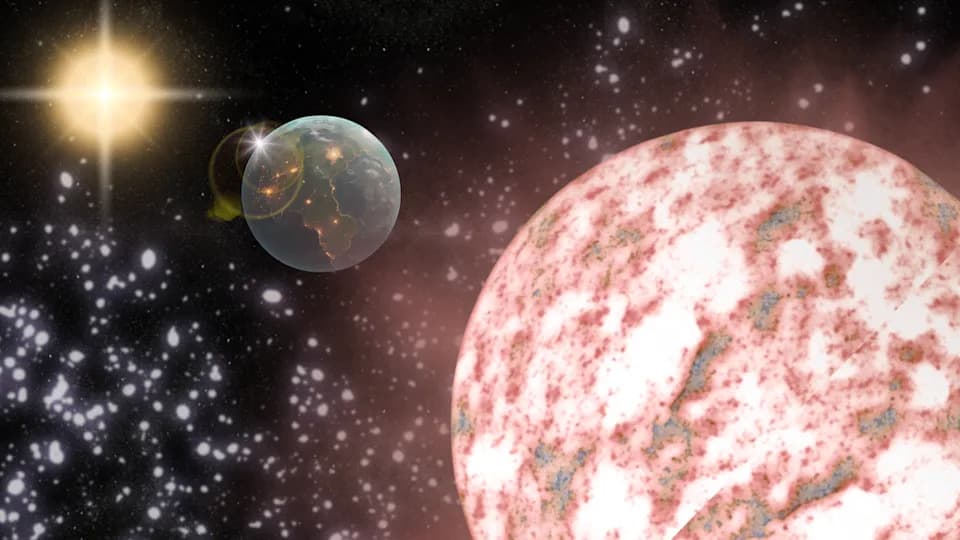
An illustration of the weird star system of CD-35 2722, the foreground object is a brown dwarf, the background object is a star, but is the middle body an exomoon?. | Credit: Robert Lea (created with Canva)
Researchers using the Very Large Telescope (VLT) have detected a moon-like object in the unusual CD-35 2722 system that may be the strongest exomoon candidate to date — or it may force astronomers to rethink how we define planets and moons.
CD-35 2722 lies about 73 light-years from Earth. The system contains a star roughly half the mass of the Sun and a close companion classified as a brown dwarf — a so-called "failed star" that forms like a star but never gains enough mass to sustain hydrogen fusion. Brown dwarfs occupy the mass range between the biggest gas-giant planets and the smallest true stars, typically about 13–80 times the mass of Jupiter (≈0.013–0.08 solar masses).
The newly observed body looks moon-like because it orbits the system's brown dwarf rather than the star itself. But it is unusually large — substantial enough that some would call it a planet. Because it orbits an object that in turn orbits a star, the team describes it more generally as an exosatellite.

The Extremely Large Telescope (ELT), currently under construction in Chile, could be integral in the hunt for exomoons and exosatellites. | Credit: ESO/G. Vecchia
"This system is somewhat hard to define using solar-system-based words like 'planet' and 'moon.' The exosatellite is clearly massive enough to be a planet, but it does not orbit a star, though it orbits an object that orbits a star," said team leader Kevin Hoy of the Universidad Diego Portales and the Millennium Nucleus of Young Exoplanets and their Moons (YEMS) in Chile.
"The satellite we report is a giant gaseous body orbiting a highly massive companion, itself several times the mass of Jupiter... In the CD-35 2722 system, where we are blurring the lines between stars, planets, and moons, the whole thing becomes more complicated to describe," added team member Alice Zurlo.
The researchers published their findings in the journal Nature on 22 July. While they stop short of declaring the object a confirmed "exomoon" — in part because doing so would require clearer definitions for bodies in these intermediate mass and orbital regimes — they emphasize that this is a first-of-its-kind detection of an exosatellite and a compelling target for follow-up observations.
Future observatories should help resolve the ambiguity. The Extremely Large Telescope (ELT), currently under construction in Chile, will provide improved direct-imaging and spectroscopic capabilities that could confirm the object's orbit, measure its mass and composition, and determine whether it formed like a moon or like a planet.
Whatever its ultimate classification, the discovery reinforces a persistent lesson from exoplanet science: planetary systems are diverse and often defy neat, solar-system-based categories.
Help us improve.