The International Space Station produced a striking potassium chloride crystal that grew in hollow, stair-stepped layers visible in images shared by astronaut Don Pettit on July 18. In microgravity — about a million times weaker than Earth's gravity — forces such as molecular attraction dominate, producing 'hopper' growth that favors edges and corners and leaves centers hollow. Studies of such defect-reduced crystals can reveal near-ideal structures and may inform semiconductor and advanced-materials manufacturing on Earth.
Astronaut Shares Stunning Photo of 'Hopper' Potassium Chloride Crystal Growing on the ISS
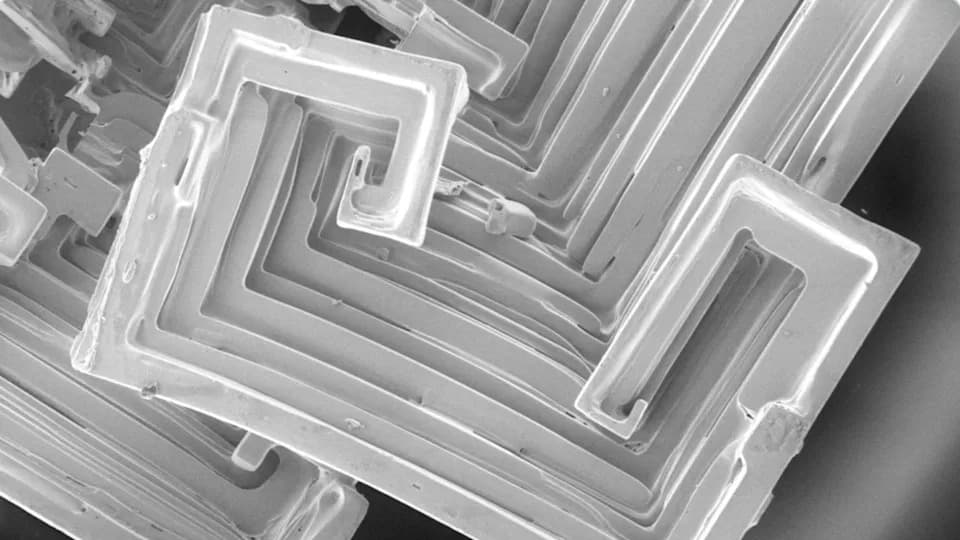
A potassium chloride crystal was grown aboard the International Space Station, where microgravity enables it to form in stepped, hollow layers instead of the solid shapes seen on Earth. | Credit: Don Pettit via X
A potassium chloride crystal grown aboard the International Space Station produced an arresting, almost sculptural shape that would be nearly impossible to recreate on Earth. The image and accompanying video, credited to NASA astronaut Don Pettit and shared on July 18 via X, show the salt forming in stepped, hollow layers rather than the familiar solid cubes seen under terrestrial conditions.
How Microgravity Changes Crystal Growth
On the ISS, crystals develop in microgravity — a near-weightless environment of orbit where the gravitational pull is roughly a million times weaker than on Earth's surface. That dramatic reduction makes other forces, such as molecular attraction and polarity, much more influential in determining how atoms and molecules organize.
'[Other] forces start to become far more pronounced than gravity forces,' said Anne Wilson, a professor of chemistry and biochemistry at Butler University, explaining why familiar materials can behave differently in space.
Those altered conditions allow potassium chloride — a common salt sometimes used as a sodium substitute in foods and sports drinks — to crystallize in ways rarely seen in Earthbound laboratories. Instead of growing uniformly across flat faces until the crystal becomes heavy and sags or settles, crystals in microgravity continue to extend outward from their nucleation points.
What Is 'Hopper' Growth?
Potassium chloride normally forms cube-shaped crystals on Earth. In microgravity, growth occurs predominantly at edges and corners rather than across faces, leaving centers hollow and producing stacked, pyramid-like structures. Scientists call this pattern 'hopper growth.' The same behavior can occur with common table salt (sodium chloride) under similar low-gravity conditions. As new corners form during growth, the crystal can change direction entirely, producing the elegant scrolling, stair-stepped patterns visible in Pettit's images.
Why This Matters
Beyond its visual appeal, hopper growth provides valuable scientific insight. Materials formed without gravity's dominant influence often contain fewer defects, giving researchers a clearer view of near-ideal crystalline structures. That knowledge can help refine manufacturing processes for semiconductors and other advanced materials on Earth, where minimizing defects is critical to performance.
Images and videos like these also inspire public curiosity about fundamental physics. 'I love seeing videos of how things behave in space,' Wilson said. 'Who would think that something as simple as potassium chloride could still be super cool?'
ISS crew members devote much of their time to experiments that are difficult or impossible under Earth's gravity. Recent station research includes studies in the upgraded Cold Atom Laboratory, where teams create and probe Bose–Einstein condensates, and long-duration exposure experiments — for example, moss spores that were left outside the station for nine months and were still able to grow after return to Earth.
Help us improve.