
LHS 1140 b, a planet 48 light-years away, shows helium escaping from its upper atmosphere — a sign of a substantial atmosphere. Refined models that include JWST data favor a water-rich world containing an estimated 9–20% water by mass rather than a purely rocky composition. The planet orbits a relatively quiet red dwarf and receives about half the sunlight Earth does. While the helium detection is promising, signal variability means further confirmation is needed; there is no evidence of life.
Helium Leak on Nearby Super-Earth Strengthens Case for Habitability of LHS 1140 b
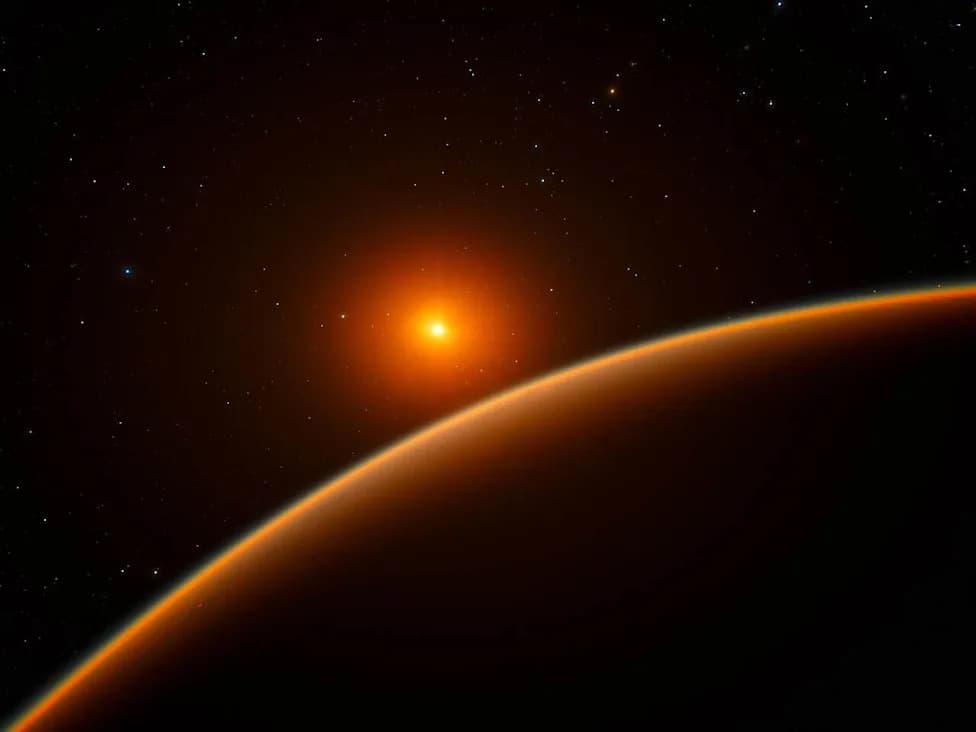
Artist’s impression of the super-Earth exoplanet LHS 1140 b orbiting its red dwarf host star, LHS 1140 | Image Credit: ESO/spaceengine.org
A planet 48 light-years away, LHS 1140 b, has been observed leaking helium from its upper atmosphere — a detection that strengthens the case that this world may host a substantial atmosphere and conditions favorable to liquid water.
The Discovery
First discovered in 2017, LHS 1140 b was initially classified as a super-Earth with a radius about 1.73 times Earth’s and a mass roughly 5.6 times greater. New observations with the Magellan Clay Telescope revealed an escaping helium signature in the planet’s upper atmosphere. That signature matches predictions from earlier atmospheric-evolution models that expected light gases to be blown off by stellar activity, leaving a helium-dominated upper layer.
What the Models and Data Suggest
Refined models that incorporate updated mass and radius measurements together with James Webb Space Telescope (JWST) data now favor a water-rich "ocean world" interpretation for LHS 1140 b. Those models estimate that water could account for roughly 9–20% of the planet’s mass rather than LHS 1140 b being a purely rocky body.
"At this point, we have absolutely no evidence for life on the planet," lead author Collin Cherubim told the New York Times. "But we think all of the really important, essential ingredients are there."
Orbital Environment and Star Activity
LHS 1140 b orbits a red dwarf star (also named LHS 1140) at a distance about ten times closer than Earth is to the Sun. Because the star is substantially smaller and cooler than the Sun, the planet receives roughly half the sunlight Earth does. Red dwarfs can be flare-active and pose risks to planetary atmospheres, but observations from the European Southern Observatory indicate this particular star is currently faint and relatively inactive, emitting little high-energy radiation.
Significance and Caveats
The helium detection is important because a substantial atmosphere is one of three basic prerequisites scientists typically consider when assessing habitability (alongside a suitable bulk composition and an orbital distance that allows liquid water). If the helium interpretation holds up after further study, LHS 1140 b would be the first planet with direct atmospheric evidence consistent with potential habitability among nearby rocky or water-rich worlds. That said, some observations show variability in the helium signal and researchers emphasize the need for independent confirmation and continued monitoring.
There is currently no evidence of life on LHS 1140 b. Still, the combination of a likely substantial atmosphere, a bulk composition consistent with rock or a water-rich world, and a temperate orbit make it one of the most compelling targets in the search for potentially habitable exoplanets.
Sources: Science (journal), NASA Exoplanet Archive, James Webb Space Telescope (JWST) data, Magellan Clay Telescope observations, European Southern Observatory, New York Times.
Help us improve.





















