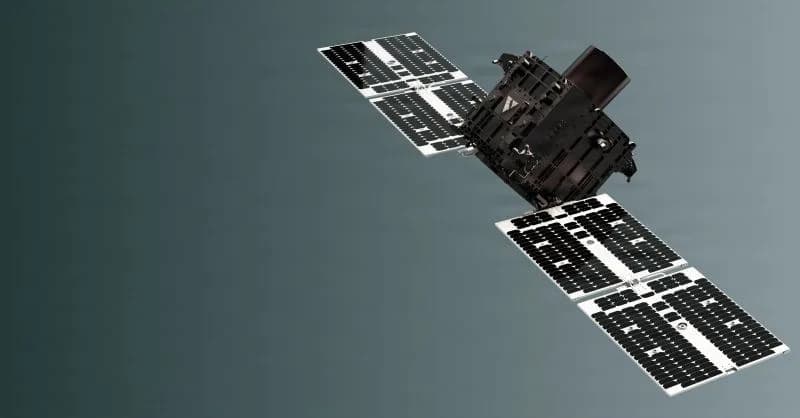
Northrop Grumman launched a two‑armed Mission Robotic Vehicle (MRV) carrying three detachable electric propulsion modules to extend the life of fuel‑depleted communications satellites. The MRV will take about a year to reach geosynchronous orbit (approximately 22,300 miles/36,000 km) and is expected to begin servicing satellites by mid‑2027. Each washing‑machine‑sized module uses xenon electric thrusters to add several more years of operation to aging satellites, potentially saving operators like SES and Optus millions.
Robotic Salvage Mission Launched to Give New Life to Fuel‑Depleted Satellites
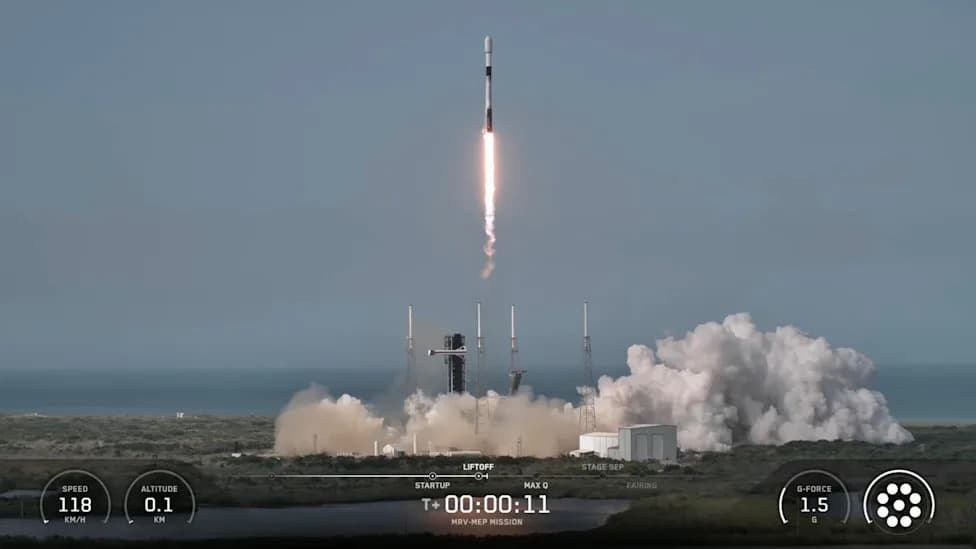
This image from video provided by SpaceX shows a Falcon 9 rocket carrying Northrop Grumman’s mission robotic vehicle — dubbed MRV, launches from Cape Canaveral, Fla., on Tuesday, July 21, 2026. (SpaceX via AP)(SpaceX via AP)
A two‑armed robotic spacecraft launched from Cape Canaveral on Tuesday on a private salvage mission to attach life‑extending propulsion modules to communications satellites running low on fuel.
Launched on a SpaceX rocket, Northrop Grumman's Mission Robotic Vehicle (MRV) carried three detachable, electric‑propelled propulsion modules — colloquially described as "jetpacks" — that will climb toward geosynchronous orbit and await capture by the MRV. The minivan‑sized servicer will take about a year to reach the 22,300‑mile (36,000‑kilometer) geosynchronous belt where hundreds of communications satellites remain fixed relative to Earth's surface.
How the Mission Works
Once the MRV arrives — expected around mid‑2027 — it will use its two articulated arms, each roughly 10 feet (3 meters) long, to grab the propulsion modules and attach them to aging satellites. Each propulsion module is about the size of a washing machine and uses xenon‑fed electric thrusters to provide enough thrust to keep an out‑of‑fuel satellite operating for several additional years.
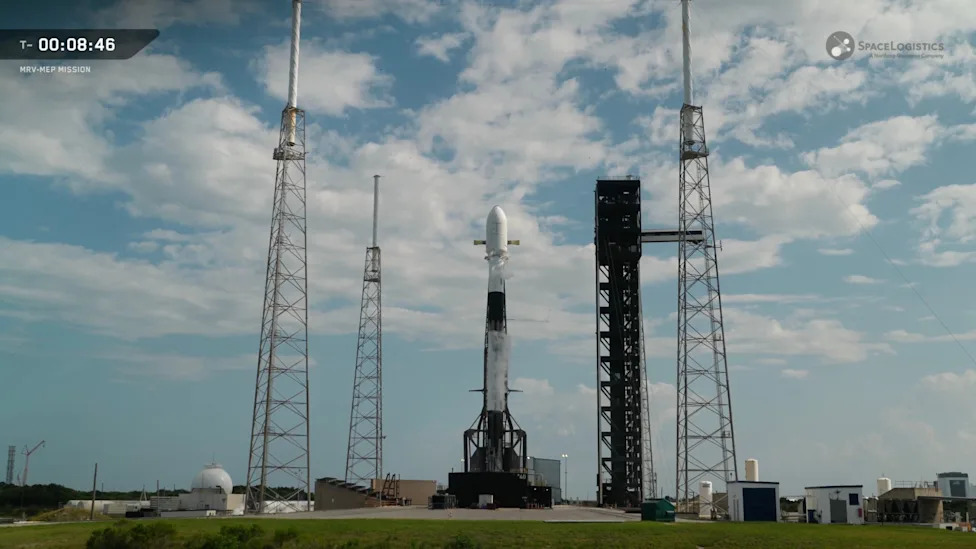
This image from video provided by SpaceX shows a Falcon 9 rocket carrying Northrop Grumman’s mission robotic vehicle — dubbed MRV, preparing for launch from Cape Canaveral, Fla., on Tuesday, July 21, 2026. (SpaceX via AP)(SpaceX via AP)
The inaugural flight carries three such modules. They were programmed to separate after liftoff, use their own propulsion to climb toward geosynchronous orbit and then be captured one at a time by the MRV for installation on designated satellites.
Why This Matters
If successful, the mission could save satellite operators — including Luxembourg's SES and Australia's Optus — millions of dollars by extending the service life of expensive spacecraft rather than replacing them. Satellite servicing is an emerging industry aimed at reducing space‑hardware costs and easing orbital congestion.
Background And Related Efforts
Northrop Grumman previously extended satellite lifetimes with missions in 2019 and 2020 that docked with faltering communications craft and steered them to safer orbits. The company envisions future robotic servicers that can perform in‑space repairs, relocate functioning satellites or attach to defunct vehicles for removal from crowded orbits. Development partners include the U.S. Naval Research Laboratory and the Defense Advanced Research Projects Agency.
Separately, Katalyst Space Technologies is testing its Link servicer in orbit ahead of a planned boost for NASA's Swift observatory. Swift, launched in 2004, has been losing altitude faster than normal following increased solar activity. Under a roughly $30 million NASA contract, Katalyst aims to raise Swift back to its original 373‑mile (600‑kilometer) orbit, potentially giving the nearly $400 million gamma‑ray telescope more years of operation. Northrop Grumman provided Link's ride to space aboard a plane‑launched Pegasus rocket.
Note: The Associated Press Health and Science Department receives support from the Howard Hughes Medical Institute's Department of Science Education and the Robert Wood Johnson Foundation. The AP is solely responsible for all content.
Help us improve.