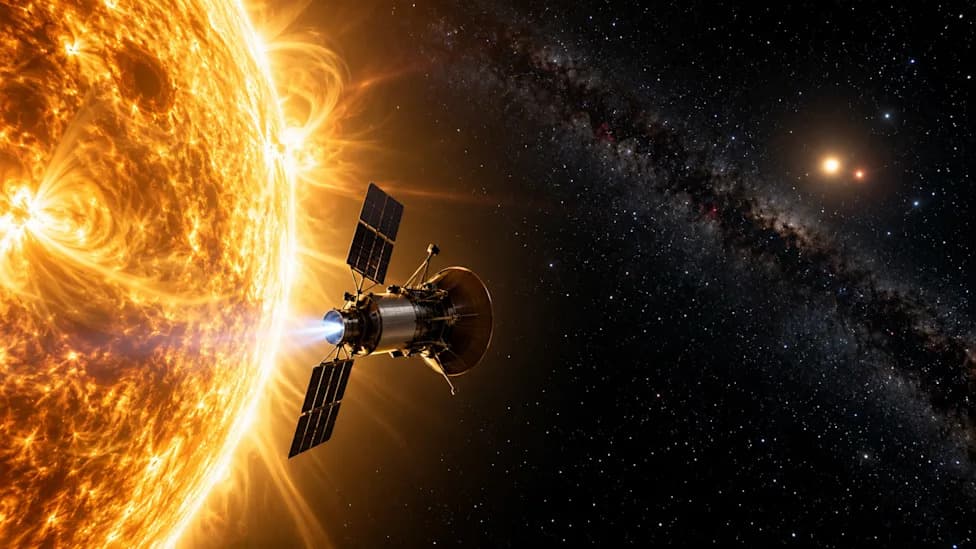
Voyager 1, launched in 1977, remains the most distant active human-made object and continues sending telemetry from interstellar space. Its three RTGs have declined from about 470 watts at launch to roughly 230 watts today, forcing engineers to power down systems and adopt conservation measures. JPL's proposed "Big Bang" heater-switch plan aims to save about 10 watts to protect thrusters and extend operations into the 2030s. At ~15.85 billion miles away, one-way signals now take about 23 hours to reach Earth; the probe also carries the golden record of Earth's greetings.
Voyager 1 at Nearly 50 Years: Still Talking to Earth — But Its Messages Now Take About 23 Hours
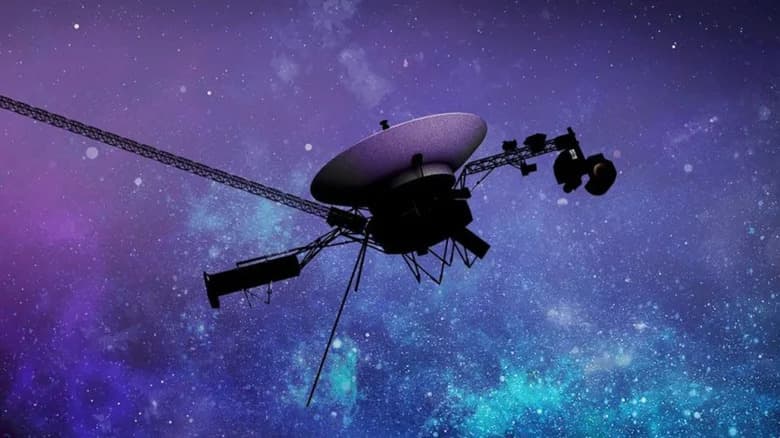
Artist's rendering of the NASA Jet Propulsion Laboratory's Voyager 1 probe traversing interstellar space - NASA/JPL-Caltech
Voyager 1 now sails through the star-strewn expanse beyond our solar system as both the oldest active spacecraft and the most distant human-made object. Launched in 1977, before the parents of some current team members were born, it continues to return scientific data long after engineers expected it to fail. With systems degrading and its radioisotope power source slowly losing output, the probe persists on its lonely voyage at the very edge of human reach. It also carries the famous golden record, a time capsule of Earth's sounds and greetings that may one day speak for humanity.
From Planetary Tour to Interstellar Pioneer
Voyager 1 departed Earth in 1977 as part of a twin mission with Voyager 2. The original objective was to fly past Jupiter and Saturn and gather measurements with a suite of instruments including an ultraviolet spectrometer, a magnetometer, and an imaging science subsystem. During those encounters Voyager 1 discovered previously unknown rings and moons around both planets and dramatically expanded our knowledge of the outer solar system.
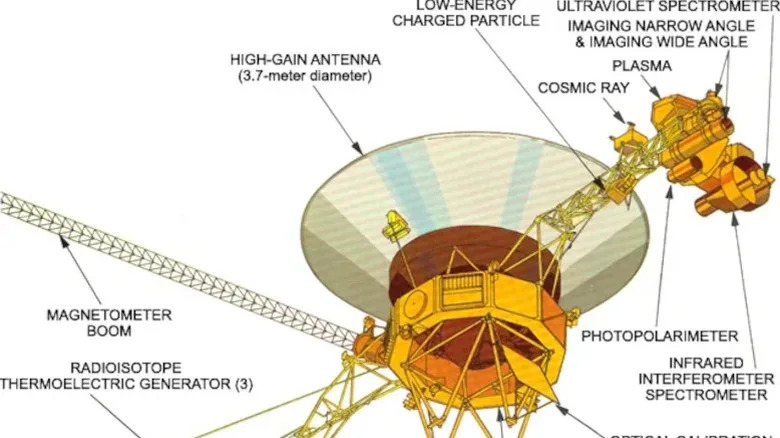
A diagram of the scientific instruments aboard the NASA Jet Propulsion Laboratory's Voyager 1 probe - NASA/JPL-Caltech
In 1989, NASA's Jet Propulsion Laboratory repurposed the Voyagers to study the heliosphere's boundary — the region dominated by the Sun's magnetic field and particle wind — and what lay beyond it. Using the remaining functional instruments, Voyager 1 probed regions of extremely hot plasma and in 1998 passed Pioneer 10 to become the most distant human-launched object. In 2012 it crossed the heliopause and entered interstellar space, where it continues to send telemetry back to Earth.
Power, Plumbing, and a Bold Plan
Age and distance have taken a toll. Voyager 1 is powered by three radioisotope thermoelectric generators (RTGs), devices that convert heat from decaying plutonium into electricity. At launch the RTGs produced roughly 470 watts; today output is down to about 230 watts. That decline forces engineers to prioritize which instruments and systems remain powered.
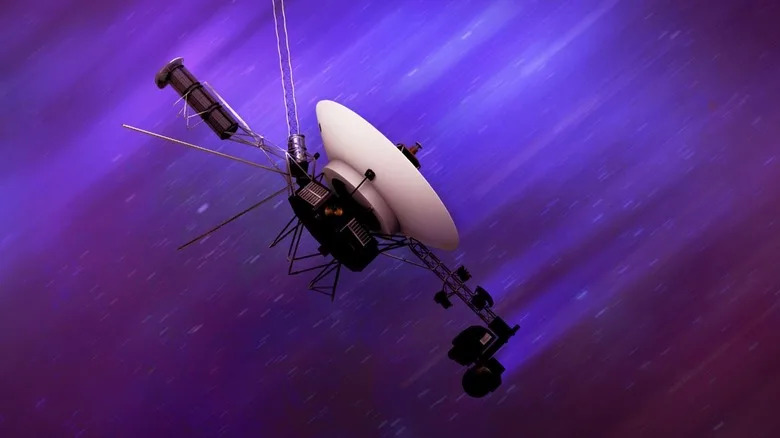
Artist's rendering of the NASA Jet Propulsion Laboratory's Voyager 1 probe traversing interstellar space - NASA/JPL-Caltech
One of the most critical concerns is the spacecraft's thruster plumbing. Lines that feed propellant to attitude-control thrusters are partially clogged and at risk of freezing. If the thrusters fail, Voyager 1 would lose the ability to precisely point its high-gain antenna at Earth and two-way communication could be lost permanently. To prevent that outcome, some systems are kept on primarily to provide heat — but that consumes precious watts.
To conserve energy while protecting the thrusters, JPL engineers have proposed a maneuver nicknamed the "Big Bang": switching off the circuits currently heating the lines and simultaneously activating alternate heaters to keep plumbing warm at lower overall power cost. If successful, the change could save about 10 watts — a modest amount that could nonetheless extend useful operations into the 2030s for both Voyagers.
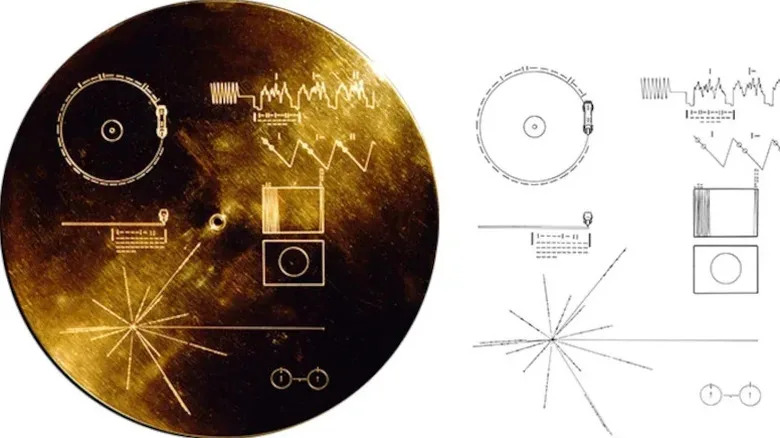
The golden record aboard the NASA Jet Propulsion Laboratory's Voyager 1 probe, with diagrams of its pictographs - NASA
Distance, Delay, and Data Rates
At the time of writing, Voyager 1 is roughly 15.85 billion miles from Earth and receding at about 88,000 miles per hour. From that distance a one-way radio transmission takes approximately 23 hours to arrive at JPL; round-trip exchanges therefore approach two days. The data link is extremely slow by modern standards — roughly 160 bits per second — comparable to early dial-up connections but sufficient to transmit vital engineering telemetry and occasional scientific measurements.
The Golden Record and a Lasting Legacy
Engineers acknowledge that a time will come when Voyager 1 falls silent, but its role as an emissary persists in the golden record it carries. The record contains pictorial diagrams, basic mathematical and scientific information, natural sounds, and greetings in 55 languages — including messages recorded by then‑U.S. President Jimmy Carter and U.N. Secretary‑General Kurt Waldheim. Even if we never learn whether Voyager 1 ever encounters another intelligence, it stands as one of humanity's most remarkable achievements: a small, durable piece of Earth cast into the cosmic ocean.
Bottom line: JPL's careful power management and the planned heater-switch maneuver give Voyager 1 a chance to keep whispering across the void for years to come — but every watt counts, and contact will eventually end.
Help us improve.