
NASA has moved a bottom segment of the left solid rocket booster for Artemis III into the Vehicle Assembly Building at Kennedy Space Center as the agency prepares to assemble the SLS rocket. The two SRBs supply roughly 7.2 million pounds of thrust and are essential for liftoff. Artemis III, currently targeted for mid-to-late 2027, will be a roughly two-week crewed mission focused on rendezvous and docking tests with prototype landers from Blue Origin and SpaceX rather than a lunar landing. NASA aims to complete a wet dress rehearsal of the rocket before year-end as additional components continue to arrive.
NASA Begins Stacking Artemis III: SRB Segment Arrives at Kennedy Ahead of 2027 Crew Flight
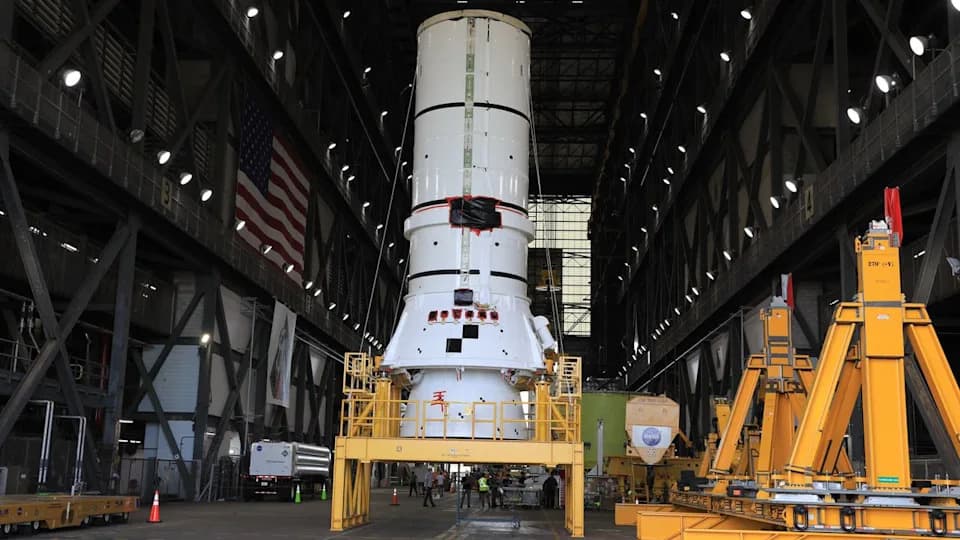
Credit: NASA
NASA has taken a visible step toward assembling its next crewed Artemis rocket, moving a bottom segment of the left solid rocket booster (SRB) into the Vehicle Assembly Building (VAB) at Kennedy Space Center in Florida.
The booster segment is one of two SRBs that will mount to either side of the Space Launch System (SLS) core. Together those boosters provide roughly 7.2 million pounds of thrust — more than 75% of the vehicle's liftoff power — and are therefore essential to lifting the heavy SLS off the pad.
"Soon, assembly of the rocket will begin as we prepare to send crew aboard Orion to test the rendezvous and docking capabilities needed for future lunar landings," NASA said.
What Arrived and What Comes Next
The Artemis III SLS core stage arrived at the VAB in May, but it was delivered without the engine section attached. Once the engine segment is integrated, teams will continue stacking other components onto the main vehicle — a process that previously took about a year for Artemis II once all elements were delivered. NASA has said the agency aims to complete a wet dress rehearsal of the integrated rocket before the end of the year, while other SRB segments and SLS parts continue to arrive at the VAB.
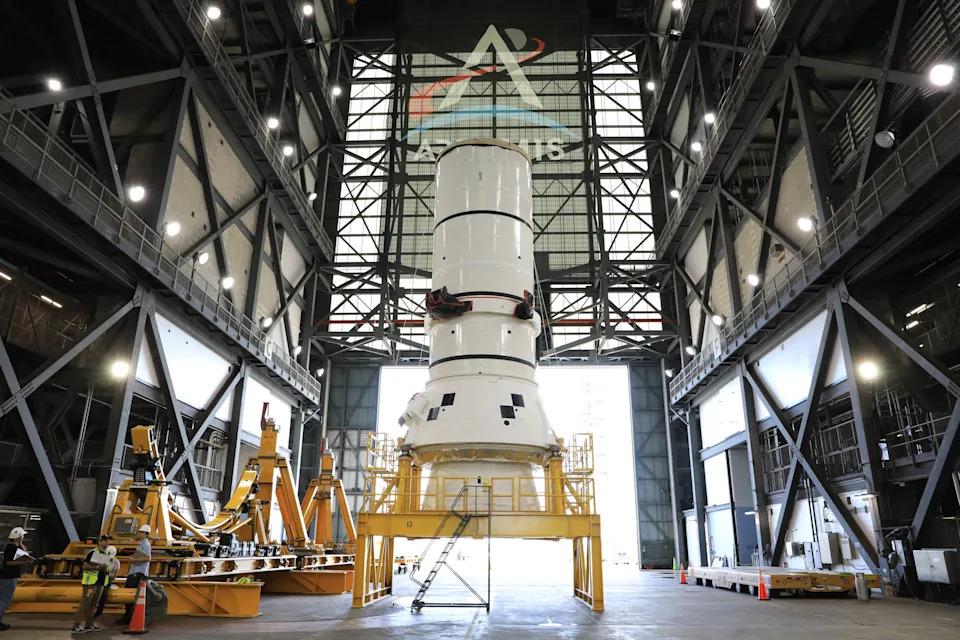
NASA
SRB Details
Each SRB measures roughly 177 feet (54 meters) tall and is filled with solid propellant made of polybutadiene acrylonitrile (PBAN), ammonium perchlorate, and aluminum powder. The two boosters together weigh about 3.2 million pounds (1.45 million kg). Unlike liquid-fueled engines, solid rocket motors cannot be throttled or shut down once ignited — making their performance and reliability crucial for a safe liftoff. Without the SRBs, the four RS-25 engines on the SLS core would not produce enough thrust to lift the vehicle.
Mission Role: Artemis III
Artemis III will be the second crewed flight of the Artemis program and is currently targeted for mid-to-late 2027. The mission will not include a lunar surface landing; instead, a four-person crew flying on the Orion spacecraft will spend roughly two weeks in orbit testing rendezvous and docking procedures with prototype lunar landers developed by industry partners.
NASA has contracted two partners for lander demonstrations: Blue Origin and SpaceX. The crew is expected to first rendezvous and dock with Blue Origin's Blue Moon lander, enter its crew cabin, and test components of the Artemis extravehicular activity (EVA) suit intended for lunar surface operations. Later, Orion will rendezvous with a SpaceX Starship V3 boilerplate equipped with a docking adapter. SpaceX has indicated that the Starship V3 planned for Artemis III will be a non-crewed, boilerplate test vehicle and will not include a full life-support cabin.
If current schedules hold, the Artemis program's first crewed lunar landing is planned for Artemis IV, currently targeted for late 2028, following the system- and crew-level tests scheduled for Artemis III.
Why this matters: The arrival of SRB segments and continued stacking activity are visible milestones that show hardware progress toward the Artemis III flight and the broader timeline for returning humans to the lunar surface.
Help us improve.





















