
(152637) 1997 NC1, an asteroid estimated between about 820 and 1,800 yards across, will pass roughly 1.59 million miles from Earth on June 27 at about 7:15 a.m. EDT. Traveling at roughly 5.6 miles per second, it poses no immediate threat. Observers with strong binoculars or small telescopes may see it under dark skies, though moonlight and light pollution could impede viewing. Agencies like the ESA routinely monitor such near-Earth objects to refine orbits and assess risk.
Asteroid As Big As Five Cruise Ships Will Fly Past Earth This Weekend — May Be Visible With Binoculars
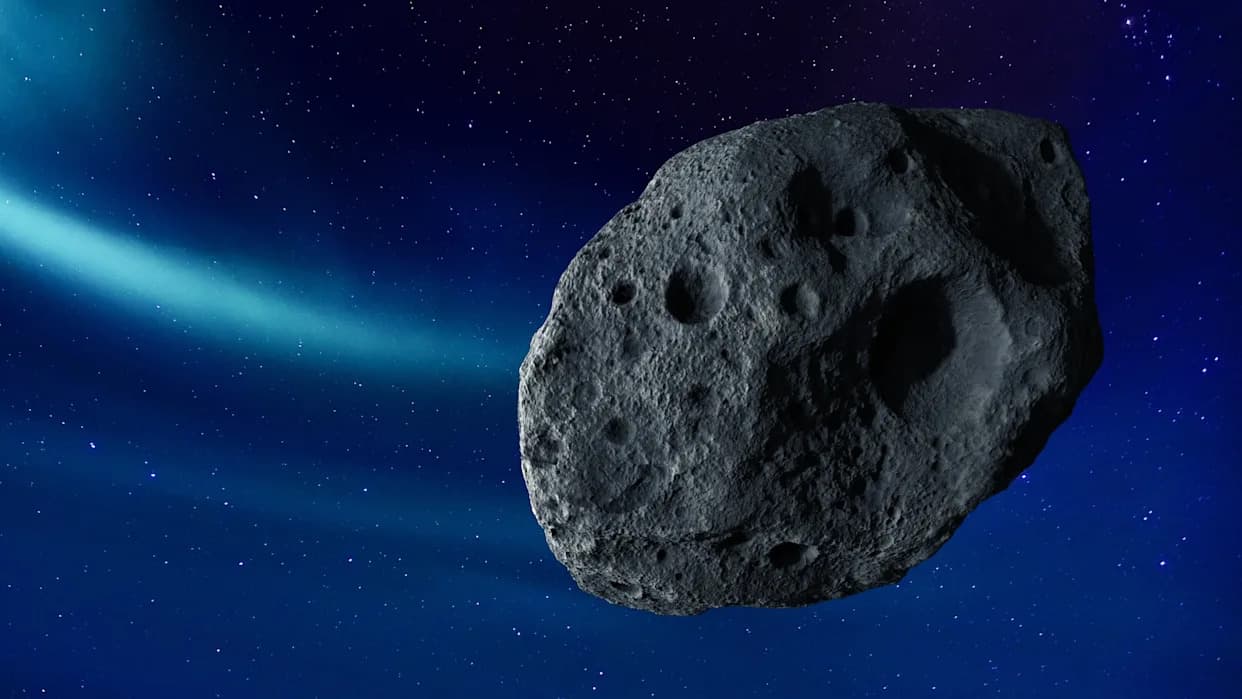
Similarly close encounters occur every few years.
An asteroid roughly the size of five cruise ships will make a close pass by Earth this weekend. Designated (152637) 1997 NC1, the object will come closest on June 27 at about 7:15 a.m. EDT, closing to roughly 1.59 million miles from Earth — more than six times the distance to the Moon.
What We Know
(152637) 1997 NC1 is moving at approximately 5.6 miles per second (about 20,160 miles per hour). Observations made since its discovery nearly two decades ago indicate an estimated diameter of roughly 820 to 1,800 yards based on its reflectivity, though astronomers caution it may be somewhat smaller.
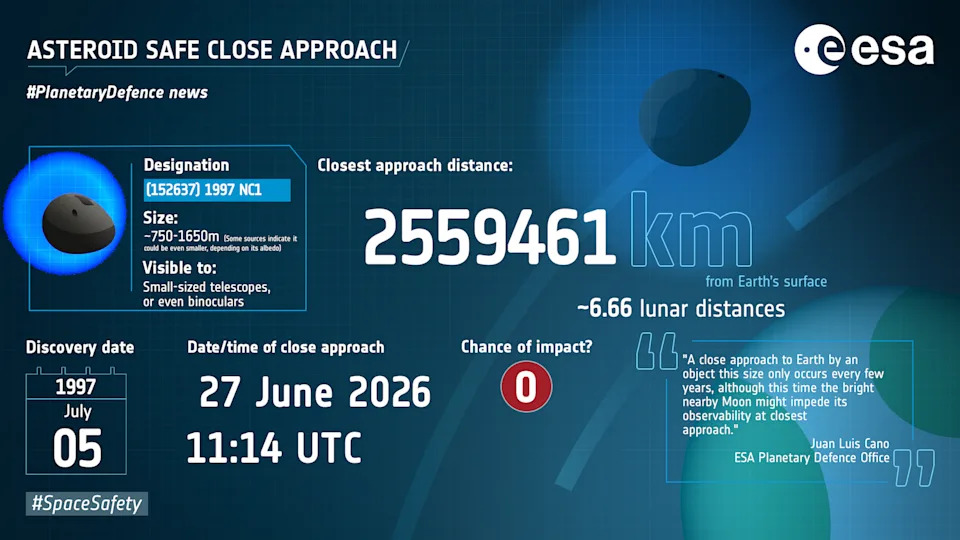
At its closest, the asteroid will be over six times the distance between the Earth and the moon. Credit: ESA
Will It Be Visible?
Stargazers with strong binoculars or small telescopes may be able to spot the asteroid under dark, clear skies. Observers in the Northern Hemisphere are favored during the approach; those in the Southern Hemisphere may catch a view as it departs. Visibility will depend on local light pollution and the Moon's phase — a bright moon near closest approach could make the object harder to see.
“A close approach to Earth by an object this size only occurs every few years, although this time the bright nearby moon might impede its observability at closest approach,” said Juan Luis Cano, information specialist at the European Space Agency's Planetary Defence Office.
Why Astronomers Track Near-Earth Objects
Space agencies and observatories routinely monitor near-Earth objects to refine their orbits and assess any potential hazard. While Earth has experienced impacts throughout its history — from the event linked to the dinosaurs' extinction about 66 million years ago to the 1908 Tunguska airburst over Siberia — truly catastrophic strikes are rare on human timescales. Continual tracking helps scientists detect and predict future close approaches long before they become a threat.
For those who want to try observing (152637) 1997 NC1: check local astronomy club notices or observatory livestreams for viewing tips, and pick a location with a clear, dark horizon and plenty of time around the predicted closest-approach window.
Help us improve.





















