
The June Bootids are typically weak but occasionally produce dramatic outbursts, notably in 1998 and 2004. Forecasts place possible peak activity this week (AMS: June 20; SPA: June 27), but the shower remains unpredictable. Watch from a dark site with your naked eye, let your eyes adapt about 30 minutes, and avoid cloudy skies or bright moonlight. The shower’s radiant lies in the Bootes constellation, high in the western–southwestern sky for Northern Hemisphere viewers.
How to Watch the Unpredictable June Bootids Meteor Shower — What to Expect This Week
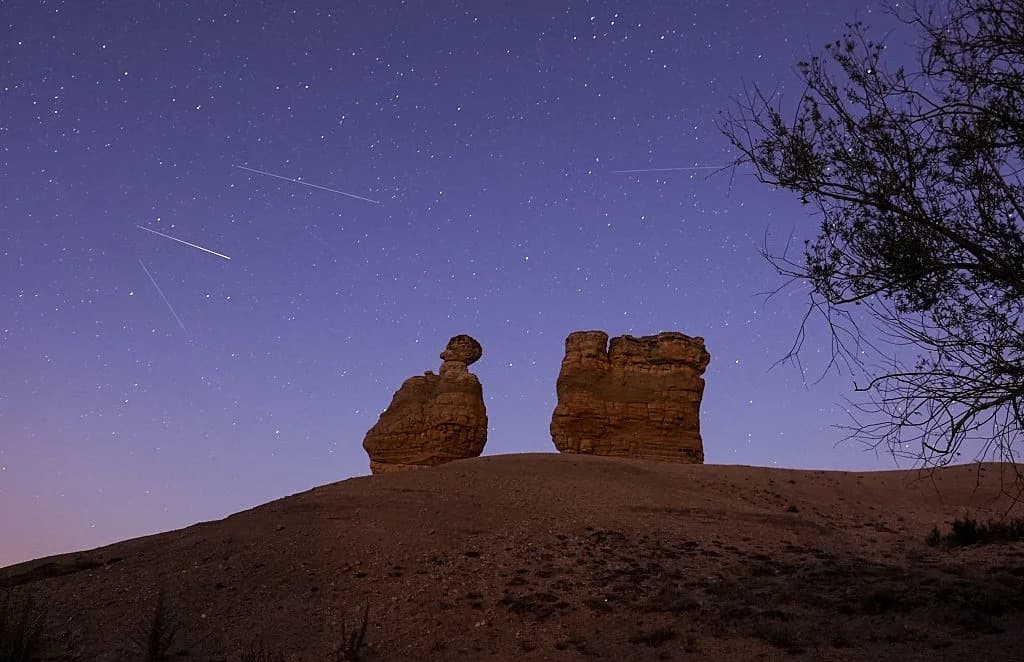
A view of the sky shows the Perseid meteor shower captured with long-exposure photography at the Kusca fairy chimneys in Cihanbeyli district of Konya, Turkiye, during the night hours on Aug. 12, 2025. —Ercin Erturk—Anadolu/Getty Images
The June Bootids may put on an unexpectedly active show this week. Normally a modest shower, the Bootids have produced sudden outbursts in the past that surprised skywatchers and astronomers alike.
What Are Meteors?
Meteors—often called “shooting stars” or “falling stars”—are streaks of light created when small particles from space burn up as they enter Earth’s atmosphere. On a typical clear night you might see a few meteors per hour; during a strong meteor shower the rate can rise to dozens per hour.
Why the June Bootids Are Unpredictable
The June Bootids are usually weak, according to the American Meteor Society, but they have produced notable outbursts. The Society for Popular Astronomy recorded an “unexpected outburst” on June 27, 1998, when observers reported roughly 50–100 meteors per hour. Another surge on June 23, 2004, produced up to about 50 meteors per hour.
“There are no predictions of an outburst this year,” the Royal Museums Greenwich notes on its website. “But there never are, until it happens.”
When Might It Peak?
Forecasters expect the shower to reach its peak around this week. The American Meteor Society estimated a maximum around June 20, while the Society for Popular Astronomy pointed to a possible peak near June 27. Because the Bootids are erratic, both dates are approximate and activity can vary sharply from year to year.
How to Watch
You do not need any special equipment—your naked eye is the best tool. For the best chance to see meteors:
- Find a dark site well away from city lights with an unobstructed view of the sky.
- Allow your eyes about 30 minutes to adapt to the dark.
- Check the weather and moon phase beforehand—clouds and bright moonlight reduce visibility.
- Look broadly at the sky rather than staring only at the shower’s radiant to maximize sightings.
Where to Look
The apparent origin point, or radiant, of the June Bootids lies in the Bootes constellation. For Northern Hemisphere viewers, Bootes appears high in the western to southwestern night sky. Identifying the radiant can help confirm that the meteors you see belong to this shower, but scanning a wide area increases your chances of spotting fast-moving streaks.
Even though no outburst is officially predicted this year, the Bootids’ history of surprises means a sudden flare-up is always possible. Whether you see a handful of meteors or a sudden storm, a clear, dark night offers the best chance to witness this unpredictable summer show.
Help us improve.





















