
The U.S. is hosting new Israel–Lebanon talks in Washington after a renewed ceasefire between Israel and Hezbollah. Mediators report progress in early US–Iran talks and an MoU has spurred a 60‑day negotiation window. Key elements include a de‑confliction cell and coordination mechanisms to monitor the ceasefire, but disputes persist over Israeli deployments and enforcement. Reported humanitarian tolls exceed 4,000 dead and more than one million displaced.
Washington to Host Israel–Lebanon Talks After Renewed Ceasefire; De‑confliction Mechanism Takes Center Stage
(Al Jazeera)
The United States has arranged a new round of talks between Israel and Lebanon to be held in Washington, D.C., from Tuesday through Thursday, following the announcement of a renewed ceasefire between Israel and Hezbollah.
The meeting comes as mediators report progress in preliminary US–Iran discussions and as participants seek to lock in mechanisms that will prevent a return to broader fighting. A central element of the recent joint agreement is a "de‑confliction cell" intended to curb Israeli military operations in Lebanon and provide direct communication channels to support further negotiations.
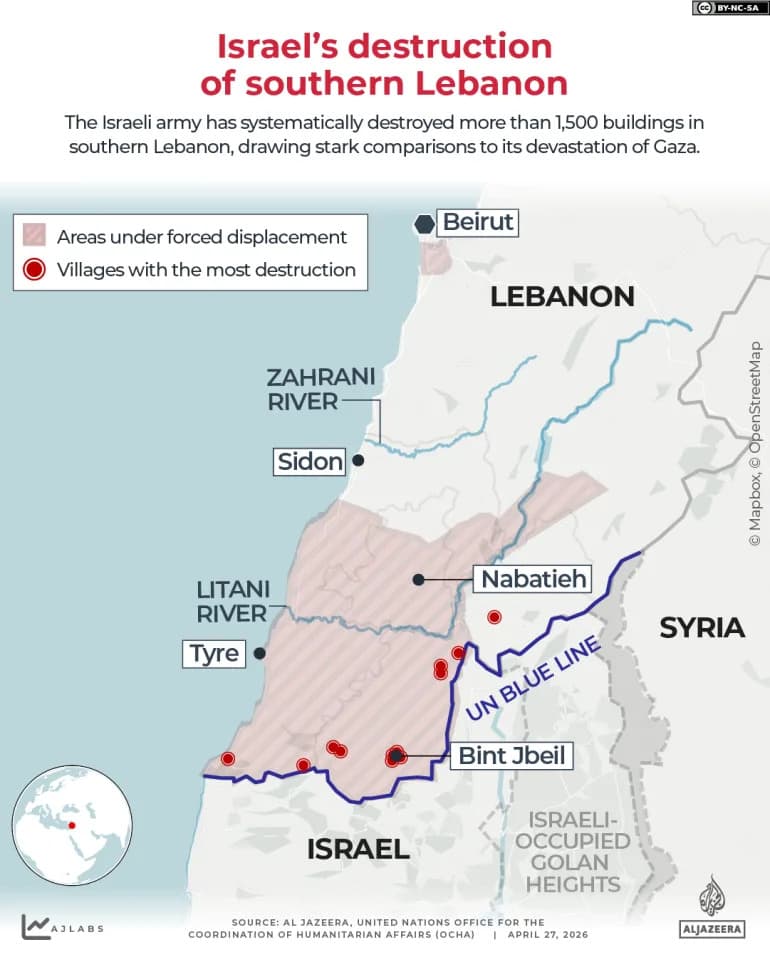
Humanitarian organizations report heavy civilian tolls and displacement in Lebanon amid months of fighting. According to available counts cited by officials and relief agencies, more than 4,000 people have been killed and over one million residents displaced as military activity and advances have affected southern and other parts of Lebanon.
What Officials Are Saying
Mediators said that the United States and Iran have agreed a new roadmap toward a final deal after "encouraging progress" in early high‑level talks in Switzerland. Those discussions also led to a memorandum of understanding (MoU) that triggered a planned 60‑day technical negotiation period; the start of those talks was postponed amid renewed strikes in Lebanon.
The joint statement accompanying the delay calls for the establishment of a de‑confliction cell, a high‑level committee, and direct communication channels designed to support negotiations and to "ensure the adherence of the termination of military operations in Lebanon." U.S. officials have said the parties will also create coordination mechanisms to monitor any ceasefire and address specific technical issues, such as demining in strategic waterways.
U.S. officials said these mechanisms are meant to protect Lebanon's territorial integrity and sovereignty while addressing Israeli security concerns, which will require coordination with the Lebanese armed forces and steps to limit Hezbollah's military actions.
Iranian officials welcomed what they called "major progress" but warned that the first real test will be whether the de‑confliction cell and other mechanisms are effective on the ground.
The Lebanese presidency said recent calls with international partners focused on consolidating the ceasefire and on how the proposed mechanisms might be implemented to limit further escalation.
Hezbollah has condemned the planned Washington talks and reiterated its demand that Israeli forces withdraw fully from Lebanese territory before it will accept a negotiated process.
Israeli officials have repeatedly said they will retain military forces in key security zones and that operations will continue against perceived threats. Those statements underscore a major point of contention heading into the Washington meeting: how to reconcile Israel's security demands with Lebanese sovereignty and Iran's insistence on concrete steps to halt hostilities.
Background
A U.S.-mediated ceasefire in November 2024 sought to end active hostilities between Hezbollah and Israel but included language that allowed Israel to act if it judged a security threat existed. Fighting and exchanges resumed in the spring after a series of strikes and counterstrikes, and direct Israel–Lebanon talks resumed in April — the first direct meetings since the early 1990s — producing a short ceasefire window that did not hold.
Diplomats and mediators are hoping that the Washington talks will translate agreement on paper into reliable, verifiable steps on the ground: an effective de‑confliction cell, clear monitoring procedures for a ceasefire, and confidence‑building measures that can reduce the risk of renewed large‑scale violence.
The humanitarian toll and the question of Israeli withdrawals remain the most sensitive issues. Observers caution that implementation and enforcement of the agreed mechanisms — not just their wording — will determine whether the pause in fighting becomes a durable peace process or a brief lull in escalation.
Help us improve.





















