The James Webb Space Telescope has captured the first direct evidence of metal‑salt clouds in the atmosphere of GJ504b, the so‑called “Pink Planet.” Using JWST’s coronagraph and advanced processing, researchers isolated a high‑quality spectrum in about two hours that reveals water, methane, carbon dioxide and ammonia. Atmospheric modeling shows that metal‑salt cloud layers best reproduce the observed features and that the atmosphere is enriched in heavy elements. The result demonstrates JWST’s power to study faint, cold worlds and refines models of cloud chemistry on substellar companions.
JWST Reveals Exotic Metal‑Salt Clouds Over the ‘Pink Planet’ GJ504b
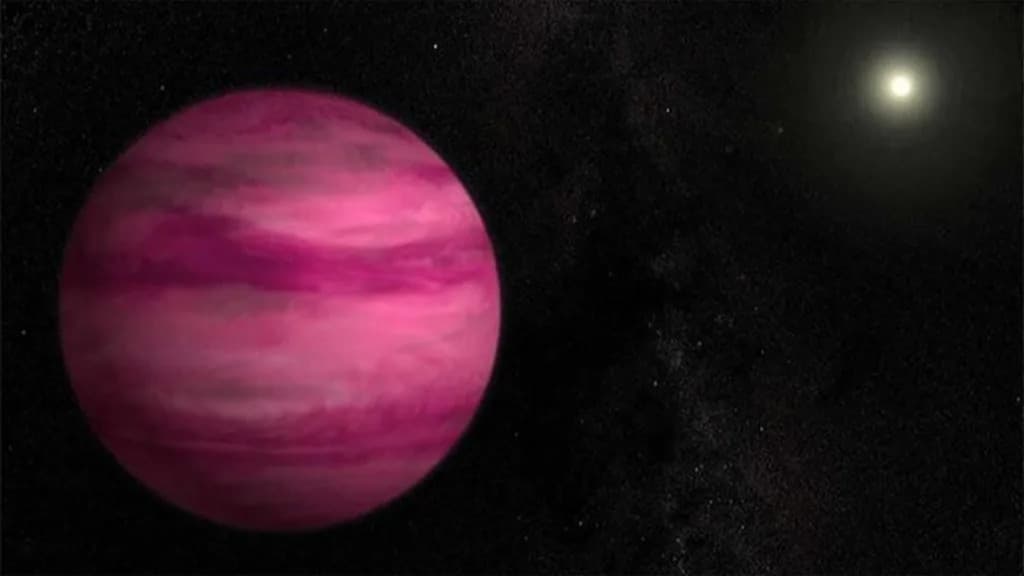
The James Webb Space Telescope has produced the first direct evidence of metal‑salt clouds in the atmosphere of GJ504b, the rosy-hued object nicknamed the “Pink Planet.” Once too faint for ground-based instruments, this cold, planetary‑mass companion has now yielded a clear spectrum that exposes unusual atmospheric chemistry and cloud layers unlike those previously observed on such cool substellar objects.
How the Discovery Was Made
An international team led by Aneesh Baburaj (postdoctoral associate, Northwestern University/CIERA) used JWST’s coronagraphic instruments and advanced data‑processing techniques developed in collaboration with scientists at the Space Telescope Science Institute, including Marshall Perrin. These methods suppressed the host star’s glare and isolated GJ504b’s faint light, producing a high‑fidelity spectrum in roughly two hours — a task that previously required many nights on the largest ground telescopes and still often failed.
Spectrum and Atmospheric Composition
The JWST spectrum reveals a complex mix of water vapor, methane, carbon dioxide and ammonia. Initial atmospheric models failed to reproduce the observed features until the team added cloud layers. By testing three cloud scenarios, the best match came from clouds composed of metal salts — exotic condensates predicted more than 15 years ago but never directly observed on such a cold companion until now.
Properties of GJ504b
Cataloged as GJ504b, the companion orbits a Sun‑like star about 57 light‑years from Earth. It has a mass near 25 times that of Jupiter, placing it on the boundary between very massive gas giants and low‑mass brown dwarfs (commonly described as a “planetary‑mass companion”). GJ504b is unusually cool, with an estimated temperature of roughly 290°C (≈563 K / ≈550°F), significantly cooler than many young gas giants and brown dwarfs, which often exceed ~1000 K. Its age is constrained to about 2.5–4 billion years.
Implications
The detection of metal‑salt clouds demonstrates JWST’s ability to probe the atmospheres of faint, cold worlds and provides new empirical constraints for atmospheric chemistry and cloud formation models. The findings also indicate that GJ504b’s atmosphere is enriched in heavy elements (astronomical “metals”), a clue to its formation and evolutionary history. These techniques and insights will help researchers study other cold exoplanets and improve comparisons with solar‑system giants such as Jupiter, where ammonia and other ices shape cloud structure.
Published: The Astronomical Journal
Help us improve.