
About 99 members of the National Coordinating Committee of the Bolivarian Army surrendered weapons in Putumayo as part of a deal with President Gustavo Petro, marking an unusual early step in disarmament. The fighters were flown to the Guamuez Valley for a 10-month transition period and housed in solar-powered dwellings. The move is seen as the most significant progress for Petro's "total peace" initiative but comes just days before a decisive runoff election that could determine the policy's future. International tensions persist over Petro's extradition stance and U.S. backing of his opponent.
Nearly 100 Guerrillas Surrender Arms in Putumayo, a Major Early Win for Petro’s 'Total Peace' Plan
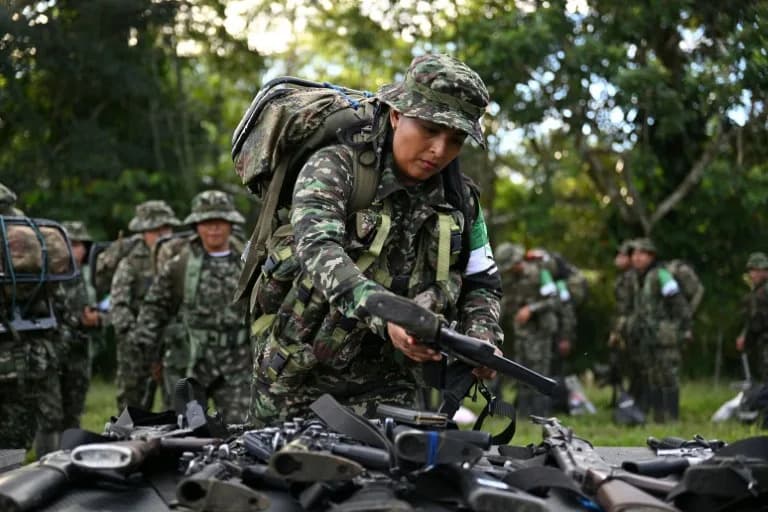
Rebels from the National Coordinating Committee of the Bolivarian Army surrendered their arms in the southern department of Putumayo, days before a presidential run-off election (Raul ARBOLEDA)(Raul ARBOLEDA/AFP/AFP)
About 99 members of the National Coordinating Committee of the Bolivarian Army laid down their weapons on Thursday in a jungle area of southern Colombia under an agreement with President Gustavo Petro, AFP reporters who witnessed the event said. The disarmament took place in Putumayo department, three days before a presidential runoff that could reshape the future of Petro’s peace agenda.
Clad in camouflage, the fighters deposited rifles into a large container marked with the slogan: "I bet on life, I fulfill my commitment to peace." Officials said the act represents the first formal step toward negotiating the group’s disarmament and legal status with the government.
Military helicopters airlifted the fighters from remote jungle locations to a transition site in the Guamuez Valley, where they will remain for a 10-month reintegration period. The ex-combatants were given hygiene kits and accommodated in solar-powered housing while authorities process their legal status and explore reintegration measures.
The group split from the FARC, which itself demobilized in 2016 after roughly half a century of conflict with the state. The decision to hand over weapons this early in talks is notable: the FARC surrendered arms about a year after signing its peace agreement, making this gesture a rare, early confidence-building measure.
The Wider Context
Colombia is the world’s largest producer of cocaine, and the National Coordinating Committee of the Bolivarian Army reportedly controls important drug-producing zones along the border with Ecuador. The government estimates the group may number between 2,000 and 2,500 members, making it smaller than the National Liberation Army (ELN) and some FARC dissident factions, such as the group led by Iván Mordisco.
"It's a very strong and powerful message for Colombian society at this time when there's so much noise about war," said Armando Novoa, head of the government's peace delegation for talks with the group.
With President Petro’s term nearing its end, the future of his "total peace" policy remains uncertain. Colombians will vote in a runoff to choose the next president between Petro ally Senator Ivan Cepeda, who has pledged to continue the peace initiative, and far-right candidate Abelardo de la Espriella, who has promised a tougher security approach.
Petro is scheduled to hand over power to the winner on August 7. The president’s refusal to extradite guerrilla commanders who enter the peace process has strained relations with Washington; the article cites U.S. President Donald Trump’s public backing of De la Espriella, who vows to confront rebels and drug traffickers with what he calls an "iron fist."
For now, the disarmament in Putumayo stands as a concrete — if fragile — sign of progress in Colombia's long search for peace. Observers say continued dialogue, guarantees for reintegration, and security in coca-producing regions will be critical to turn this moment into lasting change.
Help us improve.





















