
The James Webb Space Telescope, combined with Hubble archival data, confirms Terzan 5 in the Milky Way bulge is a "bulge fossil fragment" rather than a typical globular cluster. Researchers identified at least four distinct star-formation episodes dated to about 12.5, 4.7, 3.8 and 2.5 billion years ago. The discovery supports models where early galactic discs fragmented into clumps that migrated inward and helped build galactic bulges. The study appears in Astronomy & Astrophysics.
Webb Confirms First 'Bulge Fossil Fragment' — Terzan 5 Shows Four Distinct Star-Formation Eras
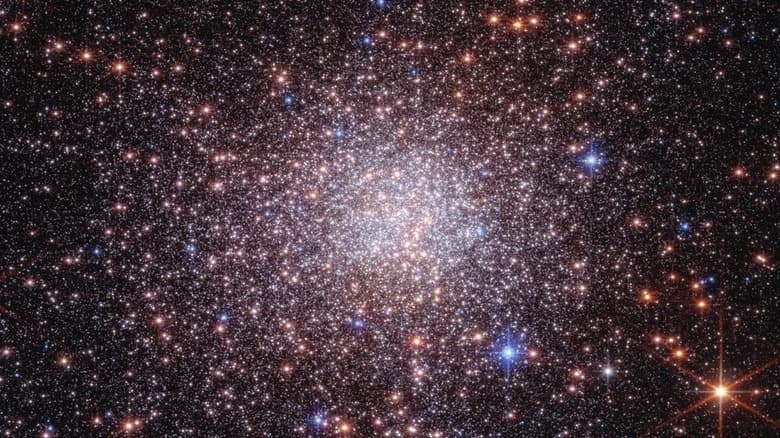
Bulge fossil fragment Terzan 5 (Webb and Hubble image) - NASA, ESA, CSA, STScI, G. Zullo (University of Bologna), F. R. Ferraro (University of Bologna). Image Processing: A. Pagan (STScI)
The James Webb Space Telescope, together with archival Hubble data, has confirmed that Terzan 5 — a dense, dust-obscured stellar clump in the Milky Way's central bulge — is not a conventional globular cluster but a surviving "bulge fossil fragment." This discovery offers a rare, direct window into how the Galaxy's bulge assembled over billions of years.
Multiple Generations of Stars
By combining Webb's infrared sensitivity with Hubble's archival observations, researchers uncovered evidence that Terzan 5 experienced at least four separate star-formation episodes rather than a single ancient burst typical of globular clusters. The team dated the stellar populations to roughly 12.5 billion, 4.7 billion, 3.8 billion and 2.5 billion years ago, demonstrating a complex formation history spanning much of the Galaxy's life.
Why Terzan 5 Is Special
Globular clusters normally host one dominant, old stellar population. Terzan 5's layered ages and chemical signatures instead point to it being a relic of the early bulge-building process — a dense clump that formed independently and survived the violent assembly of the central Milky Way.
"For some reason, this peculiar clump of stars formed separately from the bulge and was not destroyed as the bulge itself formed," said Francesco R. Ferraro, professor at the University of Bologna and principal investigator on the Webb observations. "Terzan 5 is what we now call a bulge fossil fragment because it resembles the primordial clumps that contributed to the formation of the bulge."
Implications for Galaxy Formation
The findings support theoretical models in which massive, gas-rich discs in the early Universe fragmented into dense clumps. Those clumps formed stars, migrated inward, and merged to build galactic bulges. Terzan 5 appears to be one of the few clumps that remained intact, preserving a record of multiple star-formation events across cosmic time.
"Based on observations and in-depth simulations, we think that galaxies in the early Universe had huge discs of gas that fragmented into clumps and formed stars. These clumps migrated to the center of the galaxies, and many merged to form their bulges," said Barbara Lanzoni, associate professor at the University of Bologna and co-author on the study.
Study and Publication
The team's analysis, drawing on Webb and Hubble data, was published in the journal Astronomy & Astrophysics. The result strengthens the connection between high-resolution infrared observations and theoretical models of bulge assembly, and highlights Webb's ability to peer through dust to reveal stellar histories in crowded regions.
Why it matters: Terzan 5's survival and layered star-formation history provide empirical evidence that the Milky Way's bulge was built, at least in part, from inward-migrating clumps of stars and gas — and that some of those clumps can persist for billions of years as fossilized witnesses to galaxy formation.
Help us improve.





















