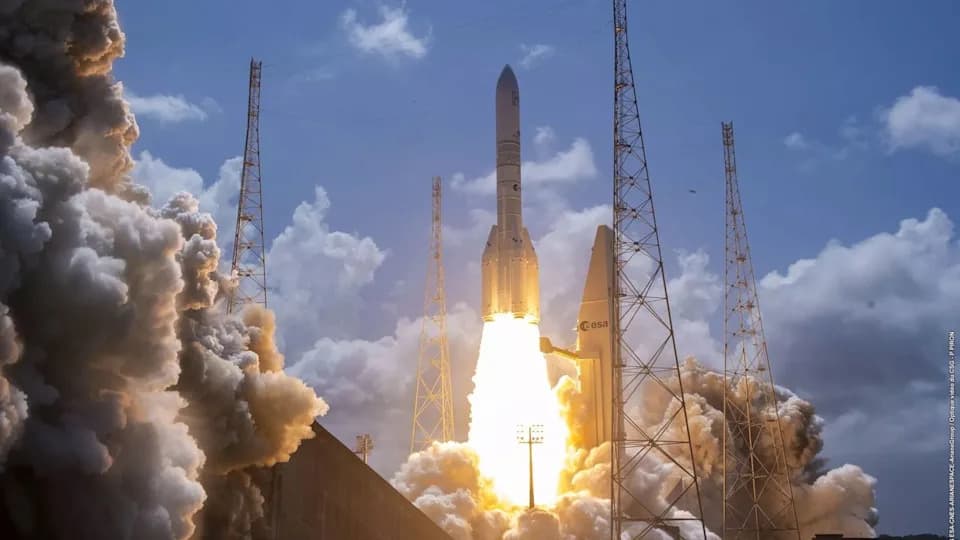
A European Ariane 6 rocket is set to lift a record-setting Amazon Leo broadband payload into low Earth orbit on Wednesday morning, June 17. Live coverage begins ahead of liftoff so viewers can follow the mission from Europe’s Spaceport in Kourou, French Guiana.
Launch Details
The Ariane 6 is scheduled to launch during a 29-minute window that opens at 7:53 a.m. EDT (1153 GMT; 8:53 a.m. local Kourou time). Arianespace will begin live streaming the countdown at 7:00 a.m. EDT (1100 GMT), and other outlets may rebroadcast the feed if it is made available.
Payload And Why It’s Significant
Atop the vehicle are 36 Amazon Leo broadband satellites. That is both the largest number of satellites and the heaviest payload ever launched by an Ariane rocket. Based on available documentation (29 satellites ≈ 37,000 lb / 16,800 kg), an average Amazon Leo satellite weighs about 1,275 lb (578 kg). By that estimate, 36 satellites total roughly 45,900 pounds (≈20,820 kg), though Arianespace’s press kit does not list a precise mass for this stack.
P160C Boosters — A New Variant
To lift this heavy payload, Ariane 6 will fly with four strap-on P160C solid-propellant boosters. Ariane rockets have flown with four boosters before, but the P160C is a more powerful variant making its debut on this mission. Arianespace says the P160C increases Ariane 6’s LEO payload capacity by more than two tons and improves performance for geostationary, scientific and exploration missions.
Mission Timeline
If the mission proceeds as planned, the rocket will release the Amazon Leo satellites into an orbit around 289 miles (465 kilometers) above Earth. According to the flight timeline, all 36 spacecraft should be free-flying approximately 1 hour and 51 minutes after liftoff.
Context
This flight is Amazon Leo’s 14th launch overall (counting two prototype spacecraft launched in October 2023) and the third Amazon Leo mission flown on an Ariane 6. It is also the eighth flight of the Ariane 6 heavy-lift rocket. Ariane 6 was originally expected to debut in 2020 but did not make its first flight until July 2024; that inaugural mission reached orbit and deployed nine CubeSats, though an upper-stage underburn prevented a final burn intended to prepare two experimental reentry capsules for deployment. Subsequent Ariane 6 missions have been fully successful.
How To Watch
Watch Arianespace’s live stream beginning at 7:00 a.m. EDT (1100 GMT). If the feed is shared, major space outlets may also rebroadcast the stream. Keep an eye on official Arianespace channels for the most reliable coverage and mission updates.
Note: Payload mass figures are estimates derived from earlier documentation; Arianespace’s official press kit for this flight confirms the configuration as the heaviest Ariane payload to date but does not publish a single mass figure for the full stack.