
On May 30, 2026, a 1–2 meter meteor entered Earth’s atmosphere at about 42,000 mph and fragmented near 40 miles altitude, producing an airburst with energy roughly equal to 300 tons of TNT and a sonic boom heard along the Massachusetts–New Hampshire border. This event is part of an active season that included recoverable falls traced to asteroid Vesta and a 7-ton Lake Erie airburst. While Earth's atmosphere shields us from most space debris, recovered fragments provide valuable scientific insights — report sightings to the American Meteor Society.
How Meteor Airbursts Create Sonic Booms — The May 30 Cape Cod Event and What It Means
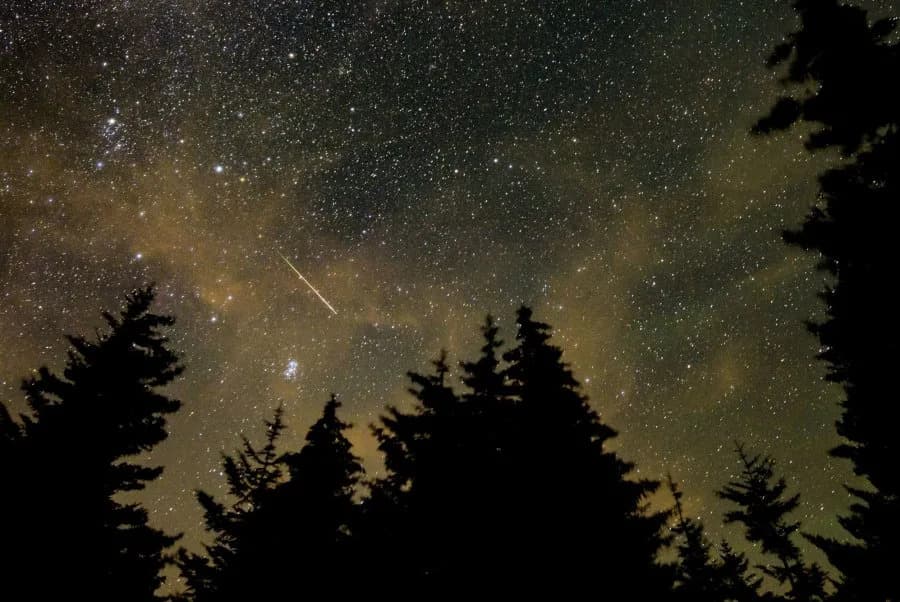
In this 30 second exposure, a meteor streaks across the sky during the annual Perseid meteor shower in 2021, in Spruce Knob, W.Va. File Photo by Bill Ingalls/NASA/UPI
Earth constantly sweeps through a vast cosmic sea of debris left over from the formation of the solar system. Most of the time we pass silently through this dust, protected by a thin layer of atmosphere. Occasionally, though, the universe announces itself in a dramatic, unmistakable way.
On the afternoon of May 30, 2026, residents along the Massachusetts–New Hampshire border were startled by a loud sonic boom. Witness reports along the Eastern Seaboard, together with satellite imagery analyzed by NASA, identified the source as a small meteor roughly 1–2 meters (3–5 feet) across traveling about 42,000 mph (≈68,000 km/h) when it entered Earth’s upper atmosphere.
Friction with the increasingly dense air converted the meteor’s kinetic energy into intense heat. At an altitude near 40 miles (≈60 km) the combined stress of heat and pressure caused the rock to fragment in a brilliant airburst. That breakup released an estimated energy equivalent to about 300 tons of TNT and produced the shock wave people heard on the ground. Most of the object vaporized; remaining fragments fell into Cape Cod Bay.
Why These Events Make Noise
Any object moving through air faster than the speed of sound (roughly 761 mph or 1,225 km/h at sea level) produces a shock wave. When a meteor breaks up high in the atmosphere, that blast of pressure can be heard as a thunderous clap or a series of booms across a wide area. The altitude, speed, size and angle of entry determine whether an event is felt on the ground and how much damage — if any — results.
An Active Meteoritic Season
The Cape Cod fireball was part of an especially active period. From March 8–11, observers in Northern Europe documented bright daytime fireballs whose recovered fragments were traced by laboratory analysis to the asteroid Vesta in the main belt. On March 17, a roughly 7-ton object (~6 feet across) entered over Lake Erie at about 45,000 mph (≈72,400 km/h), producing a bright daytime flash and an airburst estimated at ~250 tons of TNT; meteorite hunters subsequently recovered pristine fragments near Valley City, Ohio. On March 21, a ~3-foot fragment produced an airburst of roughly 26 tons of TNT over Texas; a homeowner near Houston later found a small meteorite after a localized roof puncture.
Earth’s Atmosphere: A Powerful Shield
The most notable modern benchmark is the Chelyabinsk event (Feb. 15, 2013). That meteor was much larger — around 60 feet (≈18 m) across and an estimated 10,000 tons — and its airburst, roughly 30 times the energy of the Hiroshima bomb, shattered windows across hundreds of square miles and injured about 1,500 people. Chelyabinsk underscores that while the atmosphere absorbs most incoming objects, a sufficiently large or fast impactor can still cause ground-level harm.
Risk and Scientific Opportunity
Despite dramatic headlines, the odds of any one person being struck by a meteorite are vanishingly small. Most incoming material arrives as dust grains that burn up as meteors or shooting stars. When larger fragments survive, recovered meteorites provide scientists with rare physical samples from the early solar system.
If you witness a bright fireball or hear an unusual sonic boom, consider reporting it to the American Meteor Society. Timely reports, dashcam footage, doorbell or security video, and satellite data greatly improve scientists’ ability to reconstruct trajectories and guide recovery efforts.
Author: Shawn Laatsch is director of the Versant Power Astronomy Center at the University of Maine. This article is republished from The Conversation under a Creative Commons license. The views expressed are those of the author.
Help us improve.





















