The United States and Iran have agreed to an interim deal intended to halt hostilities and allow the reopening of the strategic Strait of Hormuz. Officials say the pact is expected to be signed in Switzerland, though earlier announcements of progress have collapsed and details remain contested.
Timeline: Key Moments in the Nuclear Standoff and Regional Escalation
1967 — Iran receives the Tehran Research Reactor, supplied by the United States under the Cold War-era "Atoms for Peace" program.
1979 — Shah Mohammad Reza Pahlavi, gravely ill, flees Iran amid mass protests. Ayatollah Ruhollah Khomeini returns and the Islamic Revolution brings him to power. Students seize the U.S. Embassy in Tehran, launching a 444-day hostage crisis. Under international pressure, Iran's nuclear efforts stall.
August 2002 — Western intelligence agencies and an Iranian opposition group disclose Iran's previously secret Natanz enrichment facility.
June–October 2003 — Britain, France and Germany begin nuclear talks with Iran; by October Iran suspends enrichment under international pressure.
February 2006 — After Mahmoud Ahmadinejad's election, Iran announces it will resume uranium enrichment; talks with Britain, France and Germany stall.
June 2009 — A disputed presidential election and Ahmadinejad's declared reelection spark the Green Movement and a harsh government crackdown.
October 2009 — Under President Barack Obama, the U.S. and Iran open a secret back channel in Oman that leads to later discreet contacts.
July 2012 — U.S. and Iranian officials hold clandestine face-to-face talks in Oman.
July 2015 — Iran and world powers announce a comprehensive nuclear agreement that limits Tehran's enrichment in exchange for lifting economic sanctions.
May 8, 2018 — President Donald Trump withdraws the U.S. from the 2015 deal, calling it the "worst deal ever," and vows to seek tougher terms; direct talks do not resume during his first term.
May 8, 2019 — Iran begins rolling back commitments under the accord; a series of regional attacks on land and at sea are later blamed on Tehran.
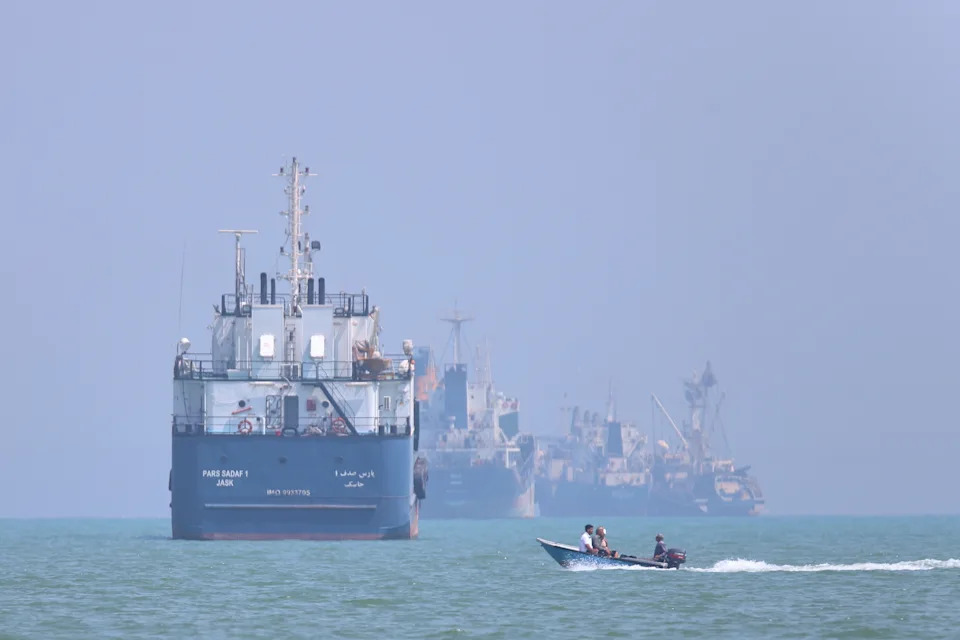
A small motorboat passes anchored vessels in the Strait of Hormuz off Bandar Abbas, Iran, Thursday, June 11, 2026.(Amirhosein Khorgooi/ISNA via AP)(AP Photo/Amirhosein Khorgooi)
Jan. 3–8, 2020 — A U.S. drone strike in Baghdad kills Gen. Qassem Soleimani. Iran retaliates with missile strikes on bases in Iraq hosting U.S. forces, and days later the IRGC mistakenly shoots down a Ukrainian passenger jet, killing all 176 aboard.
July 2, 2020 — An explosion heavily damages a centrifuge-production plant at Natanz; Iran blames Israel.
April 2021 — Indirect Vienna talks under President Joe Biden attempt to restore the nuclear deal but fail to produce an agreement. In April, Natanz is struck again and Iran begins enriching uranium up to 60% purity — a significant technical step closer to weapons-grade levels.
Feb. 24, 2022 — Russia invades Ukraine; Moscow later uses Iranian-made armed drones and missiles in the conflict.
July 17, 2022 — A senior Iranian adviser says Iran is technically capable of building a nuclear weapon but has not decided to do so.
Oct. 7, 2023 — Hamas attacks in Israel trigger a major Israel–Hamas war; Iran, a backer of Hamas, provides support and regional tensions rise.
Nov. 19, 2023 — Yemen's Houthi rebels, long supported by Iran, seize a commercial vessel and launch a months-long campaign of attacks on Red Sea shipping, drawing international naval responses.
April–Oct. 2024 — A series of direct and indirect strikes and counterstrikes between Iran and Israel escalate: Iran fires hundreds of missiles and drones at Israel; Israel conducts strikes on Iranian sites and on allied groups across the region.
Jan.–Dec. 2025 — Diplomatic efforts and military escalations continue. The IAEA finds Iran in noncompliance in June; Iran announces a third enrichment facility. Israel launches a major campaign against Iranian targets in mid‑June, and the U.S. conducts strikes on Iranian nuclear sites. A ceasefire is later announced.
Late 2025–Early 2026 — Economic collapse and protests in Iran deepen after a crashing rial and rising prices. Government crackdowns and communications blackouts fuel unrest; thousands are reported killed and detained amid nationwide demonstrations.
Feb.–Mar. 2026 — Naval incidents and aerial engagements raise tensions: U.S. forces down an Iranian drone, Iranian fast-attack boats harass merchant shipping, and Tehran temporarily closes the Strait of Hormuz. On Feb. 28, a major escalation kills Supreme Leader Ayatollah Ali Khamenei; his son is later named the country's new paramount ruler. Fighting deescalates after a fragile ceasefire is announced in April.
June 15, 2026 — The United States and Iran reach an initial agreement to reopen the Strait of Hormuz and extend a fragile ceasefire, with a signing reportedly planned in Switzerland. The pact is presented as an interim measure while negotiations continue and many details remain unresolved.
Note: This timeline compiles reported developments from multiple sources. Attribution is noted where events have been widely attributed to particular actors (for example, some sabotage incidents are widely blamed on Israel). Some details remain disputed or contested by the parties involved.