
Australian researchers have traced a two-decade radio mystery to a compact binary system, ASKAP J1745-5051, where a white dwarf accreting from a red dwarf produces prolonged radio bursts. The stars' eccentric 1.4-hour orbit brings their magnetic fields into contact, stripping charged particles that generate radio emission lasting minutes to over an hour. X-ray peaks do not coincide with the radio bursts, implying different emission regions. The finding helps separate these transients from magnetar-related signals and improves classification for future surveys.
20-Year Radio Mystery Linked to Magnetic Collisions in a Two-Star System
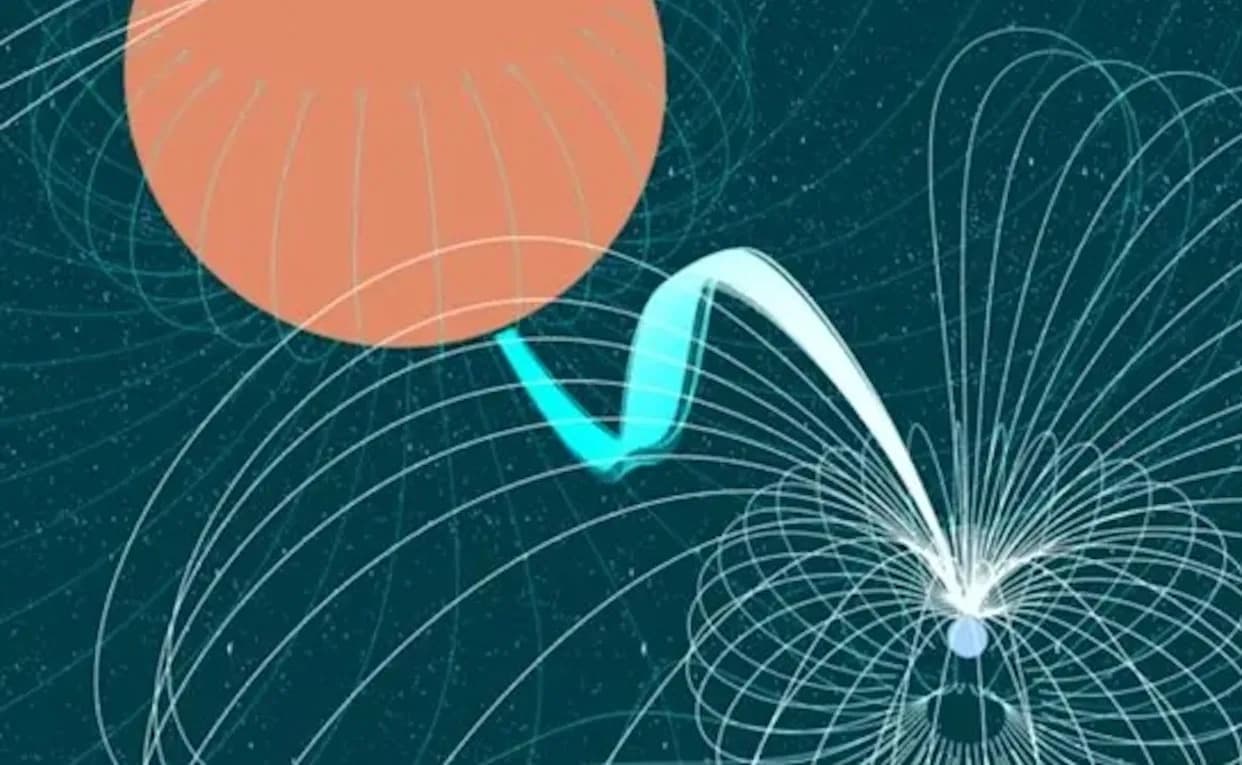
Photo Credit: Carl Knox (OzGrav/Swinburne) and Dr. Joshua Preston Pritchard (CSIRO)
A team of Australian astronomers has traced a roughly 20-year-old puzzle—unusually long-lived radio signals—to a compact binary system where two stars' magnetic fields collide. The system, catalogued as ASKAP J1745-5051, appears to generate prolonged radio bursts when a white dwarf and a red dwarf interact during close approaches in their orbit.
How the Signal Was Traced
Using the Australian SKA Pathfinder (ASKAP) radio telescope, researchers localized a long-period radio transient to a white dwarf that is accreting material from a nearby red dwarf companion. The pair complete an orbit every 1.4 hours; because the orbit is elongated, the stars periodically come close enough for their magnetic fields to interact directly.
What Produces the Radio Bursts
When the magnetic fields meet, the encounters appear to strip charged particles from the stars' atmospheres and funnel them along magnetic field lines. As those particles travel and accelerate, they produce the extended radio emission that lasts minutes and, in some cases, more than an hour—far longer than the typical second-or-less radio flashes astronomers often observe.
Multiwavelength Clues
The binary also emits X-rays, but the peak X-ray output does not line up with the strongest radio bursts. That timing mismatch suggests the radio and X-ray emission originate in different regions or from different physical processes within the system.
"Long-period radio transients have puzzled astronomers for years," said lead researcher Kovi Rose. "Now we've been able to show that the source for one of these transients comes from a white dwarf actively pulling material from a companion star."
Why This Matters
Before this result, many astronomers suspected extreme objects such as magnetars—neutron stars with ultra-strong magnetic fields—could explain long radio transients. Identifying a white-dwarf/red-dwarf binary as the source for at least one case shows these signals can arise from very different systems. That distinction helps astronomers classify radio transients more accurately, prioritize telescope time effectively, and improve data-processing methods for faint or noisy signals.
Future work will test whether other long-period transients share the same origin or whether the class includes multiple kinds of sources. Either outcome will sharpen our understanding of transient radio phenomena and the range of magnetic interactions in close binary systems.
Help us improve.





















