The Small Magellanic Cloud (SMC) is undergoing a galaxy-wide tidal disruption driven by the larger Large Magellanic Cloud (LMC), new research reports. An 11-year VISTA/VMC dataset shows nearly all tracked SMC stars are moving outward at about 38,000 mph (61,000 km/h) along a southeast–northwest axis, consistent with the LMC's gravitational pull. Over the next few hundred million years this motion could significantly distort — or even split — the SMC before the pair merge with the Milky Way in roughly 2.4 billion years. Upcoming radial-velocity measurements will refine the 3D picture of this disruption.
On the Edge of the Milky Way: Large Magellanic Cloud Is Ripping the Small Magellanic Cloud Apart, Study Finds
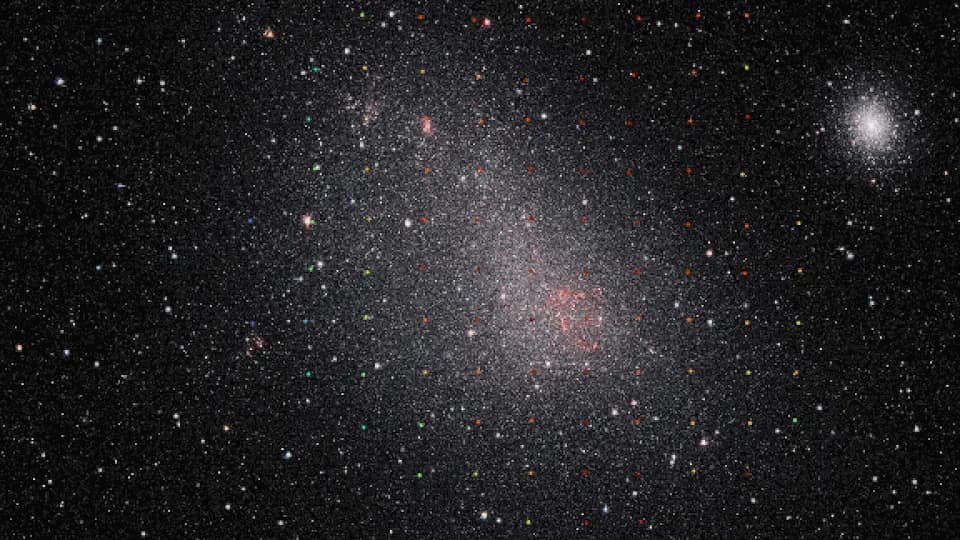
A new study shows that the stars within the Small Magellanic Cloud are being dragged apart by the gravitational pull of its big sibling, the Large Magellanic Cloud. | Credit: ESO/VISTA VMC/ AIP/ S. Vijayasree
A dramatic gravitational tussle is unfolding in our cosmic neighborhood: the Large Magellanic Cloud (LMC) appears to be tearing its smaller companion, the Small Magellanic Cloud (SMC), apart. New analysis of more than a decade of observations reveals a galaxy-wide tidal disruption that challenges previous ideas about the SMC's structure and hints the dwarf could be split in two before both clouds ultimately merge with the Milky Way.
What the Study Found
Using an 11-year baseline from the VISTA Survey of the Magellanic Clouds (VMC), astronomers mapped motions of stars across the SMC and found that nearly every tracked star — including those near the galaxy's center — is moving outward at an average speed of about 38,000 mph (61,000 km/h). These motions are aligned along a southeast–northwest axis, pointing to gravitational forces from the larger LMC rather than the Milky Way as the main driver of the disruption.
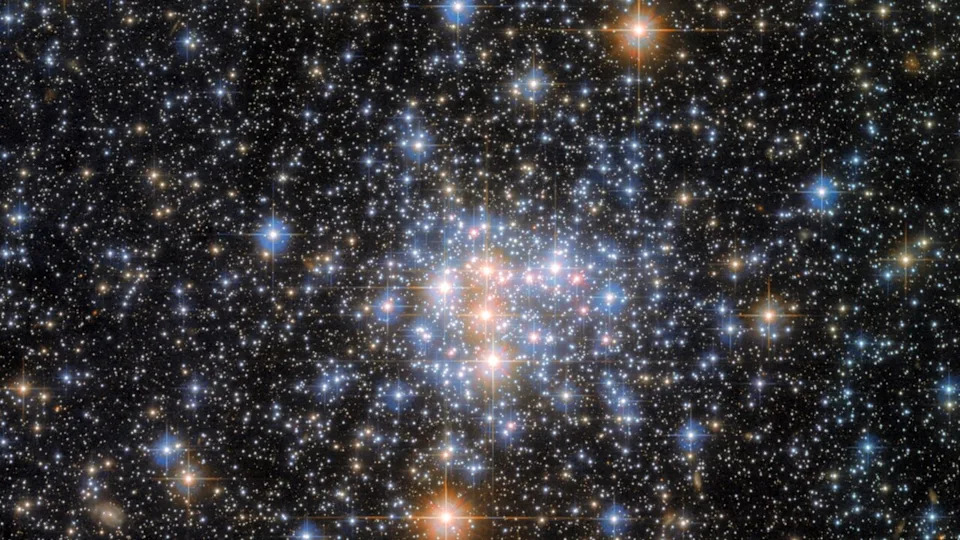
Researchers tracked the movements of thousands of stars within the SMC in order to make the surprising discovery. | Credit: ESA/Hubble
The team describes this phenomenon as a 'galaxy-wide tidal disruption.' At the measured pace, individual stars could shift by several thousand light-years over a few hundred million years — enough to substantially distort the SMC's shape. Researchers estimate there is a reasonable chance the SMC could be cleaved in two by the time the pair merge with the Milky Way in roughly 2.4 billion years.
Background: The Magellanic Clouds And Their Stream
The Large and Small Magellanic Clouds are two of the Milky Way's most prominent satellite galaxies. The LMC lies roughly 160,000 light-years from Earth, while the SMC sits about 200,000 light-years away, partially obscured behind its larger sibling. The SMC contains roughly 3 billion stars; the LMC may host up to ten times that number. A vast ribbon of gas and dust known as the Magellanic Stream connects the two and is thought to be the product of their long gravitational interactions with each other and with the Milky Way.
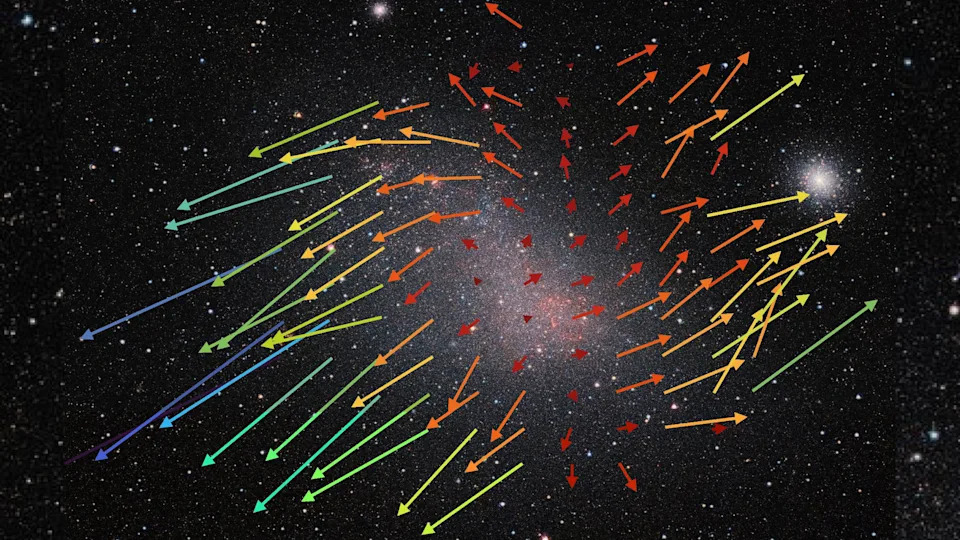
The arrows show the direction the stars in the Small Magellanic Cloud are moving. | Credit: ESO/VISTA VMC/ AIP/ S. Vijayasree
Why This Matters
Until now, many astronomers modeled the SMC as a slowly rotating, irregular dwarf galaxy. The new results challenge that view: rather than organized rotation, the SMC's internal motions appear dominated by repeated gravitational encounters with the LMC over billions of years. That has implications for how scientists interpret the formation, evolution, and ultimate fate of dwarf galaxies orbiting larger hosts.
'The internal motions of stars in the SMC are dominated not by orderly rotation, but by gravitational disturbances caused by repeated encounters with the LMC over billions of years,' said Sreepriya Vijayasree, the study's lead author.
Co-author Maria-Rosa Cioni, principal investigator for the VMC survey, added that the precision of the 11-year dataset allowed a level of detail in mapping the SMC's internal kinematics that is 'outstanding for observations from the ground.'
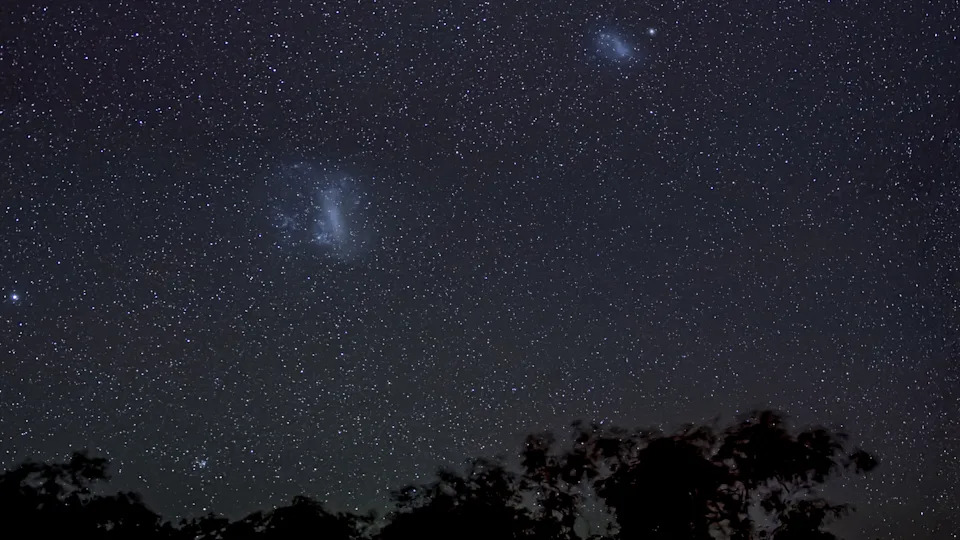
The LMC (left) and the SMC (right) are both clearly visible in the night sky from the Southern Hemisphere. | Credit: MWX Photo via Getty Images
What's Next
The team expects to refine their picture with the upcoming One Thousand and One Magellanic Fields survey, which will add a new instrument to VISTA and provide radial velocities (motions toward and away from Earth). Combining proper motions from VMC with radial velocities will yield a fuller 3D view of the disruption and help determine whether the SMC will indeed be split before its final merger with the Milky Way.
Beyond the Magellanic Clouds, these findings raise broader questions about the dynamics of the Milky Way's many dwarf satellites: more than 60 are known, from massive companions like the LMC down to ultrafaint systems with only a few hundred thousand stars. Improved surveys and instruments will help clarify how common tidal shredding is among these systems.
Help us improve.